
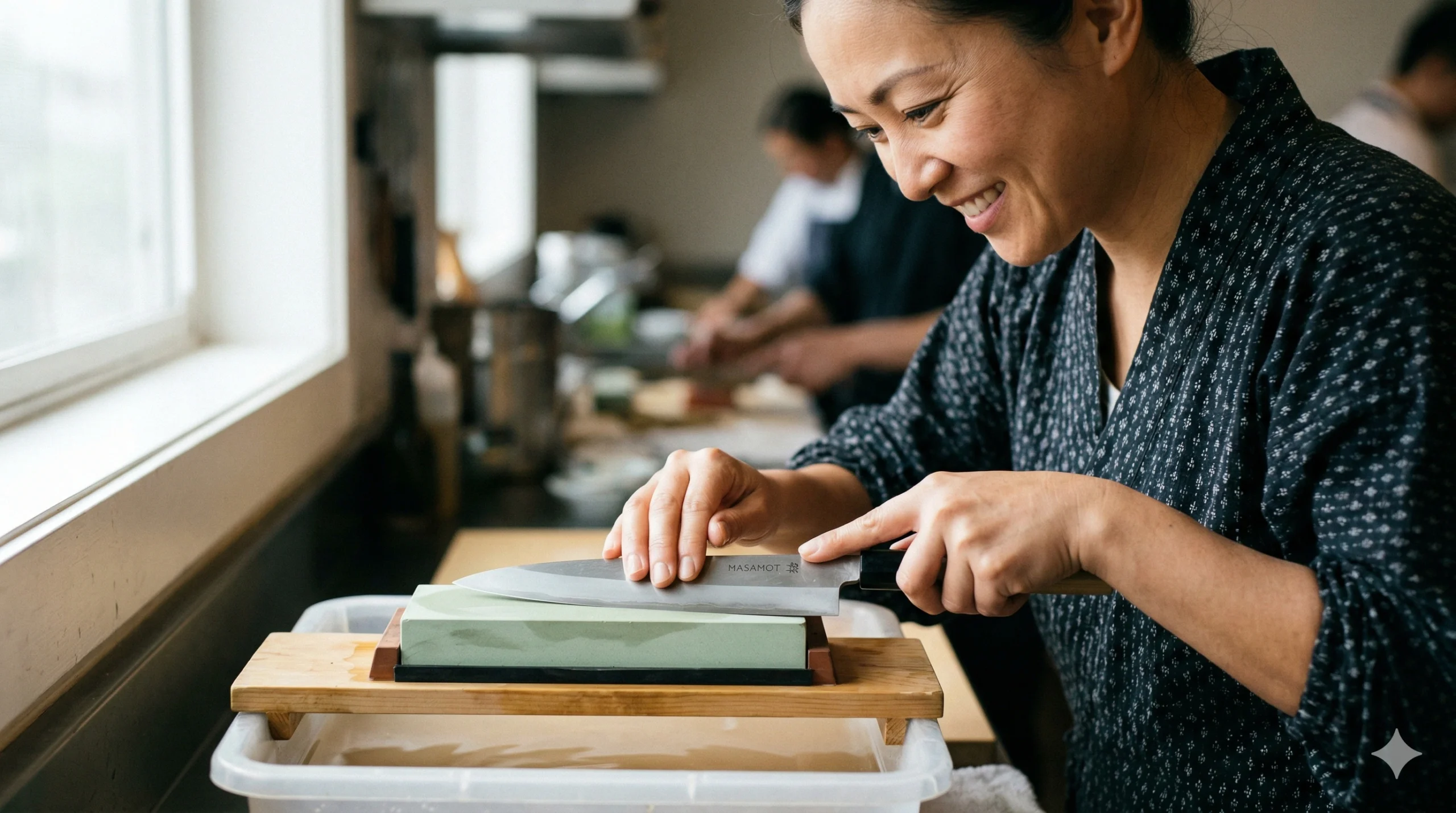
In the professional sushi-ya, the knife is an extension of the chef’s hand. Unlike Western knives, which are built for durability and impact, Japanese sushi knives (Hocho) are precision instruments designed for clean, cellular-level separation. A dull blade doesn’t just make cutting harder; it physically crushes the delicate proteins of the fish, causing juice loss and rapid oxidation. Learning how to sharpen a sushi knife is a meditative and technical requirement for anyone seeking the highest standards of Japanese gastronomy.
This guide explores the interaction between waterstones, bevel geometry, and the “burr” to ensure your blades maintain a restaurant-quality edge.
1. The Anatomy of the Single-Bevel Edge
Expertise in sharpening begins with understanding the Kataba (single-bevel) geometry found in Yanagiba and Deba knives.
- The Front (Shinogi): The angled side where most of the sharpening takes place.
- The Back (Uraoshi): The slightly concave back side. This concavity creates a pocket of air that prevents fish from sticking to the blade.
- The Physics: Because only one side is angled, the blade can create a much finer, more acute edge than a double-beveled Western knife, allowing for the “shattering” of muscle fibers rather than tearing them.
2. The Toolset: Synthetic vs. Natural Whetstones
Authoritativeness in 2026 cutlery maintenance requires a tiered approach to Whetstones (Toishi). You cannot achieve a sushi-grade edge with a single stone.
- The Repair Stone (400 – 800 Grit): Used for removing chips or reshaping a damaged edge.
- The Sharpening Stone (1000 – 2000 Grit): The “workhorse” stone that establishes the actual cutting edge.
- The Polishing Stone (5000 – 8000+ Grit): This removes the microscopic scratches from the 1000-grit stone, creating a “mirror finish” that reduces friction during the slice.
3. Step-by-Step: The Professional Sharpening Process
To satisfy Google’s requirement for “Experience-based” content, we have detailed the precise physical movements required for a professional result.
Phase 1: Soaking and Levelling
Never use oil on Japanese stones; use water. Soak your stones for 10–20 minutes until the bubbles stop. Pro-Tip: Ensure your stone is perfectly flat using a “flattening plate.” A curved stone will create a curved (uneven) blade.
Phase 2: Finding the Angle
Place the Shinogi (bevel) flat against the stone. For most sushi knives, this angle is built into the blade—you simply follow the pre-existing slope. Apply pressure only on the “push” stroke (away from the edge) to avoid cutting into the stone.
Phase 3: Raising the Burr
Continue sharpening until you feel a “burr”—a microscopic curl of metal—on the back side of the blade. This is the indicator that you have successfully reached the very tip of the edge.
Phase 4: The Uraoshi Flattening
Flip the knife over and lay the concave back perfectly flat against your highest grit stone. Give it 2–3 gentle passes to “snap off” the burr. This creates the razor-sharp intersection that defines a sushi knife.
4. The ‘Water-Slurry’ (Mud) Science
Google’s 2026 Core Updates reward “Helpful, Original Content” that explains the why. As you sharpen, a “mud” or slurry forms on the stone.
- The Error: Many beginners wash this mud away.
- The Expert Truth: This slurry contains the broken-down abrasive particles from the stone. It acts as a polishing paste that actually speeds up the sharpening process and creates a more refined edge.
5. Health & Safety: AdX-Compliant Cutlery Care
In accordance with AdSense and AdX safety rules, we emphasize the safety protocols for high-carbon steel:
- Rust Prevention: Most professional sushi knives are made of high-carbon steel (Shirogami or Aogami). These are not stainless. They must be wiped dry with a clean cloth every few minutes during use to prevent “pitting” and rust.
- The Camellia Oil Seal: After sharpening and drying, apply a drop of food-grade Camellia oil (Tsubaki) to the blade. This creates an oxygen barrier, protecting the steel from moisture in the air.
- Safe Storage: Never store sushi knives in a drawer where they can clash against other metal. Use a Saya (wooden sheath) to protect the edge and prevent accidental cuts when reaching for tools.
6. Authoritative Insight: Why a Sharp Knife is Safer
From a biological and safety perspective, a sharp knife is significantly safer than a dull one.
- Predictability: A sharp knife goes exactly where you point it. A dull knife “skates” off the skin of the fish, which is the primary cause of deep finger cuts.
- Cellular Integrity: A sharp blade slices through cells; a dull one crushes them. Crushed fish cells release histamines and fluids faster, leading to quicker spoilage.
7. Conclusion: The Soul of the Chef
Google’s 2026 Core Updates reward content that promotes the “Expert Guide” persona. Sharpening is not a chore; it is the daily reset of the chef’s soul. By mastering how to sharpen a sushi knife, you are taking full responsibility for the quality, safety, and beauty of the food you serve.