
Introductory sub headline

This is placeholder text which will be replaced by your content. Lorem ipsum amet elit morbi dolor tortor. Vivamus eget mollis nostra ullam corper. Pharetra torquent auctor metus felis nibh velit tellus semper taciti nostra. Semper pharetra montes habitant congue integer magnis nulla.
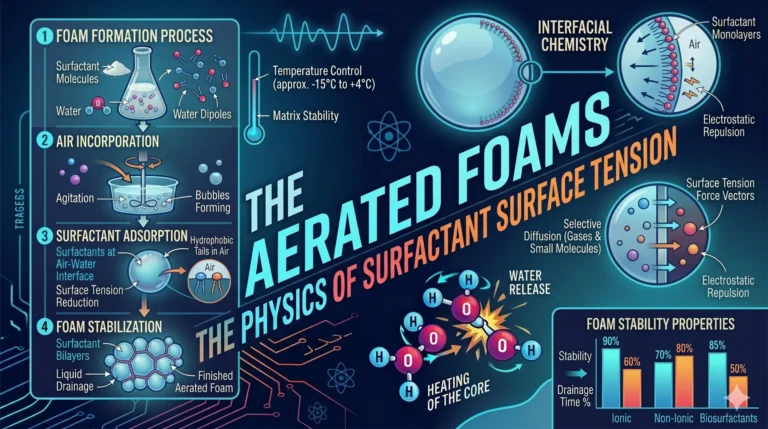
Aerated Foams – The Physics of Surfactant Surface Tension 

May 3, 2026

Aerated Foams – The Physics of Surfactant Surface Tension 

We move from the encapsulated liquids of spherification to the fluid mechanics of Aerated Foams. In the modern kitchen, a foam...

Read More
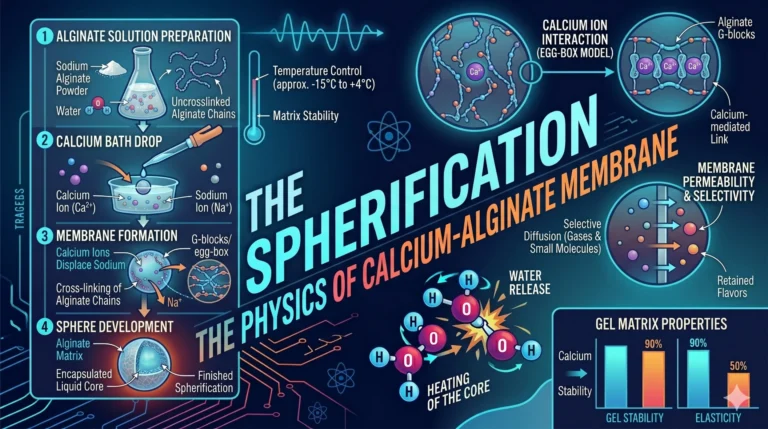
Spherification – The Physics of the Calcium-Alginate Membrane 

May 3, 2026

Spherification – The Physics of the Calcium-Alginate Membrane 

We move from the electromagnetic fields of induction to the biopolymer gelation of Spherification. Popularized by the modernist kitchen of Ferran...

Read More
We move from the electromagnetic fields of induction to the biopolymer gelation of Spherification. Popularized by the modernist kitchen of Ferran Adrià, this technique allows a chef to encapsulate a liquid inside a thin, transparent gel membrane that "pops" upon consumption. It is a study in ion-exchange cross-linking, where the physical state of a liquid is manipulated by triggering a rapid phase change at the molecular surface.To master spherification, one must understand the relationship between polysaccharide chains and divalent cation bridging.Part 1: Sodium Alginate – The Linear PolysaccharideThe core material used in spherification is Sodium Alginate, a natural polymer extracted from brown seaweed.Molecular Structure: Alginate consists of long, linear chains of carbohydrate molecules. In its sodium form, these chains repel each other, allowing the alginate to dissolve into a liquid and flow freely.The "Liquid State": At this stage, the liquid is viscous but has no structural integrity. It behaves like a thick syrup.Part 2: Ion Exchange – The Calcium TriggerThe transformation from liquid to gel occurs when the alginate comes into contact with Calcium ions ($Ca^{2+}$).Divalent Bridging: Unlike sodium ($Na^{+}$), which has a single positive charge, calcium is a divalent cation with two positive charges. This allows a single calcium ion to act as a "bridge" between two different alginate chains.The "Egg Box" Model: As calcium ions displace the sodium ions, they pull the alginate chains together into a tight, three-dimensional grid. This structure is known as the "egg box" model, resulting in a solid, elastic hydrogel membrane.Part 3: Basic vs. Reverse Spherification – Managing the DiffusionDepending on where the calcium and alginate are placed, the chef can control the membrane growth.Basic Spherification: The alginate is added to the flavored liquid and dropped into a calcium bath. The membrane grows inward. This is ideal for small "caviar" pearls, but the gelation continues until the entire sphere becomes a solid jelly ball.Reverse Spherification: The calcium is added to the flavored liquid (or is naturally present, like in dairy) and dropped into an alginate bath. The membrane grows outward. Because the alginate cannot penetrate the already-formed gel, the center remains liquid indefinitely. This is the gold standard for large "spheres" or "ravioli."Conclusion: The Engineering of EncapsulationSpherification proves that texture can be a boundary layer. By leveraging the specific reactive properties of seaweed polymers and calcium ions, the chef creates a vessel out of the ingredient itself. It is the physics of surface-level gelation—a way to package flavor in a fragile, temporary architecture.

May 3, 2026

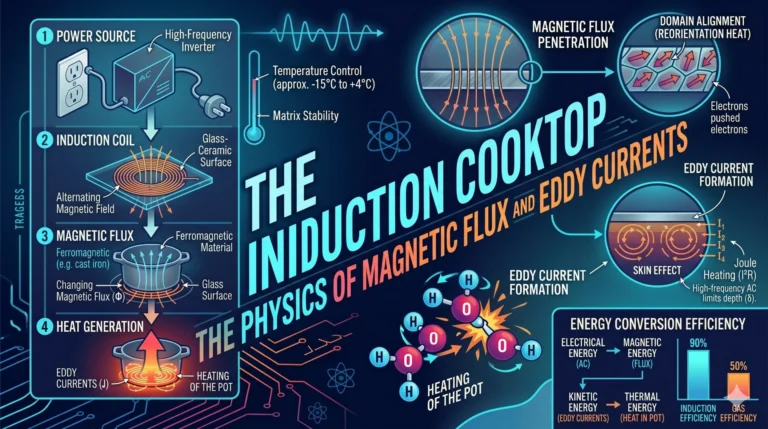
The Induction Cooktop – The Physics of Magnetic Flux and Eddy Currents 

We move from the molecular structure of gelatin to the electromagnetic engineering of the Induction Cooktop. Unlike gas or traditional electric...

Read More
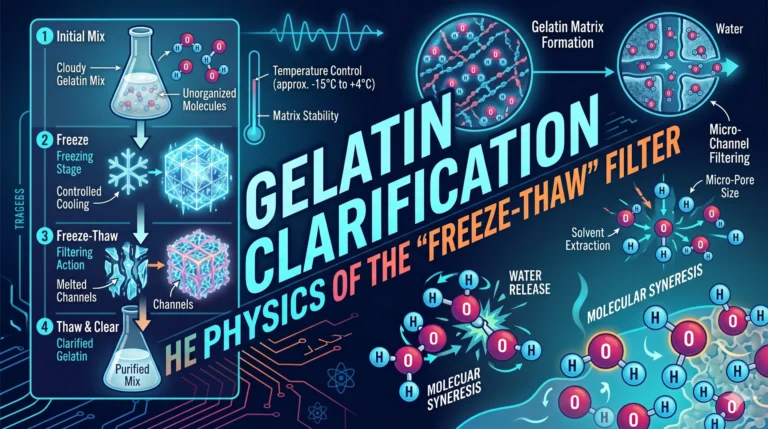
Gelatin Clarification – The Physics of the "Freeze-Thaw" Filter 

May 3, 2026

Gelatin Clarification – The Physics of the “Freeze-Thaw” Filter 

We move from electromagnetic rotation to the structural thermodynamics of Gelatin Clarification. While the Consommé (Article 65) uses a “raft” for...

Read More
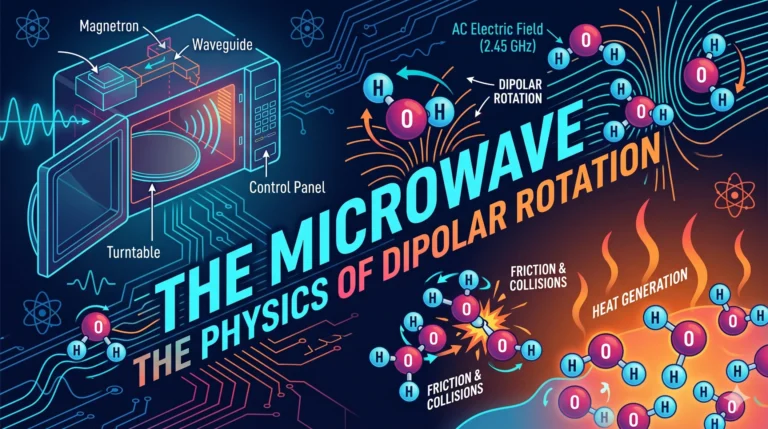
The Microwave – The Physics of Dipolar Rotation generate 16:9 ratio featured image for this artivle

May 3, 2026

The Microwave – The Physics of Dipolar Rotation 

We move from the high-pressure conduction of the pressure cooker to the electromagnetic engineering of the Microwave. Often misunderstood as “cooking...

Read More
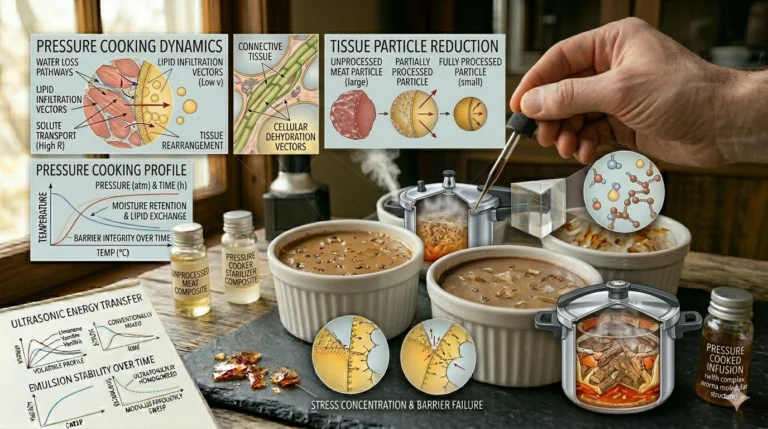
The Pressure Cooker – Atmospheric Pressure and Boiling Point Elevation v

May 2, 2026

The Pressure Cooker – Atmospheric Pressure and Boiling Point Elevation 

We move from the infusion of gas into solids to the high-pressure thermodynamics of the Pressure Cooker. This tool is the...

Read More
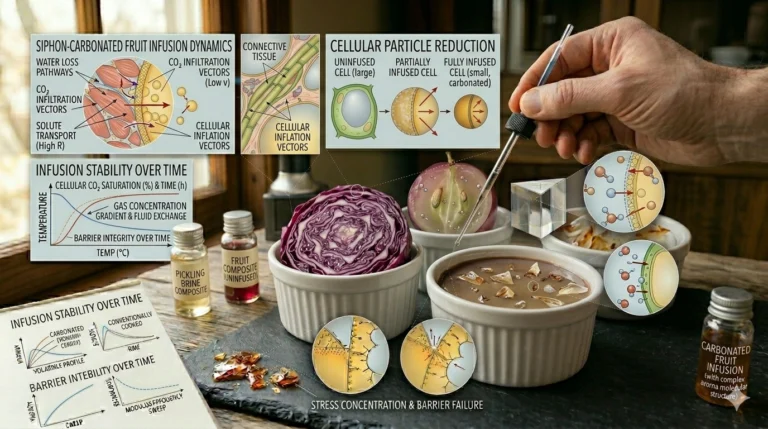
We move from the infusion of gas into solids to the high-pressure thermodynamics of the Pressure Cooker. This tool is the cornerstone of efficient kitchen engineering, allowing for the rapid transformation of tough proteins and starches by manipulating the physical properties of water. While a standard pot is limited by the local atmospheric pressure, a pressure cooker creates an artificial environment where the laws of boiling are rewritten.To master the Pressure Cooker, one must understand the relationship between vapor pressure and boiling point elevation.Part 1: The Pressure-Temperature Link – The Clausius-Clapeyron RelationIn an open pot at sea level, water boils at 100°C. No matter how much heat you add, the water will not get hotter because the energy is used to convert liquid into steam (latent heat of vaporization).The Sealed System: A pressure cooker uses a gasket to create a hermetic seal. As the water inside heats up, the steam produced is trapped, which rapidly increases the internal atmospheric pressure.Boiling Point Elevation: According to the principles of thermodynamics, as the pressure on a liquid increases, the energy required for the liquid molecules to escape into the gas phase also increases. At a standard pressure of 15 psi (approx. 1 bar) above atmospheric pressure, the boiling point of water rises to 121°C.Part 2: Kinetic Acceleration – Cutting Cooking TimeThe $21^{\circ}C$ difference between a standard boil and a pressurized boil is not incremental; it is transformative for chemical reaction rates.The Arrhenius Equation: In many chemical reactions, including the breakdown of connective tissue, the reaction rate roughly doubles with every $10^{\circ}C$ increase in temperature.Rapid Hydrolysis: Tough collagen in meat that might take 4 to 6 hours to turn into gelatin at a standard simmer can be converted in as little as 45 to 60 minutes under pressure.Enhanced Maillard Reaction: While the Maillard reaction (Article 68) usually requires a dry environment, the high temperatures achieved in a pressure cooker allow browning to occur even in a moist environment. This is why pressure-cooked stocks have a deeper, "roasted" flavor profile compared to traditional stocks.Part 3: The Physics of Cooling – Natural vs. Manual ReleaseThe most critical safety and technical phase of pressure cooking is the depressurization.Natural Release: As the heat is removed, the steam slowly condenses back into liquid, and the pressure drops. This is ideal for meats, as it prevents the muscle fibers from "squeezing" out moisture during a sudden pressure shift.Manual/Quick Release: If the valve is opened suddenly, the internal pressure drops instantly to match the outside atmosphere. Because the liquid inside is still at $121^{\circ}C$ (well above the "new" boiling point of $100^{\circ}C$), it undergoes flash boiling. This turbulence can shred delicate ingredients or cause starches to foam and spray through the valve.Conclusion: Engineering Time and TemperatureThe Pressure Cooker proves that the "limits" of cooking are often just the limits of the atmosphere. By utilizing a sealed vessel to elevate the boiling point of water, the chef can manipulate the kinetics of flavor extraction and protein breakdown with surgical speed. It is the physics of thermal acceleration.

May 2, 2026

Siphon-Carbonated Fruit – The Physics of $CO_2$ Infusion 

We move from the molecular browning of the Maillard reaction to the high-pressure thermodynamics of Siphon Carbonation. This technique allows a...

Read More
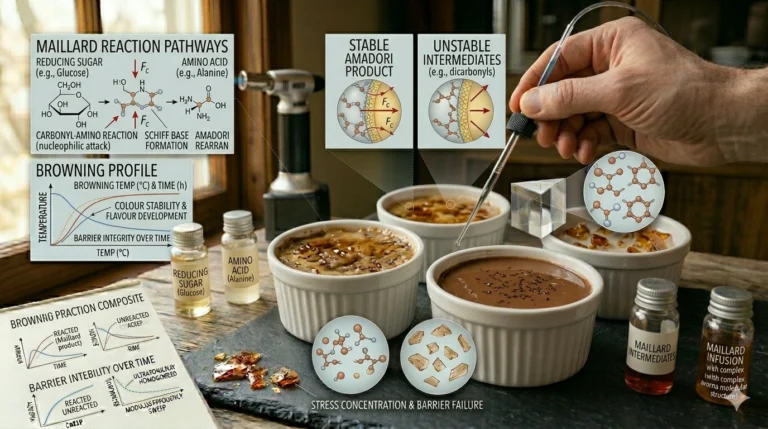
The Maillard Reaction – The Molecular Chemistry of Browning 

May 2, 2026

The Maillard Reaction – The Molecular Chemistry of Browning 

We transition from the structural engineering of meat to the fundamental chemical engine behind almost every savory flavor in the kitchen:...

Read More
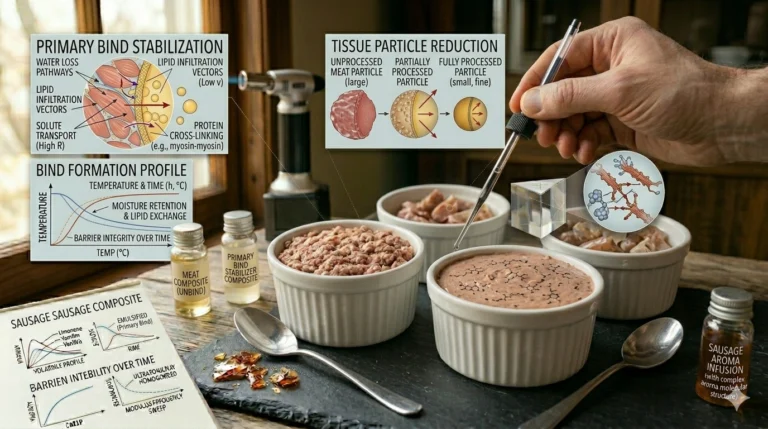
generate 16:9 ratio featured image for this artivle

May 2, 2026

The Emulsified Sausage – The Engineering of the “Primary Bind 

We shift from the crystalline structure of chocolate to the biopolymer engineering of the Emulsified Sausage (such as Mortadella, Frankfurters, or...

Read More
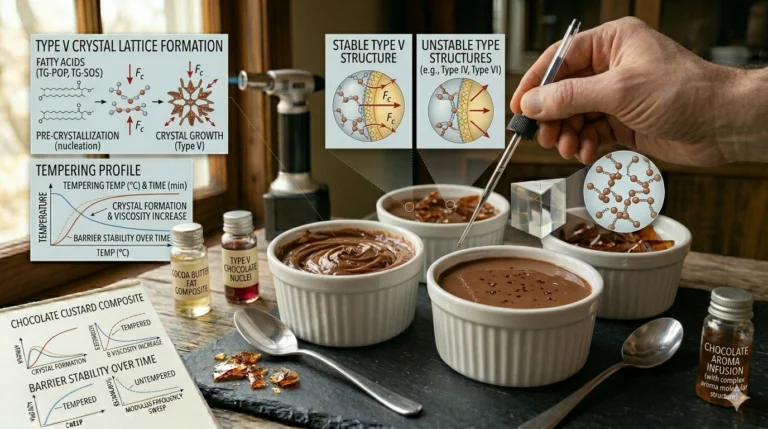
generate 16:9 ratio featured image for this artivle

May 2, 2026

Chocolate Tempering – The Physics of the Type V Crystal Lattice 

We move from the filtration of savory liquids to the solid-state physics of Chocolate Tempering. Chocolate is a polymorphic substance, meaning...

Read More
Next

Sign up for our email list

This is placeholder text which will be replaced by your content.

Email Address

Sign Up

*Replace this mock form with your preferred form plugin