
We move from the infusion of gas into solids to the high-pressure thermodynamics of the Pressure Cooker. This tool is the cornerstone of efficient kitchen engineering, allowing for the rapid transformation of tough proteins and starches by manipulating the physical properties of water. While a standard pot is limited by the local atmospheric pressure, a pressure cooker creates an artificial environment where the laws of boiling are rewritten.To master the Pressure Cooker, one must understand the relationship between vapor pressure and boiling point elevation.Part 1: The Pressure-Temperature Link – The Clausius-Clapeyron RelationIn an open pot at sea level, water boils at 100°C. No matter how much heat you add, the water will not get hotter because the energy is used to convert liquid into steam (latent heat of vaporization).The Sealed System: A pressure cooker uses a gasket to create a hermetic seal. As the water inside heats up, the steam produced is trapped, which rapidly increases the internal atmospheric pressure.Boiling Point Elevation: According to the principles of thermodynamics, as the pressure on a liquid increases, the energy required for the liquid molecules to escape into the gas phase also increases. At a standard pressure of 15 psi (approx. 1 bar) above atmospheric pressure, the boiling point of water rises to 121°C.Part 2: Kinetic Acceleration – Cutting Cooking TimeThe $21^{\circ}C$ difference between a standard boil and a pressurized boil is not incremental; it is transformative for chemical reaction rates.The Arrhenius Equation: In many chemical reactions, including the breakdown of connective tissue, the reaction rate roughly doubles with every $10^{\circ}C$ increase in temperature.Rapid Hydrolysis: Tough collagen in meat that might take 4 to 6 hours to turn into gelatin at a standard simmer can be converted in as little as 45 to 60 minutes under pressure.Enhanced Maillard Reaction: While the Maillard reaction (Article 68) usually requires a dry environment, the high temperatures achieved in a pressure cooker allow browning to occur even in a moist environment. This is why pressure-cooked stocks have a deeper, "roasted" flavor profile compared to traditional stocks.Part 3: The Physics of Cooling – Natural vs. Manual ReleaseThe most critical safety and technical phase of pressure cooking is the depressurization.Natural Release: As the heat is removed, the steam slowly condenses back into liquid, and the pressure drops. This is ideal for meats, as it prevents the muscle fibers from "squeezing" out moisture during a sudden pressure shift.Manual/Quick Release: If the valve is opened suddenly, the internal pressure drops instantly to match the outside atmosphere. Because the liquid inside is still at $121^{\circ}C$ (well above the "new" boiling point of $100^{\circ}C$), it undergoes flash boiling. This turbulence can shred delicate ingredients or cause starches to foam and spray through the valve.Conclusion: Engineering Time and TemperatureThe Pressure Cooker proves that the "limits" of cooking are often just the limits of the atmosphere. By utilizing a sealed vessel to elevate the boiling point of water, the chef can manipulate the kinetics of flavor extraction and protein breakdown with surgical speed. It is the physics of thermal acceleration.

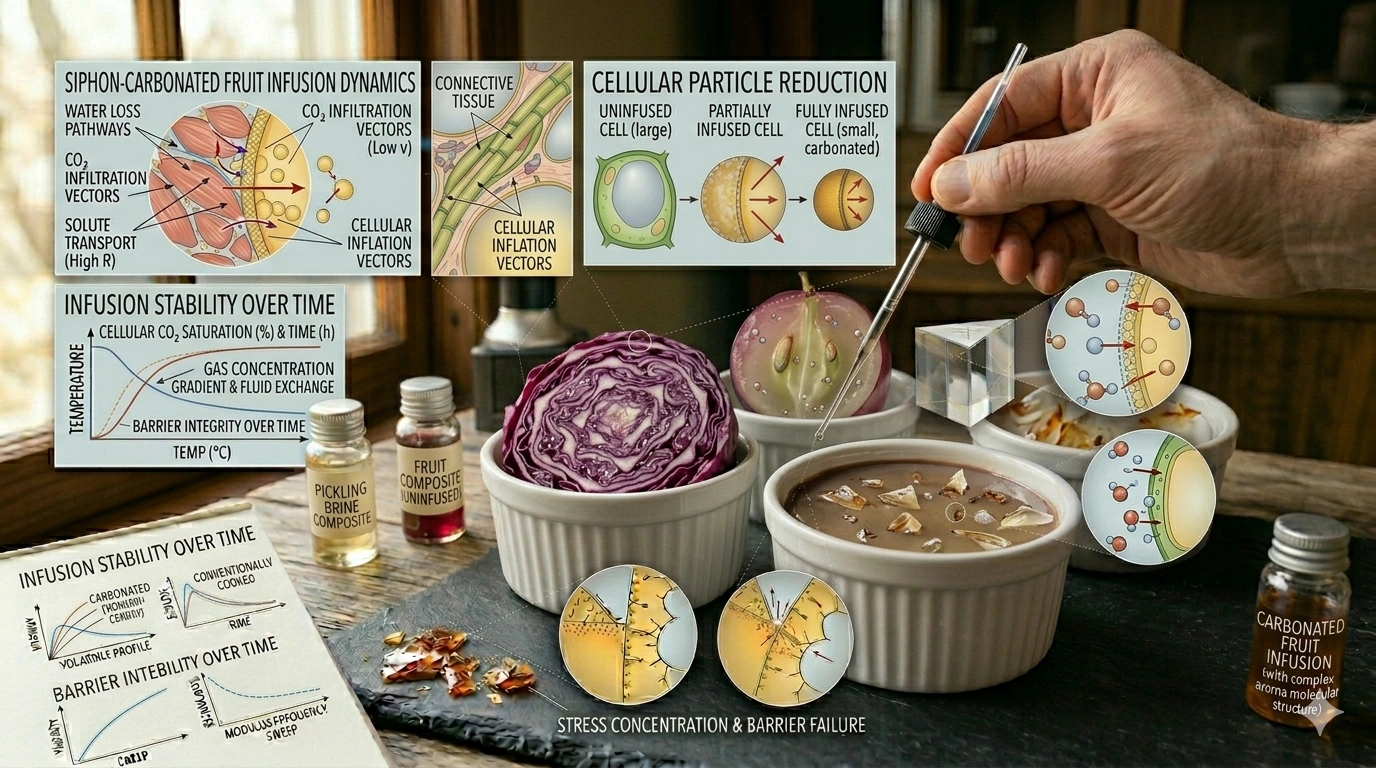
We move from the molecular browning of the Maillard reaction to the high-pressure thermodynamics of Siphon Carbonation. This technique allows a chef to turn solid fruit—like grapes, watermelon, or oranges—into “fizzy” snacks. Unlike carbonating a liquid, where gas is dissolved into a fluid, carbonating solid fruit involves forcing $CO_2$ into the liquid held within the fruit’s cellular structure through Henry’s Law.

To master carbonated fruit, one must understand the relationship between partial pressure and cellular diffusion.The fundamental principle at play is Henry’s Law, which states that the amount of dissolved gas in a liquid is proportional to its partial pressure above the liquid.

  • Solubility under Pressure: At standard atmospheric pressure, very little $CO_2$ can enter the water inside a piece of fruit. However, inside a sealed whipping siphon, the pressure can reach $6$ to $8$ bars.
  • The Diffusion Gradient: Under this high pressure, the $CO_2$ molecules are forced through the fruit’s skin and cell walls, dissolving into the intracellular juice until equilibrium is reached.

Part 2: Cellular Integrity – Choosing the Right Matrix

Not all fruits are suitable for carbonation. The success of the “fizz” depends on the structural engineering of the fruit’s anatomy.

  • High Water Content: Fruits like grapes, citrus segments, and melons work best because they contain large vacuoles filled with liquid that can hold the dissolved gas.
  • Surface-to-Volume Ratio: Small, thin-skinned fruits or porous fruits allow the gas to penetrate more quickly. A thick-skinned fruit (like an unpeeled apple) may act as a pressure barrier, requiring much longer infusion times.
  • Pectin Density: Fruits with very dense, fibrous structures (like under-ripe pears) offer too much resistance for the gas to create a noticeable “pop” when eaten

Part 3: The Rapid Decompression – The “Fizzy” Sensation

The final step is the release of pressure, which must be handled with precision to avoid “venting” the flavor.

  • Sudden Desorption: When the siphon is vented, the external pressure drops instantly. However, the $CO_2$ inside the fruit cannot exit the cells as quickly as it entered.
  • The Bubble Effect: As you bite into the fruit, the remaining dissolved $CO_2$ rapidly expands and forms tiny bubbles on your tongue, creating the same tingling sensation as a carbonated beverage but within a solid structure.
  • The Temperature Variable: $CO_2$ is more soluble in cold liquids. For maximum “fizz,” the fruit and the siphon must be chilled to near $4^{\circ}C$ before and during the carbonation process.

Conclusion: Engineering the Solid Liquid

Siphon-carbonated fruit proves that the boundaries between food states are fluid. By utilizing high-pressure siphons to manipulate gas solubility, the modern chef can turn a standard piece of produce into a multisensory experience. It is the physics of intracellular carbonation—a way to add a hidden dimension of texture to the most basic ingredients.


Writer - Daniel Carter

Daniel Carter

Daniel Carter is a Seattle-based food writer specializing in sushi, poke, and modern Japanese dining. With over seven years of experience reviewing local restaurants, he provides clear, unbiased insights to help diners understand menus, pricing, portion quality, and overall value. His straightforward writing style makes sushi easy to enjoy for both first-time visitors and regulars.

Leave a Comment