
Introductory sub headline

This is placeholder text which will be replaced by your content. Lorem ipsum amet elit morbi dolor tortor. Vivamus eget mollis nostra ullam corper. Pharetra torquent auctor metus felis nibh velit tellus semper taciti nostra. Semper pharetra montes habitant congue integer magnis nulla.
generate 16:9 ratio featured imgage this article

April 25, 2026

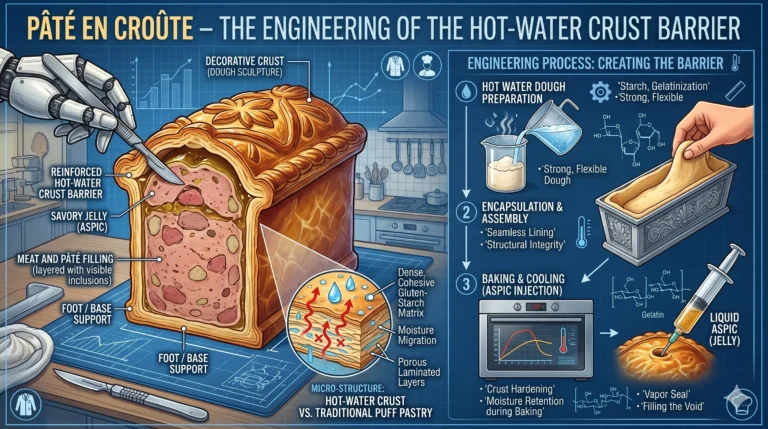
Pâté en Croûte – The Engineering of the Hot-Water Crust Barrier

We move from the delicate, aerated worlds of macarons and soufflés to the heavy-duty structural engineering of Pâté en Croûte. This...

Read More
The Macaron – The Engineering of Almond-Protein Drying

April 25, 2026

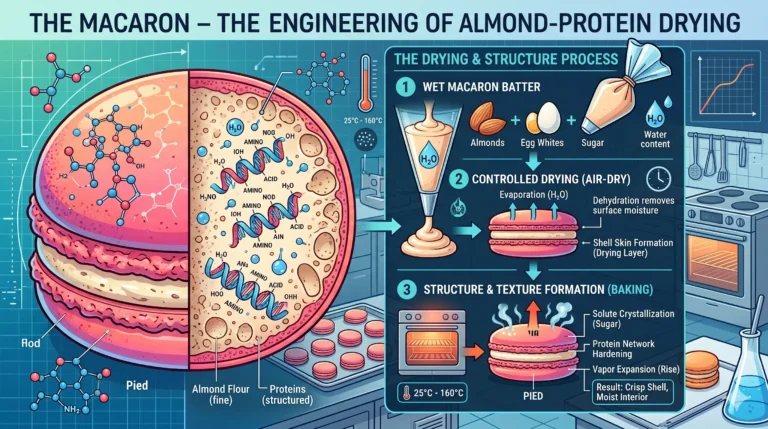
The Macaron – The Engineering of Almond-Protein Drying

The French Macaron is widely considered the ultimate test of a pastry chef’s technical discipline. Unlike most cookies, which rely on...

Read More
generate 16:9 ratio featured imgage for this article

April 25, 2026

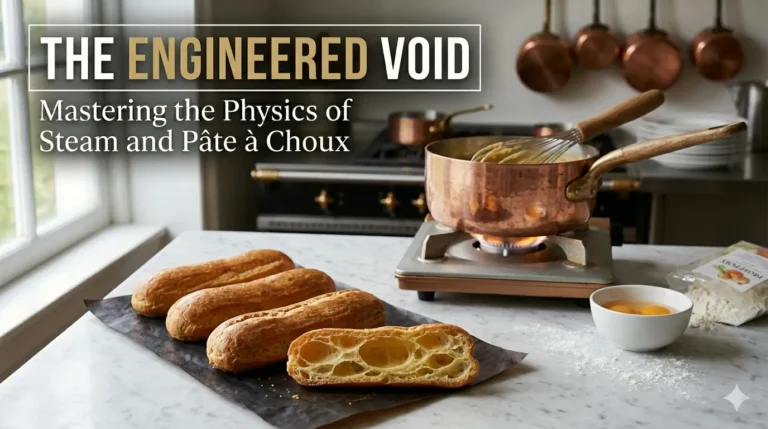
Pâte à Choux – The Engineering of the Hollow Steam-Void

We continue our technical analysis of French pastry by moving from laminated structures to the science of internal voids. Pâte à...

Read More
generate 16:9 ratio featured imgage for this article

April 25, 2026

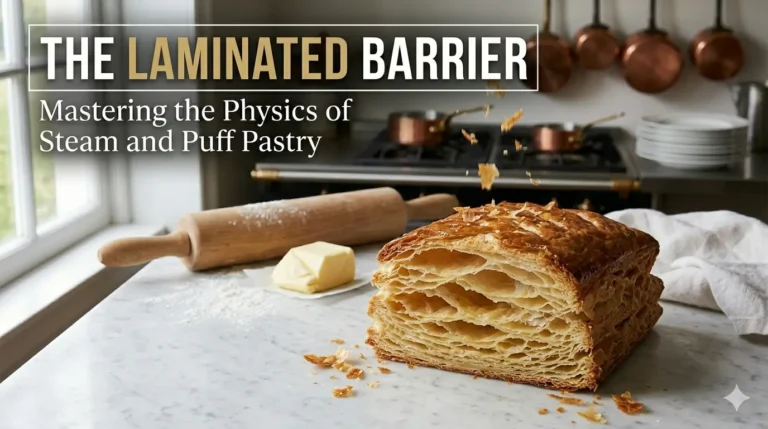
Pâte Feuilletée – The Engineering of the Laminated Butter-Flour Barrier

We move from the liquid purities of the consommé to the structural complexities of French pastry. Pâte Feuilletée (Puff Pastry) is...

Read More
We move from the liquid purities of the consommé to the structural complexities of French pastry. Pâte Feuilletée (Puff Pastry) is the ultimate study in lamination physics. It is a composite material engineered to consist of hundreds of alternating, microscopic layers of dough and fat. When subjected to intense thermal energy, these layers undergo a massive mechanical expansion, transforming a dense block of dough into a light, shattered-glass structure.To master Puff Pastry, one must understand the relationship between Water Activity ($a_w$) and the Physical Barrier Effect of cold lipids.Part 1: The Détrempe and the Beurrage – Creating the CompositePuff Pastry is not a mixture; it is a stratified stack. It begins as two distinct components:The Détrempe: A lean dough made of flour and water. Its technical purpose is to provide the structural gluten matrix.The Beurrage: A block of high-fat, pliable butter. Its purpose is to act as a physical separator.The Engineering Goal:The objective is to encase the butter within the dough and then perform a series of "turns" (folding and rolling). Each turn exponentially multiplies the number of layers. A standard "six-turn" puff pastry technically contains $729$ layers of butter separated by $730$ layers of dough.Part 2: The Leidenfrost Effect – The Engine of the RiseThe "puff" in puff pastry is not caused by yeast or chemical leaveners; it is an act of pure steam-driven mechanical engineering.Moisture Migration: The dough layers contain water. When the pastry enters a high-temperature oven ($200^{\circ}C$), the water in the dough layers flashes into steam.The Lipid Barrier: Because the butter layers have a high fat content, they are hydrophobic. Steam cannot pass through fat. Therefore, as the steam expands, it is trapped beneath the butter layer, physically lifting the dough layer above it.The Vertical Expansion: This process happens simultaneously across all $1,459$ layers. The result is a vertical lift that can increase the volume of the dough by over $10$ times its original height.Part 3: The Plasticity Window – Managing the "Smear"The primary technical failure in Puff Pastry is thermal leakage.The Temperature Threshold: If the butter becomes too warm ($>24^{\circ}C$), it loses its solidity and begins to soak into the dough layers. This destroys the lamination, turning the composite into a simple "shortcrust" dough that will not rise.The Gluten Tension: Conversely, if the dough is worked too quickly without "rest" periods, the gluten becomes too elastic and will shrink or deform during baking.The Solution: Constant refrigeration between turns to maintain the butter's plasticity—the state where it is soft enough to roll but solid enough to remain a distinct layer.Conclusion: The Architecture of the CrunchPâte Feuilletée is proof that texture is a product of geometry. By engineering hundreds of moisture-rich barriers separated by fat, the French pastry chef creates a material that utilizes the power of steam to build its own internal architecture. It is the height of culinary lamination—a fragile, golden tower of physics.

April 25, 2026

The Consommé – The Physics of the “Raft” Filtration

In classical French cuisine, the Consommé is the ultimate expression of technical purity. It is not merely a strained soup; it...

Read More
The Soufflé – The Engineering of Gas-Bubble Expansion

April 24, 2026

The Soufflé – The Engineering of Gas-Bubble Expansion

The Soufflé is the ultimate demonstration of French culinary physics. It is a high-performance structural matrix designed to capture, expand, and...

Read More
generate 16:9 ratio featured imgage for this article

April 24, 2026

The Fond and the Bone – The Physics of the Brown Stock

If the Mother Sauces are the architecture of French cuisine, then the Brown Stock (Fond Brun) is the geological foundation. Unlike...

Read More
generate 16:9 ratio featured imgage for this article

April 24, 2026

The French Omelet – The Technical Management of Curd Geometry

While often dismissed as a simple breakfast dish, the Classical French Omelet is technically one of the most demanding exercises in...

Read More
generate 16:9 ratio featured imgage for this article

April 24, 2026

French Mother Sauces – The Engineering of the Classical Emulsion

As we pivot from the clean, ingredient-focused geometry of Japanese Washoku, we enter the world of Classical French Technique. If Japanese...

Read More
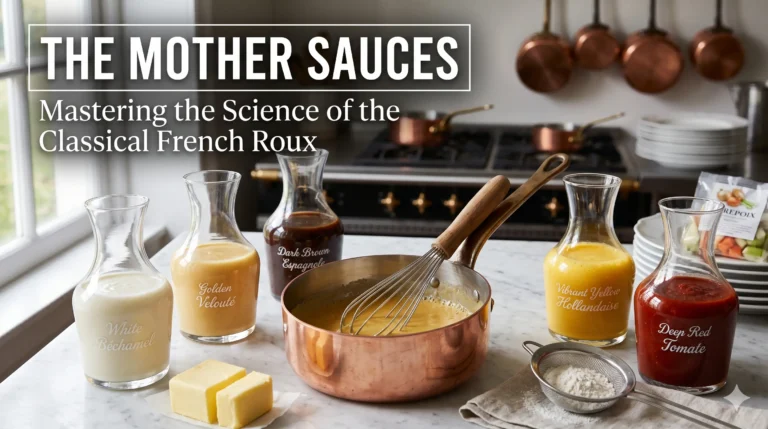
As we pivot from the clean, ingredient-focused geometry of Japanese Washoku, we enter the world of Classical French Technique. If Japanese cuisine is a study in extraction and purity, French cuisine is a study in saucier engineering. At its core lies the system of the five Mother Sauces (Grandes Sauces), codified by Auguste Escoffier.To master French cooking, one must understand the molecular physics of the Roux and the delicate equilibrium of the Permanent Emulsion.Part 1: The Roux – The Starch-Fat MatrixAlmost all Mother Sauces begin with a Roux. This is not just a thickener; it is a thermal-mechanical process that coat's flour’s starch granules in fat to prevent clumping.The Molecular Ratio: A standard roux is a 1:1 ratio by weight of flour to fat (usually clarified butter).The Physics of Thickening: When liquid is added to the roux, the starch granules (amylose and amylopectin) absorb the liquid and swell—a process called gelatinization. By coating the flour in fat first, the chef ensures that each granule hydrates individually, resulting in a smooth, velvet texture rather than "lumpy" soup.The Thermal Window:White Roux: Cooked just enough to remove the "raw flour" taste. High thickening power.Blond Roux: Cooked until the sugar in the flour begins to caramelize.Brown Roux: Deeply toasted. The high heat breaks down the starch chains, resulting in less thickening power but immense nutty depth (The Maillard Reaction).Part 2: The Mother Sauce TaxonomyThe five sauces are categorized by their Liquid Base and their Thickening Agent.SauceLiquid BaseThickening AgentTechnical ObjectiveBéchamelMilkWhite RouxA pure, neutral white emulsion. The base for Mornay.VeloutéWhite Stock (Chicken/Veal)Blond RouxA "velvety" savory sauce focusing on the clarity of the stock.EspagnoleBrown Stock (Roasted Veal)Brown Roux + MirepoixIntense reduction and Maillard complexity. The base for Demi-Glace.HollandaiseClarified ButterEgg Yolk (Emulsification)A fragile, warm biological emulsion of fat and water.TomateTomatoes/StockRoux (Traditional) or ReductionAcid management and lycopene concentration.Part 3: Hollandaise – The Biological EmulsificationHollandaise is the outlier. It does not use a roux; it uses thermal-mechanical emulsification. It is the most technically "fragile" sauce in the French repertoire.The Lecithin Bridge: Egg yolks contain Lecithin, a phospholipid that is both hydrophilic (water-loving) and lipophilic (fat-loving). It acts as the "glue" that allows clarified butter and lemon juice to merge into a single phase.The Temperature Tightrope:Below $45^{\circ}C$: The butter solidifies, and the sauce "breaks."Above $65^{\circ}C$: The egg proteins coagulate (scramble), destroying the emulsion.The Technical Solution: A Bain-Marie (water bath) is used to maintain a stable, sub-simmering environment, allowing the chef to whisk air and fat into the yolks to create a stable, aerated foam.Conclusion: The Saucier’s FoundationFrench cuisine is a modular system. By mastering the five Mother Sauces, a chef gains the ability to create hundreds of "daughter sauces" (Sauces Petites) simply by altering the aromatics or seasonings. It is a system built on the structural integrity of the roux and the biological precision of the emulsion.

April 24, 2026

The Grand Synthesis – The Unified Field Theory of Washoku

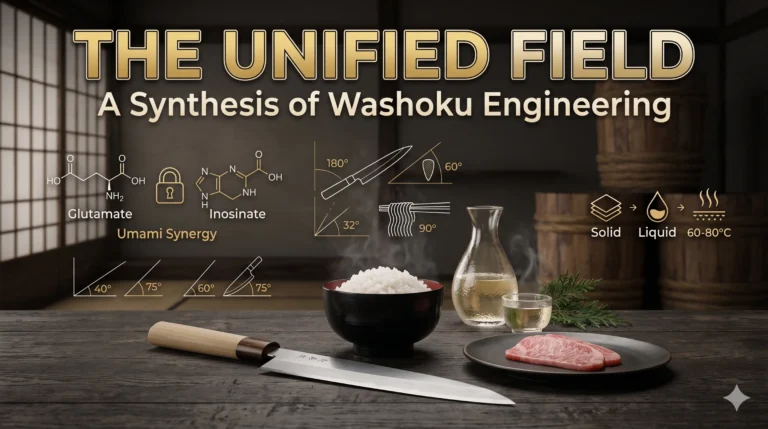
We have spent 35 articles dissecting the Japanese culinary system into its constituent parts: the metallurgy of the blade, the microbial...

Read More
Back Next

Sign up for our email list

This is placeholder text which will be replaced by your content.

Email Address

Sign Up

*Replace this mock form with your preferred form plugin