
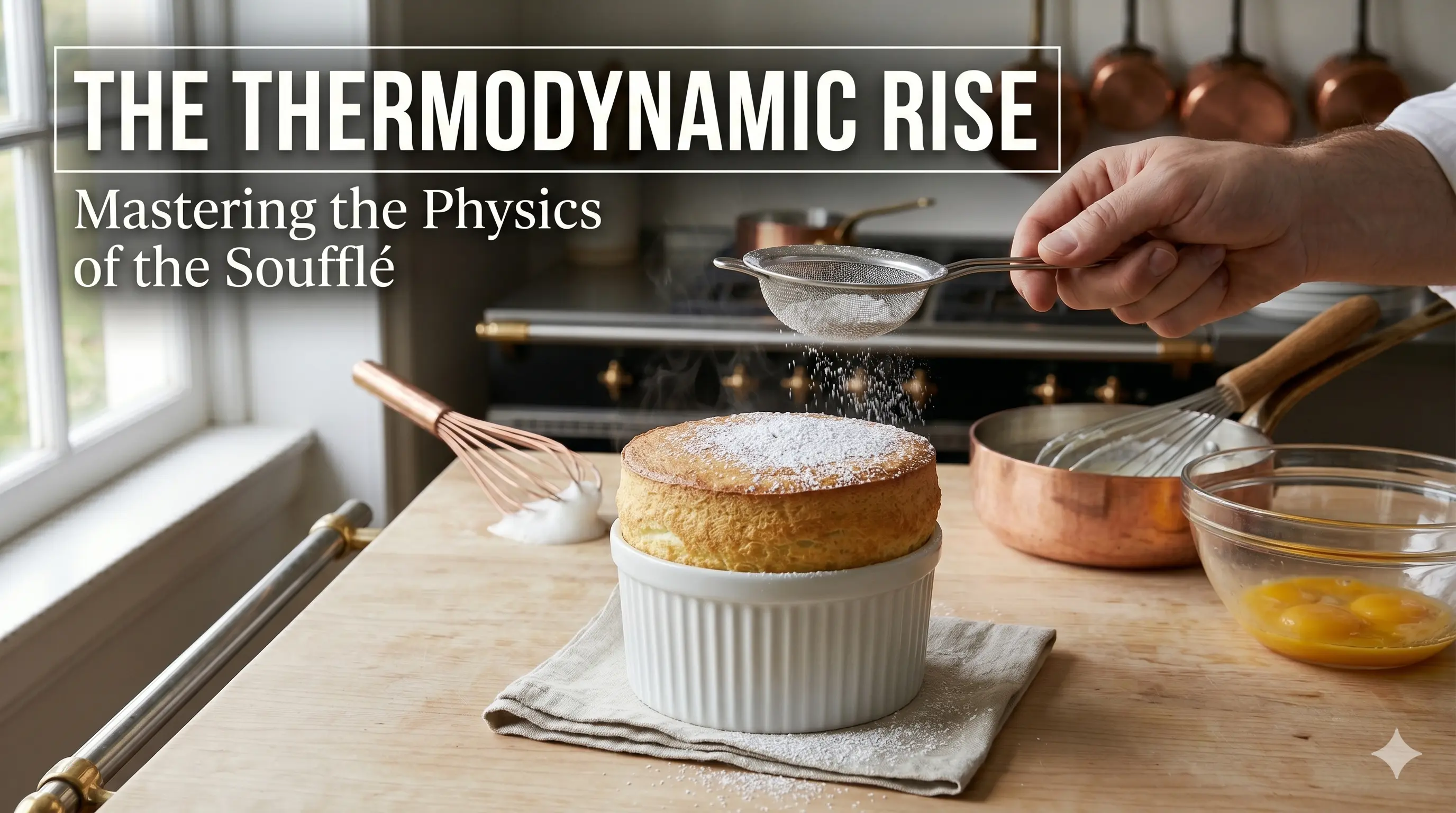
The Soufflé is the ultimate demonstration of French culinary physics. It is a high-performance structural matrix designed to capture, expand, and hold atmospheric gases. While it is often viewed as a fragile dessert, a Soufflé is technically an aerated protein-starch gel that utilizes the Ideal Gas Law to achieve its characteristic “rise.”
To master the Soufflé, one must understand the relationship between the viscosity of the base and the surface tension of the albumen foam.
Part 1: The Base – Engineering the Structural Matrix
A Soufflé cannot rise without a stable foundation. This base, typically a thick Béchamel (for savory) or a Crème Pâtissière (for sweet), acts as the structural “glue” of the dish.
- The Viscosity Threshold: The base must be thick enough to hold the air bubbles in place but fluid enough to allow them to expand. If the base is too dense (too much roux), the resistance to expansion will be too high, and the soufflé will be heavy.
- The “Liaison” (The Binder): Egg yolks are incorporated into the base to add fat and emulsification. This creates a flexible matrix that can stretch as the internal gas pressure increases during baking.
Part 2: The Albumen Foam – The Gas Capture System
The “lift” of the Soufflé comes from the mechanical aeration of egg whites (albumen).
- The Protein Net: As you whisk egg whites, you are physically unfolding (denaturing) the proteins and creating a microscopic net that traps air.
- The Stability Factor: Adding a small amount of acid (like cream of tartar or lemon juice) or sugar helps stabilize this protein net, preventing it from collapsing before it reaches the oven.
- The Folding Rule: The foam must be “folded” into the base with extreme care. If you stir too aggressively, you physically rupture the microscopic bubbles, losing the potential energy required for the rise.
Part 3: The Thermal Rise – Applying the Ideal Gas Law
The actual “rise” of the Soufflé in the oven is a beautiful application of thermodynamics ($PV = nRT$).
- Gas Expansion: As the temperature ($T$) of the air trapped inside the bubbles increases, the volume ($V$) of that gas must also increase. This internal pressure pushes against the walls of the protein-starch matrix, forcing the soufflé upward.
- Steam Injection: Simultaneously, the moisture in the base turns into steam. This creates additional internal pressure and volume, acting as a secondary “engine” for the rise.
- The Setting Point: As the soufflé reaches its maximum height, the heat of the oven finally coagulates (hardens) the egg proteins in the walls of the bubbles, turning the temporary foam into a solid, albeit delicate, structure.
Conclusion: The Architecture of Air
The Soufflé is proof that air is a technical ingredient. By engineering a flexible structural matrix and a high-tension gas capture system, the French chef uses heat to physically expand the boundaries of the dish. It is a fleeting, perfect moment of culinary engineering that exists only as long as the internal gas pressure remains higher than the atmospheric pressure outside.