
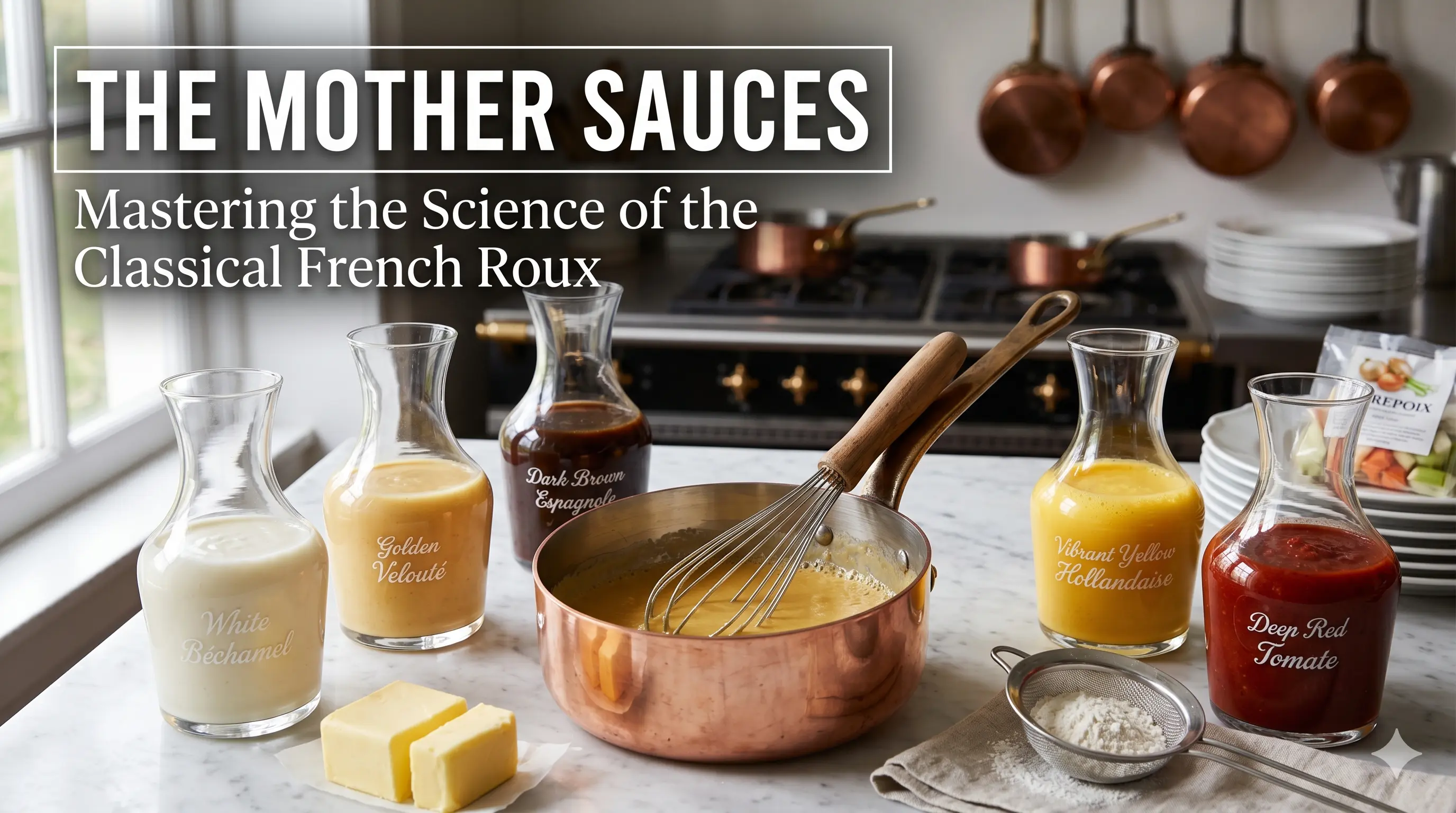
As we pivot from the clean, ingredient-focused geometry of Japanese Washoku, we enter the world of Classical French Technique. If Japanese cuisine is a study in extraction and purity, French cuisine is a study in saucier engineering. At its core lies the system of the five Mother Sauces (Grandes Sauces), codified by Auguste Escoffier.
To master French cooking, one must understand the molecular physics of the Roux and the delicate equilibrium of the Permanent Emulsion.
Part 1: The Roux – The Starch-Fat Matrix
Almost all Mother Sauces begin with a Roux. This is not just a thickener; it is a thermal-mechanical process that coat’s flour’s starch granules in fat to prevent clumping.
- The Molecular Ratio: A standard roux is a 1:1 ratio by weight of flour to fat (usually clarified butter).
- The Physics of Thickening: When liquid is added to the roux, the starch granules (amylose and amylopectin) absorb the liquid and swell—a process called gelatinization. By coating the flour in fat first, the chef ensures that each granule hydrates individually, resulting in a smooth, velvet texture rather than “lumpy” soup.
- The Thermal Window:
- White Roux: Cooked just enough to remove the “raw flour” taste. High thickening power.
- Blond Roux: Cooked until the sugar in the flour begins to caramelize.
- Brown Roux: Deeply toasted. The high heat breaks down the starch chains, resulting in less thickening power but immense nutty depth (The Maillard Reaction).
Part 2: The Mother Sauce Taxonomy
The five sauces are categorized by their Liquid Base and their Thickening Agent.
| Sauce | Liquid Base | Thickening Agent | Technical Objective |
| Béchamel | Milk | White Roux | A pure, neutral white emulsion. The base for Mornay. |
| Velouté | White Stock (Chicken/Veal) | Blond Roux | A “velvety” savory sauce focusing on the clarity of the stock. |
| Espagnole | Brown Stock (Roasted Veal) | Brown Roux + Mirepoix | Intense reduction and Maillard complexity. The base for Demi-Glace. |
| Hollandaise | Clarified Butter | Egg Yolk (Emulsification) | A fragile, warm biological emulsion of fat and water. |
| Tomate | Tomatoes/Stock | Roux (Traditional) or Reduction | Acid management and lycopene concentration. |
Part 3: Hollandaise – The Biological Emulsification
Hollandaise is the outlier. It does not use a roux; it uses thermal-mechanical emulsification. It is the most technically “fragile” sauce in the French repertoire.
- The Lecithin Bridge: Egg yolks contain Lecithin, a phospholipid that is both hydrophilic (water-loving) and lipophilic (fat-loving). It acts as the “glue” that allows clarified butter and lemon juice to merge into a single phase.
- The Temperature Tightrope:
- Below $45^{\circ}C$: The butter solidifies, and the sauce “breaks.”
- Above $65^{\circ}C$: The egg proteins coagulate (scramble), destroying the emulsion.
- The Technical Solution: A Bain-Marie (water bath) is used to maintain a stable, sub-simmering environment, allowing the chef to whisk air and fat into the yolks to create a stable, aerated foam.
Conclusion: The Saucier’s Foundation
French cuisine is a modular system. By mastering the five Mother Sauces, a chef gains the ability to create hundreds of “daughter sauces” (Sauces Petites) simply by altering the aromatics or seasonings. It is a system built on the structural integrity of the roux and the biological precision of the emulsion.