
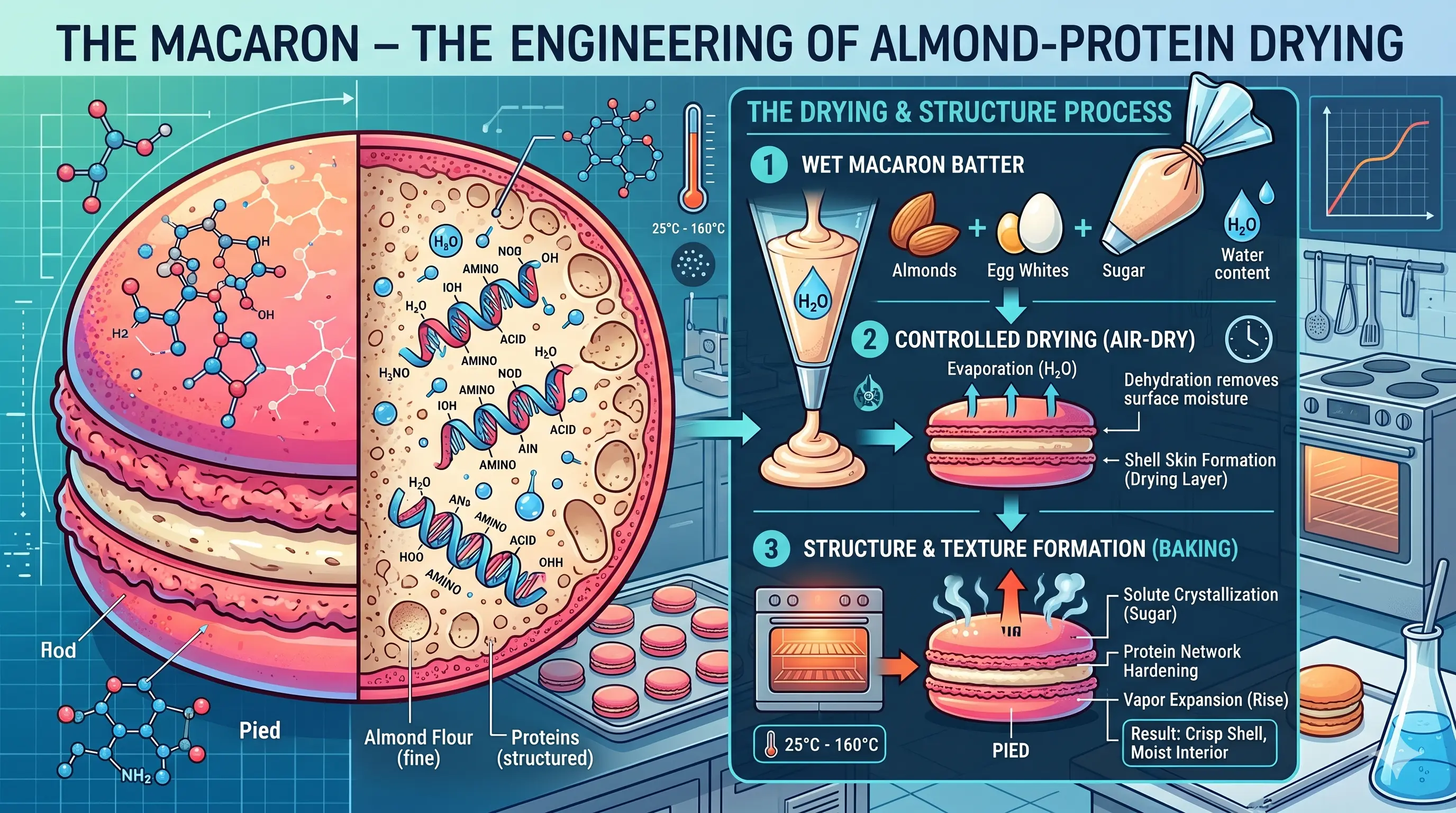
The French Macaron is widely considered the ultimate test of a pastry chef’s technical discipline. Unlike most cookies, which rely on chemical leavening or simple fat-creaming, the macaron is a low-moisture almond-meringue composite. Its iconic structure—a smooth, eggshell-thin crust and a porous, ruffled “foot” (pied)—is the result of precise surface-dehydration engineering and the management of protein-starch elasticity.
To master the Macaron, one must understand the relationship between macaronage viscosity and the formation of the pellicle.
Part 1: The Merging of the Phases – Macaronage
A macaron is created by folding a dry phase (almond flour and powdered sugar) into a wet phase (French or Italian meringue). The technical process of folding them together is called Macaronage.
- The Particle Size Variable: The almond flour must be processed into a microscopic dust. If the particles are too large, they disrupt the protein net of the meringue, leading to a grainy surface and structural collapse.
- The Viscosity Threshold: The chef must fold the batter until it reaches the “lava” stage.
- Under-mixed: The batter is too elastic; it retains peaks from piping, and the surface will crack in the oven.
- Over-mixed: The protein bonds are over-sheared, making the batter too fluid. It will spread flat and fail to rise vertically.
- The Engineering Objective: The goal is to achieve a non-Newtonian fluid consistency where the batter flows enough to self-level but retains enough surface tension to hold its circular geometry.
Part 2: The Pellicle – Engineering the Surface Dehydration
The most critical technical step in macaron production is the “rest” period before baking. This is an act of evaporative engineering.
- The Formation of the Skin: After piping, the macarons must sit at room temperature for 30 to 60 minutes. During this time, the surface moisture evaporates, creating a dry, matte “skin” called a pellicle.
- The Pressure Valve: This pellicle acts as a structural lid. When the macaron enters the oven, the internal moisture turns into steam. Because the top is dry and rigid, the steam cannot escape through the surface. It is forced to escape through the bottom, physically lifting the entire shell.
- The “Pied” (Foot): As the shell lifts, the expanding steam and coagulating proteins create the ruffled “foot” at the base. Without the pellicle, the steam would simply rupture the top, and no foot would form.
Part 3: The Maturation Paradox – Moisture Re-Migration
A macaron is not technically “finished” when it leaves the oven. It is actually at its lowest quality point: dry and brittle.
- Controlled Re-Hydration: Once filled with ganache or buttercream, the macaron must be refrigerated for 24 hours. This is the maturation phase.
- Moisture Equilibrium: The moisture from the filling slowly migrates back into the dry almond shell. This softens the interior while leaving the eggshell exterior crisp. This gradient of moisture activity ($a_w$) is what creates the signature “crunch then melt” mouthfeel.
Conclusion: The Precision of the Pellicle
The Macaron is a masterpiece of atmospheric management. By engineering a specific batter viscosity and utilizing surface dehydration to create a pressure-resistant lid, the French pastry chef forces thermodynamics to build the cookie’s architecture from the bottom up. It is the height of protein-sugar engineering—a fragile, colorful shell built on the science of evaporation.