
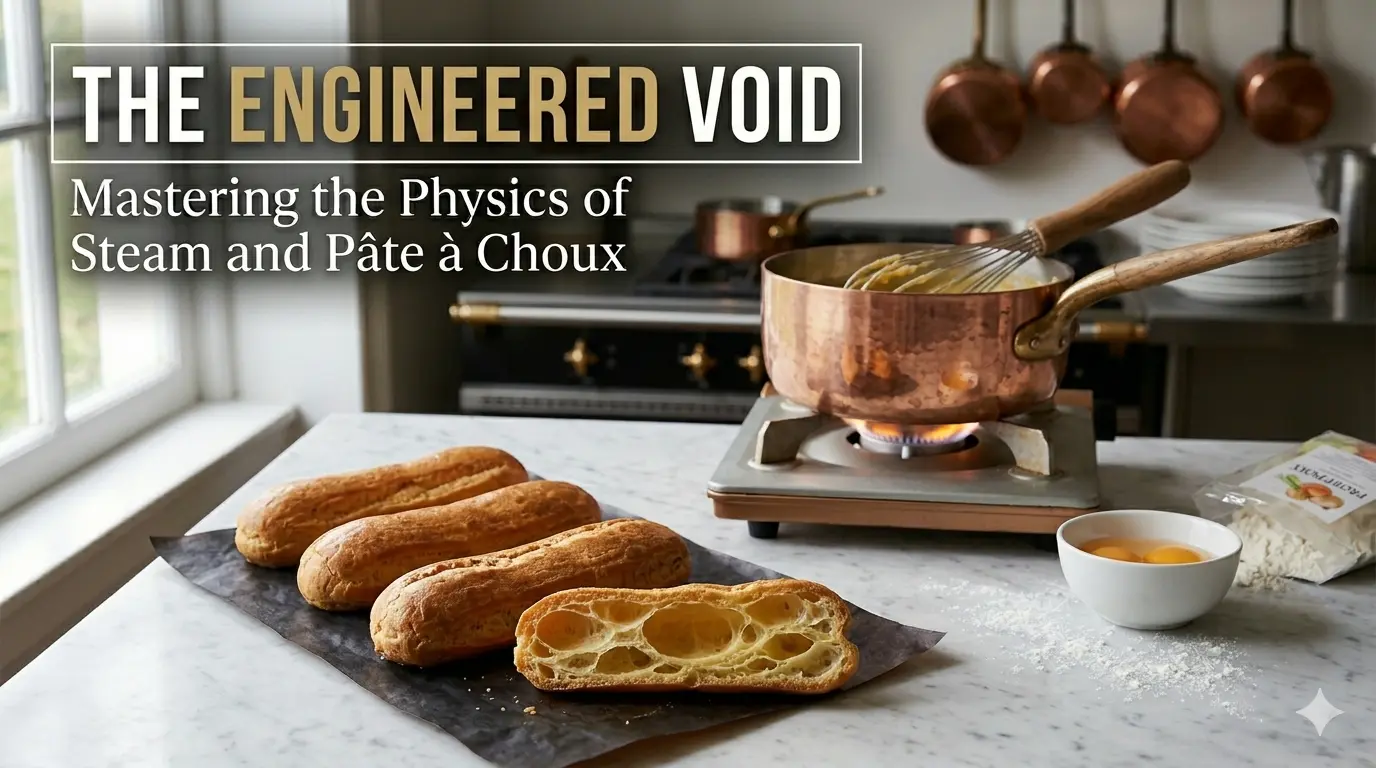
We continue our technical analysis of French pastry by moving from laminated structures to the science of internal voids. Pâte à Choux (Choux Pastry) is unique because it is the only classical dough that is cooked twice. It is not designed to be dense or flaky; it is engineered to be a hollow, structural shell. The “rise” of Choux is a violent act of thermodynamics, where internal moisture flashes into steam, inflating a flexible starch-protein matrix before it sets into a rigid form.
To master Pâte à Choux, one must understand the relationship between starch gelatinization and vapor pressure expansion.
Part 1: The Panade – The First Cook and Starch Gelatinization
The foundation of Pâte à Choux is the Panade, a mixture of water/milk, fat, and flour that is cooked on the stovetop. This first cook is not for flavor; it is for starch engineering.
The Technical Objective:
When flour is added to boiling liquid and fat, two critical chemical events occur:
- Starch Gelatinization: The high heat ($100^{\circ}C$) causes the starch granules in the flour to swell and absorb the liquid. They burst, releasing amylose and amylopectin, which create a thick, cohesive, and viscous paste.
- Moisture Evaporation: The chef must continue to cook this paste until it pulls away cleanly from the sides of the pan. This maximizes starch gelatinization and evaporates excess water, ensuring the dough is “thirsty” and ready for the critical egg incorporation. A properly cooked Panade ensures the internal matrix is strong enough to hold steam later.
Part 2: The Emulsification – Engineering Flexibility
Once the Panade has cooled slightly, whole eggs are incorporated one by one. This is the second engineering phase, where the stiff paste is transformed into a flexible, pipeable dough.
- The Starch-Egg-Fat Matrix: The eggs serve three technical functions. The water in the whites provides the eventual steam engine. The fat in the yolks adds richness and interrupts gluten formation. Crucially, the lecithin in the yolks creates a stable emulsion between the hydrated starch matrix and the fat.
- The Pipeable Consistency: The goal is a dough that is shiny and hangs from the spoon in a distinct “V” shape. This consistency is critical. If the dough is too stiff (not enough egg), it cannot expand. If it is too loose (too much egg), it will collapse before the structure sets. The chef must manually judge the hydration of the starch-egg matrix in real-time.
Part 3: The Oven Phase – Vapor Pressure and the Hollow Void
When the piped Choux paste enters a high-temperature oven ($200^{\circ}C$ to $220^{\circ}C$), the real magic—pure thermodynamics—begins.
- The Leidenfrost Inflation: The intense heat instantly flashes the water (from the milk and egg whites) trapped within the starch-protein matrix into steam. Since the exterior of the piped dough forms a slight crust almost immediately, this steam cannot escape.
- The Rapid Expansion: The steam creates intense internal vapor pressure, which aggressively inflates the flexible, gelatinized dough. The Choux expands rapidly, pushing outward and upward until the center is entirely hollow.
- Structural Setting: As the Choux reaches its maximum volume, the heat of the oven finally coagulates the egg proteins and “sets” the starch structure, turning the flexible balloon into a rigid, hollow, and golden-brown shell.
Conclusion: The Architecture of Nothing
Pâte à Choux is proof that the most complex structure can be built around a void. By engineering a cohesive gelatinized starch matrix and utilizing the explosive power of steam, the French pastry chef creates a material that is structurally sound enough to be filled with heavy creams (like in an Éclair or Profiterole), yet light enough to melt on the tongue. It is the physics of inflation—a golden, hollow shell built on thermodynamics.