
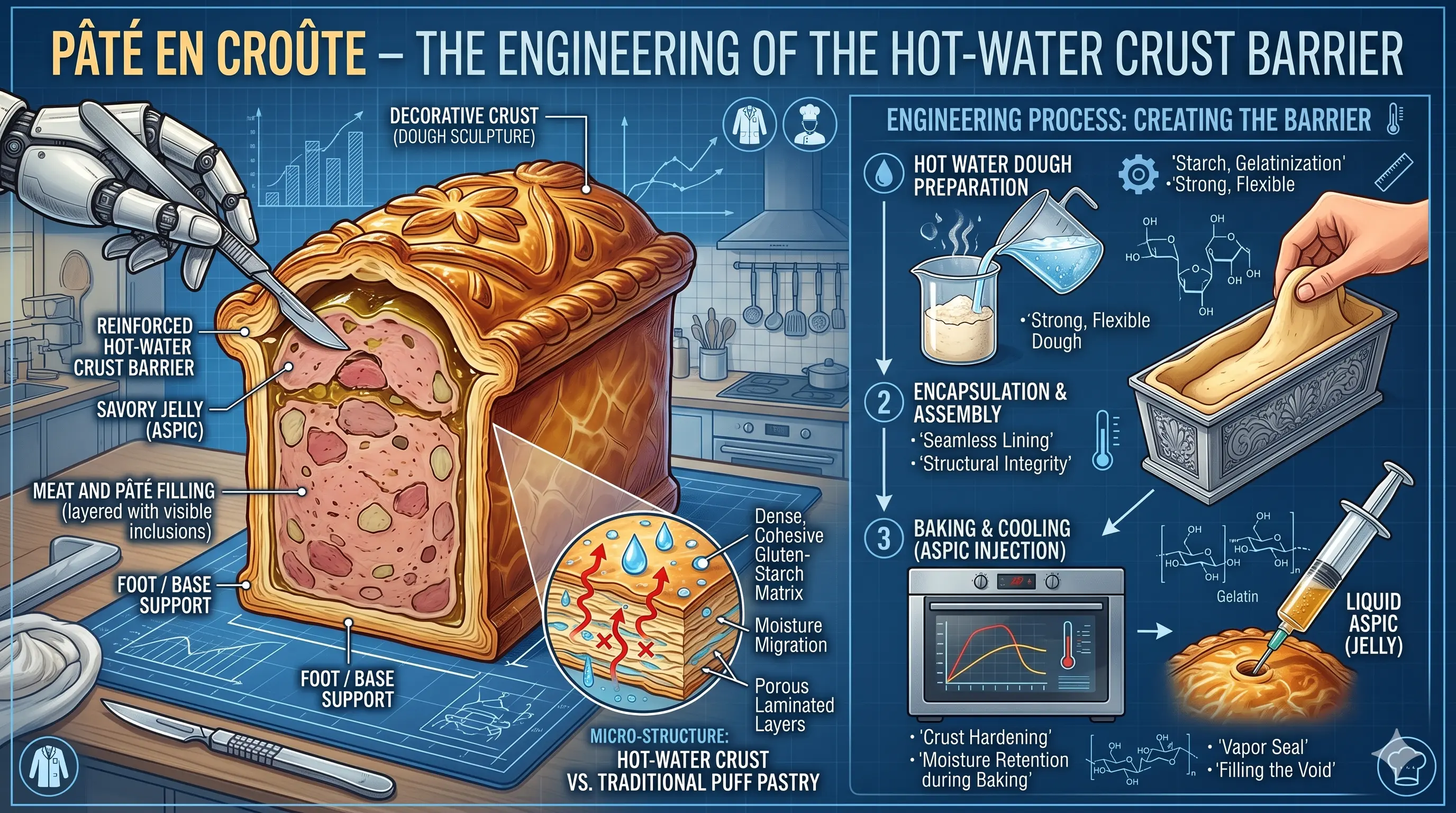
We move from the delicate, aerated worlds of macarons and soufflés to the heavy-duty structural engineering of Pâté en Croûte. This dish is a study in containment physics and moisture management. It involves a dense meat terrine encased in a robust pastry shell, often separated by a layer of savory aspic. The primary challenge is preventing the “soggy bottom” while maintaining a perfectly seasoned, cohesive meat core.
To master Pâté en Croûte, one must understand the relationship between fat-starch integration and the thermal contraction of proteins.
Part 1: The Pâte Brisée – Engineering the Structural Wall
Unlike the flaky, moisture-sensitive layers of puff pastry, the crust of a Pâté en Croûte must be a hydrophobic fortress. This is often achieved through a Hot-Water Crust or a heavily worked Pâte Brisée.
- Starch Pre-Gelatinization: By using hot water and melted fat, the starch in the flour is partially gelatinized and completely coated in lipids before the gluten network can fully develop. This creates a crust that is “short” (crumbly) but incredibly strong and resistant to moisture penetration.
- The Compression Fit: The dough is molded into a high-walled tin. It must be strong enough to support the weight of several pounds of meat during a long, slow bake without bulging or collapsing.
Part 2: The Farce – Managing Protein Contraction
The interior (the Farce) is a complex emulsion of meats, fats, and aromatics. The technical difficulty lies in what happens during the bake.
- The Shrinkage Gap: As the meat proteins (myosin and actin) cook, they denature and contract, squeezing out moisture. This inevitably causes the meat core to shrink away from the pastry walls.
- The Steam Chimney: To prevent the internal steam pressure from rupturing the crust, the chef cuts “chimneys” into the top of the pastry. These small holes allow vapor to escape, ensuring the crust stays crisp while the meat cooks.
Part 3: The Aspic Bridge – Filling the Structural Void
The final technical act occurs after the bake. The gap created by the shrinking meat is not a failure; it is a functional space.
- The Injection of Jelly: Once the pâté has cooled, the chef pours a liquid Aspic (a highly concentrated gelatin stock) through the chimneys.
- The Airtight Seal: As the aspic sets into a solid jelly, it fills the void between the meat and the crust. This serves two purposes:
- Preservation: It seals the meat from oxygen, extending its shelf life.
- Structural Integrity: It “glues” the meat to the crust, ensuring that when the pâté is sliced, the crust does not fall away from the meat.
Conclusion: The Architecture of the Encased Meat
Pâté en Croûte is the ultimate synthesis of the saucier and the pastry chef. By engineering a moisture-resistant barrier and utilizing the natural contraction of proteins to create a space for a gelatin bridge, the French chef creates a dish that is both a visual masterpiece and a triumph of structural physics.