
As we pivot from the clean, ingredient-focused geometry of Japanese Washoku, we enter the world of Classical French Technique. If Japanese cuisine is a study in extraction and purity, French cuisine is a study in saucier engineering. At its core lies the system of the five Mother Sauces (Grandes Sauces), codified by Auguste Escoffier.To master French cooking, one must understand the molecular physics of the Roux and the delicate equilibrium of the Permanent Emulsion.Part 1: The Roux – The Starch-Fat MatrixAlmost all Mother Sauces begin with a Roux. This is not just a thickener; it is a thermal-mechanical process that coat's flour’s starch granules in fat to prevent clumping.The Molecular Ratio: A standard roux is a 1:1 ratio by weight of flour to fat (usually clarified butter).The Physics of Thickening: When liquid is added to the roux, the starch granules (amylose and amylopectin) absorb the liquid and swell—a process called gelatinization. By coating the flour in fat first, the chef ensures that each granule hydrates individually, resulting in a smooth, velvet texture rather than "lumpy" soup.The Thermal Window:White Roux: Cooked just enough to remove the "raw flour" taste. High thickening power.Blond Roux: Cooked until the sugar in the flour begins to caramelize.Brown Roux: Deeply toasted. The high heat breaks down the starch chains, resulting in less thickening power but immense nutty depth (The Maillard Reaction).Part 2: The Mother Sauce TaxonomyThe five sauces are categorized by their Liquid Base and their Thickening Agent.SauceLiquid BaseThickening AgentTechnical ObjectiveBéchamelMilkWhite RouxA pure, neutral white emulsion. The base for Mornay.VeloutéWhite Stock (Chicken/Veal)Blond RouxA "velvety" savory sauce focusing on the clarity of the stock.EspagnoleBrown Stock (Roasted Veal)Brown Roux + MirepoixIntense reduction and Maillard complexity. The base for Demi-Glace.HollandaiseClarified ButterEgg Yolk (Emulsification)A fragile, warm biological emulsion of fat and water.TomateTomatoes/StockRoux (Traditional) or ReductionAcid management and lycopene concentration.Part 3: Hollandaise – The Biological EmulsificationHollandaise is the outlier. It does not use a roux; it uses thermal-mechanical emulsification. It is the most technically "fragile" sauce in the French repertoire.The Lecithin Bridge: Egg yolks contain Lecithin, a phospholipid that is both hydrophilic (water-loving) and lipophilic (fat-loving). It acts as the "glue" that allows clarified butter and lemon juice to merge into a single phase.The Temperature Tightrope:Below $45^{\circ}C$: The butter solidifies, and the sauce "breaks."Above $65^{\circ}C$: The egg proteins coagulate (scramble), destroying the emulsion.The Technical Solution: A Bain-Marie (water bath) is used to maintain a stable, sub-simmering environment, allowing the chef to whisk air and fat into the yolks to create a stable, aerated foam.Conclusion: The Saucier’s FoundationFrench cuisine is a modular system. By mastering the five Mother Sauces, a chef gains the ability to create hundreds of "daughter sauces" (Sauces Petites) simply by altering the aromatics or seasonings. It is a system built on the structural integrity of the roux and the biological precision of the emulsion.

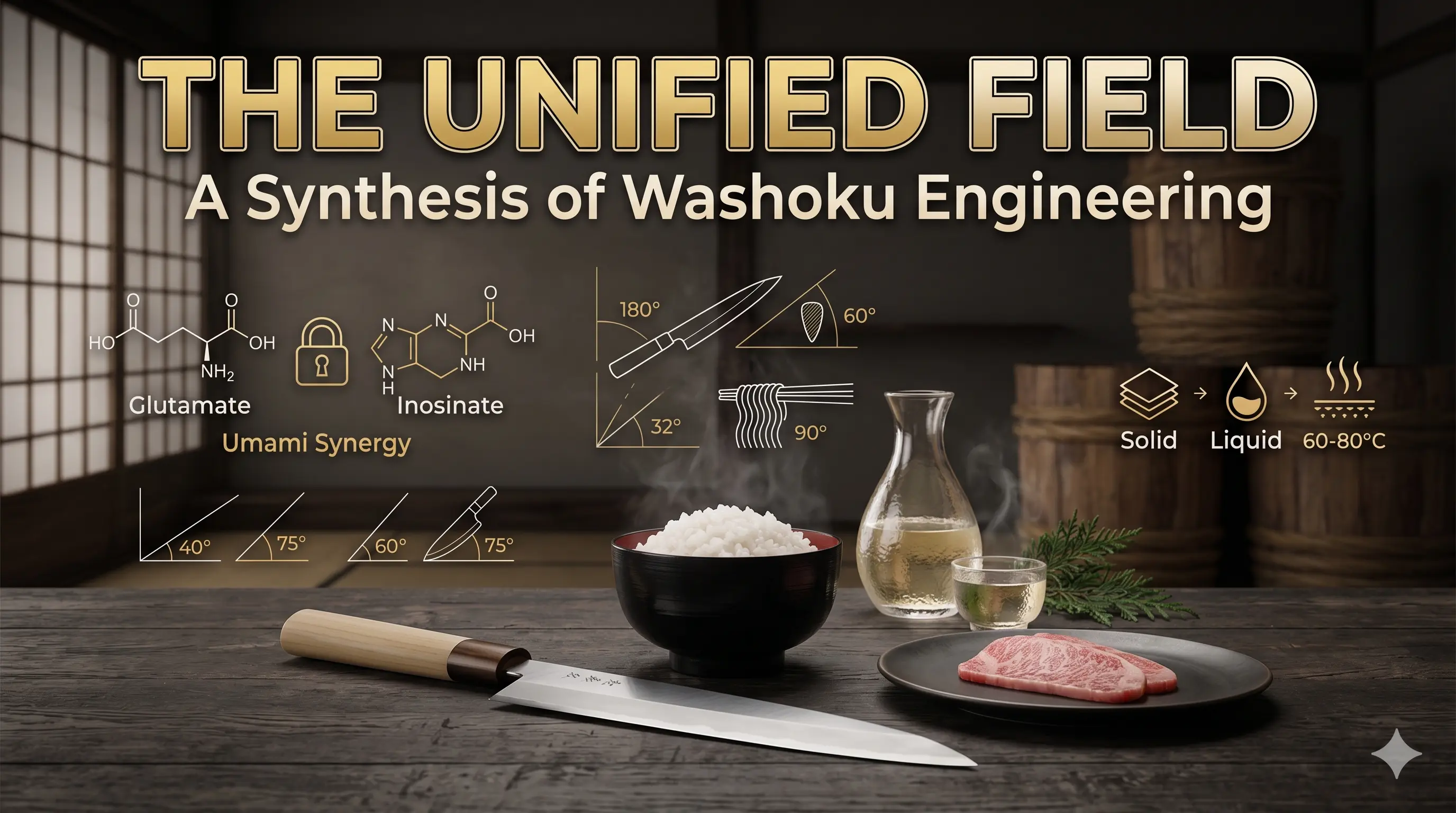
We have spent 35 articles dissecting the Japanese culinary system into its constituent parts: the metallurgy of the blade, the microbial dance of the fermentation tank, and the fluid dynamics of the stockpot. To conclude this masterclass, we must move from the microscopic to the macroscopic. Washoku is not a collection of recipes; it is a Unified Field Theory of Culinary Engineering where Chemistry, Geometry, and Thermal Management intersect to create a stable, reproducible system of excellence.

This final article synthesizes these three pillars into a single mental framework for the master craftsman.

Pillar 1: The Chemistry of Umami and Enzyme Management

The primary objective of Japanese chemistry is the liberation of amino acids.

  • Synergistic Locking: As established in Article 14, the core of the system is the $1+1=8$ multiplier. By locking Glutamate (from Kombu) with Inosinate/Guanylate (from Katsuobushi or Shiitake), the chef creates a molecular foundation that allows for extreme flavor depth without the need for heavy fats or spices.
  • The Enzymatic Guard: Whether it is the Protease in Miso (Article 21) or the Amylase in Koji (Article 30), the Japanese chef treats heat not just as a cooking tool, but as a biological switch. Staying within specific “safe zones” ($60^{\circ}C$ to $80^{\circ}C$) ensures that the living enzymes continue to refine flavor until the moment of consumption.

Pillar 2: The Geometry of Surface Area and Precision

In the Japanese system, Form dictates Flavor.

  • The Single-Bevel Logic: The geometry of the Kataba knife (Article 16) is designed for a single goal: the preservation of the cell wall. By shearing through cells at a $15^{\circ}$ angle rather than crushing them, the chef prevents the oxidation of minerals and the leakage of umami-rich fluids.
  • Interstitial Dynamics: From the air gaps in a Nigiri (Article 15) to the square cross-section of a Soba noodle (Article 33), geometry is used to manage surface-area-to-volume ratios. This determines exactly how much sauce adheres to a noodle or how quickly rice “scatters” on the tongue.

Pillar 3: Thermal Management and Phase Changes

Washoku is a study in Phase Transitions—moving substances between solid, liquid, and colloidal states.

  • Forced vs. Natural Emulsions: The difference between a clear Chintan and a cloudy Paitan (Article 25) is purely a matter of kinetic energy and thermal control.
  • The Steam-Fry Paradox: Tempura (Article 19) is not a frying technique; it is a high-speed steam-injection technique. The “fry” is merely the engineering of the thermal shell that allows the internal moisture to undergo a phase change into steam, cooking the ingredient from the inside out in seconds.

Conclusion: The Path of the Shokunin

To be a Shokunin (master craftsman) is to understand that the “soul” of a dish is actually the perfect alignment of these technical variables. When the water ratio of the rice, the angle of the blade, the temperature of the dashi, and the negative space of the plate are all in equilibrium, the result is a meal that feels effortless.

This series has provided you with the blueprint. You no longer see a bowl of soup or a piece of fish; you see a complex, beautiful, and highly engineered system. The technical journey of Washoku ends here, but your application of these principles is just beginning.


Writer - Daniel Carter

Daniel Carter

Daniel Carter is a Seattle-based food writer specializing in sushi, poke, and modern Japanese dining. With over seven years of experience reviewing local restaurants, he provides clear, unbiased insights to help diners understand menus, pricing, portion quality, and overall value. His straightforward writing style makes sushi easy to enjoy for both first-time visitors and regulars.

Leave a Comment