
We move from the liquid purities of the consommé to the structural complexities of French pastry. Pâte Feuilletée (Puff Pastry) is the ultimate study in lamination physics. It is a composite material engineered to consist of hundreds of alternating, microscopic layers of dough and fat. When subjected to intense thermal energy, these layers undergo a massive mechanical expansion, transforming a dense block of dough into a light, shattered-glass structure.To master Puff Pastry, one must understand the relationship between Water Activity ($a_w$) and the Physical Barrier Effect of cold lipids.Part 1: The Détrempe and the Beurrage – Creating the CompositePuff Pastry is not a mixture; it is a stratified stack. It begins as two distinct components:The Détrempe: A lean dough made of flour and water. Its technical purpose is to provide the structural gluten matrix.The Beurrage: A block of high-fat, pliable butter. Its purpose is to act as a physical separator.The Engineering Goal:The objective is to encase the butter within the dough and then perform a series of "turns" (folding and rolling). Each turn exponentially multiplies the number of layers. A standard "six-turn" puff pastry technically contains $729$ layers of butter separated by $730$ layers of dough.Part 2: The Leidenfrost Effect – The Engine of the RiseThe "puff" in puff pastry is not caused by yeast or chemical leaveners; it is an act of pure steam-driven mechanical engineering.Moisture Migration: The dough layers contain water. When the pastry enters a high-temperature oven ($200^{\circ}C$), the water in the dough layers flashes into steam.The Lipid Barrier: Because the butter layers have a high fat content, they are hydrophobic. Steam cannot pass through fat. Therefore, as the steam expands, it is trapped beneath the butter layer, physically lifting the dough layer above it.The Vertical Expansion: This process happens simultaneously across all $1,459$ layers. The result is a vertical lift that can increase the volume of the dough by over $10$ times its original height.Part 3: The Plasticity Window – Managing the "Smear"The primary technical failure in Puff Pastry is thermal leakage.The Temperature Threshold: If the butter becomes too warm ($>24^{\circ}C$), it loses its solidity and begins to soak into the dough layers. This destroys the lamination, turning the composite into a simple "shortcrust" dough that will not rise.The Gluten Tension: Conversely, if the dough is worked too quickly without "rest" periods, the gluten becomes too elastic and will shrink or deform during baking.The Solution: Constant refrigeration between turns to maintain the butter's plasticity—the state where it is soft enough to roll but solid enough to remain a distinct layer.Conclusion: The Architecture of the CrunchPâte Feuilletée is proof that texture is a product of geometry. By engineering hundreds of moisture-rich barriers separated by fat, the French pastry chef creates a material that utilizes the power of steam to build its own internal architecture. It is the height of culinary lamination—a fragile, golden tower of physics.

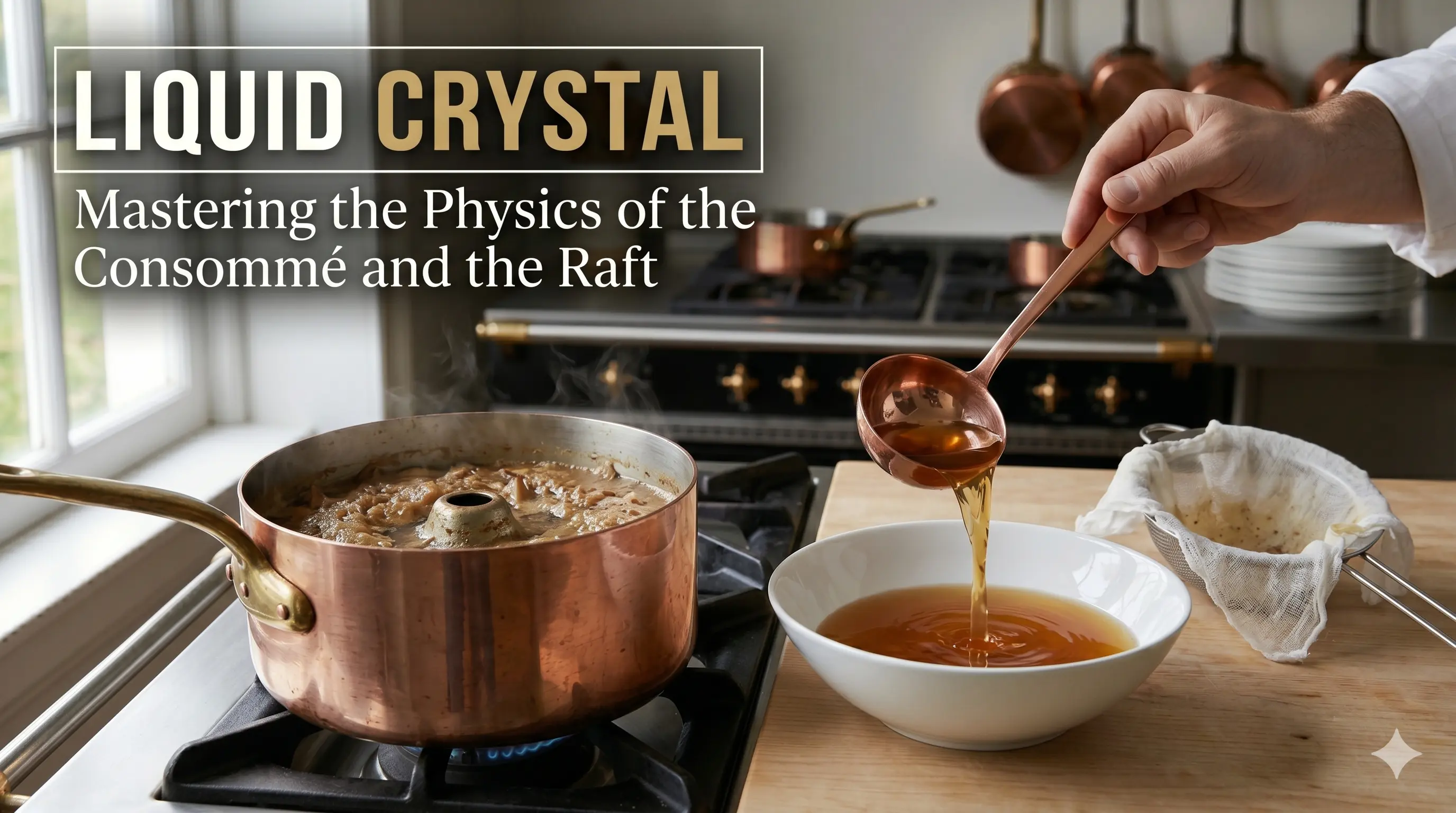
In classical French cuisine, the Consommé is the ultimate expression of technical purity. It is not merely a strained soup; it is a clarified essence achieved through a unique biological filtration system known as the “Raft.” This process utilizes the thermal coagulation properties of egg proteins and the physical principles of particle entrapment to transform a cloudy stock into a liquid that is as clear as amber glass.

To master the Consommé, one must understand the relationship between soluble proteins and the convection currents of a “lazy” simmer.

Part 1: The Clarification Mixture – Engineering the Filter

The transformation of a stock into a consommé requires a specific mixture of cold ingredients, which will eventually form the filtration “Raft.”

  • The Protein Anchor: Large amounts of lean ground meat (usually beef or poultry) provide flavor and additional soluble proteins.
  • The Coagulant: Egg whites (albumen) are the critical technical component. When cold, they are liquid and can be mixed evenly into the stock.
  • The Acid Catalyst: A small amount of acid (tomato or lemon) helps to denature the egg proteins more effectively as the temperature rises.
  • The Mirepoix: Finely minced vegetables are added to provide a secondary physical matrix for the filter.

Part 2: The Formation of the “Raft” – Biological Entrapment

The technical magic of the consommé occurs as the stock is slowly heated.

  • Convection and Coagulation: As the temperature crosses $60^{\circ}C$, the egg whites begin to coagulate. Because they were whisked into the liquid, they rise to the surface as they harden, forming a thick, sponge-like disk—the Raft.
  • Microscopic Filtration: Convection currents in the pot force the cloudy stock to circulate through the porous Raft. The coagulated egg proteins act like a microscopic “sticky” web, physically trapping every impurity, sediment particle, and fat molecule that passes through it.
  • The “Chimney” Effect: A small hole is poked in the center of the Raft. This acts as a chimney, allowing the chef to monitor the liquid’s clarity and ensuring that the pressure from steam doesn’t rupture the fragile protein filter.

Part 3: The Result – Refractive Clarity and Viscosity

A successful consommé is judged on two technical metrics: Refractive Index and Collagen Density.

  • Optical Purity: The liquid must be so clear that the pattern on the bottom of a deep bowl is perfectly visible. This indicates that the Raft has successfully removed all suspended solids.
  • The Mouthfeel Paradox: Despite its watery appearance, a consommé should feel “thick” on the tongue. This is due to the high concentration of gelatin (hydrolyzed collagen) preserved from the original stock.
  • The Final Degreasing: Even after the Raft is removed, the chef performs a final “depuration” by passing the liquid through a Chinois lined with damp cheesecloth to remove any remaining microscopic oil droplets.

Conclusion: The Mastery of Transparency

The Consommé is proof that technical perfection is often about what is removed rather than what is added. By engineering a biological “Raft” filter and managing the delicate convection of a simmer, the French chef creates a liquid that is chemically intense yet visually non-existent. It is the height of culinary refinement—a pure, golden extract of flavor and physics.


Writer - Daniel Carter

Daniel Carter

Daniel Carter is a Seattle-based food writer specializing in sushi, poke, and modern Japanese dining. With over seven years of experience reviewing local restaurants, he provides clear, unbiased insights to help diners understand menus, pricing, portion quality, and overall value. His straightforward writing style makes sushi easy to enjoy for both first-time visitors and regulars.

Leave a Comment