
Introductory sub headline

This is placeholder text which will be replaced by your content. Lorem ipsum amet elit morbi dolor tortor. Vivamus eget mollis nostra ullam corper. Pharetra torquent auctor metus felis nibh velit tellus semper taciti nostra. Semper pharetra montes habitant congue integer magnis nulla.
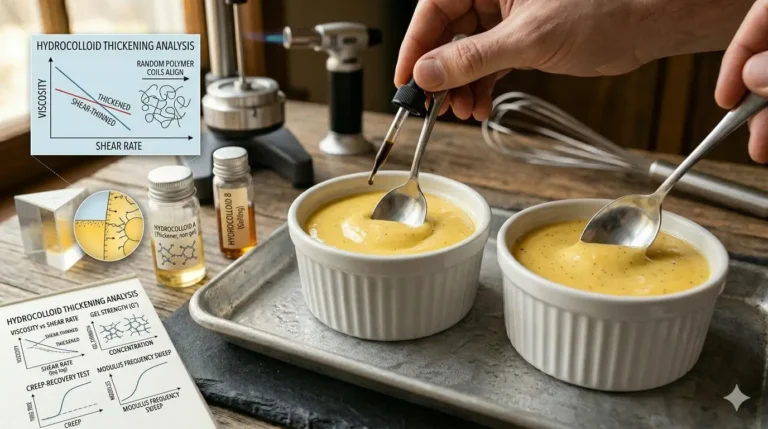
Hydrocolloid Thickening – The Physics of Shear-Thinning and Gel Strength

April 27, 2026

Hydrocolloid Thickening – The Physics of Shear-Thinning and Gel Strength

In the final stages of our molecular exploration, we move from extreme temperatures to the rheology of fluids. In modern gastronomy,...

Read More
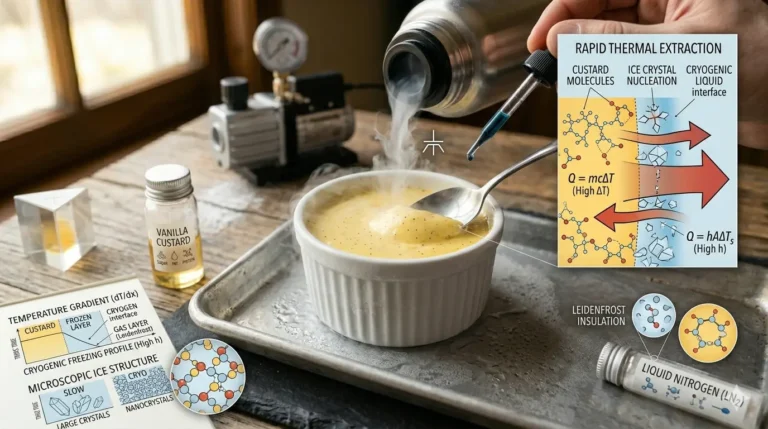
Cryogenic Cooking – The Physics of Rapid Thermal Extraction

April 27, 2026

Cryogenic Cooking – The Physics of Rapid Thermal Extraction

We transition from molecular bonding to the extreme frontier of thermal thermodynamics. Liquid Nitrogen ($LN_2$), with a boiling point of $-196^{\circ}C$,...

Read More
generate 16:9 ratio featured image for this artivle

April 27, 2026

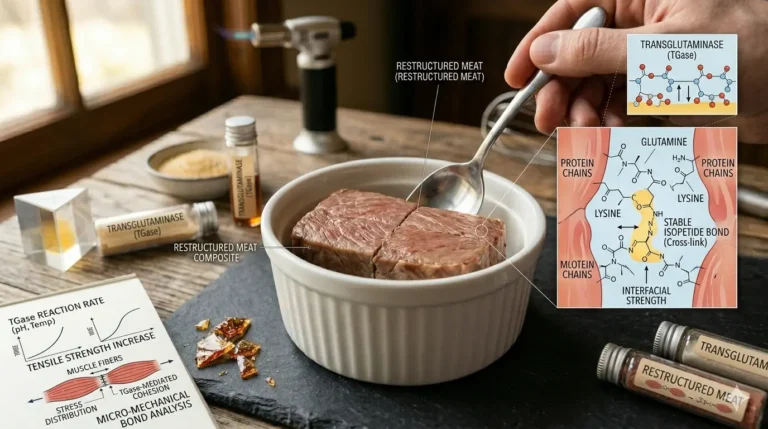
Transglutaminase – The Engineering of the “Meat Glue” Barrier

We move from the ethereal physics of foams to the mechanical world of structural protein bonding. Transglutaminase (TG), colloquially known as...

Read More
We move from the ethereal physics of foams to the mechanical world of structural protein bonding. Transglutaminase (TG), colloquially known as "Meat Glue," is an enzyme that catalyzes the formation of covalent bonds between the amino acids lysine and glutamine. In modern gastronomy, TG is used to engineer entirely new protein geometries, allowing the chef to fuse disparate pieces of meat into a single, seamless muscle mass or to create "meat noodles" without the use of starch.To master Transglutaminase, one must understand the relationship between enzyme kinetics and covalent cross-linking.Part 1: The Molecular Staple – How TG WorksUnlike traditional "binding" agents like eggs or starch, which act as a sticky physical glue, Transglutaminase operates at the molecular level.The Covalent Bond: TG facilitates a chemical reaction that creates a peptide bond. This is one of the strongest bonds in nature. Once the bond is formed, it is thermally stable; it will not melt or break even if the meat is later cooked to high temperatures ($100^{\circ}C+$).The Protein Requirement: For TG to work, the proteins must be "available." This usually requires a light dusting of the enzyme powder on the surfaces of raw meat. The reaction begins the moment the enzyme bridges the gap between two protein chains.Part 2: Structural Engineering – The "Meat Mosaic"The primary application of TG is the creation of uniform, high-yield portions from irregular cuts.Reconstituted Anatomy: A chef can take several small beef tenderloins, coat them in TG, wrap them tightly in plastic film (creating hydrostatic pressure), and refrigerate them. After 4 to 12 hours, the individual pieces fuse into a single, solid cylinder. When sliced, the "seams" are invisible, and the meat behaves as if it grew as a single muscle.Hybrid Proteins: TG allows for the fusion of different species. A chef can bond a sheet of salmon to a sheet of sea bass, or wrap a chicken breast in a layer of bacon so tightly that the bacon never unravels during the sear.Part 3: The Kinetics of Setting – Time and TemperatureThe "bond strength" of TG is a function of the enzyme's active window.The Cold-Set: Most TG applications are done in the refrigerator ($4^{\circ}C$). At this temperature, the enzyme works slowly, allowing for a precise 12-hour "set."The Thermal Inactivation: Like all enzymes, TG is a protein itself. If the meat is heated above $65^{\circ}C$ before the bonds have fully formed, the enzyme will denature and become inactive, and the bond will fail. However, once the bonds are formed, they are permanent.Safety and Hygiene: Because TG bonds raw meat surfaces together, any surface bacteria can be trapped inside the newly formed muscle. Professional engineering requires meticulous sanitation of the meat surfaces before bonding to ensure food safety.Conclusion: Redefining Protein GeometryTransglutaminase is proof that the "natural" shape of an ingredient is just a suggestion. By utilizing enzymatic covalent bonding, the modern chef becomes a biological architect, capable of restructuring protein into any form required for the dish. It is the physics of permanent adhesion—a way to build a better steak through molecular chemistry.

April 27, 2026

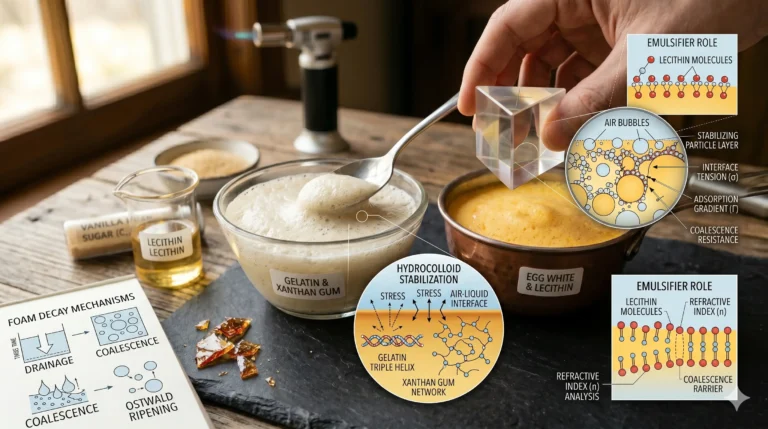
Culinary Foams – The Stabilization of Atmospheric Gels

If spherification is about encapsulating liquids, culinary foams are about the structural capture of air. In modern gastronomy, a foam is...

Read More
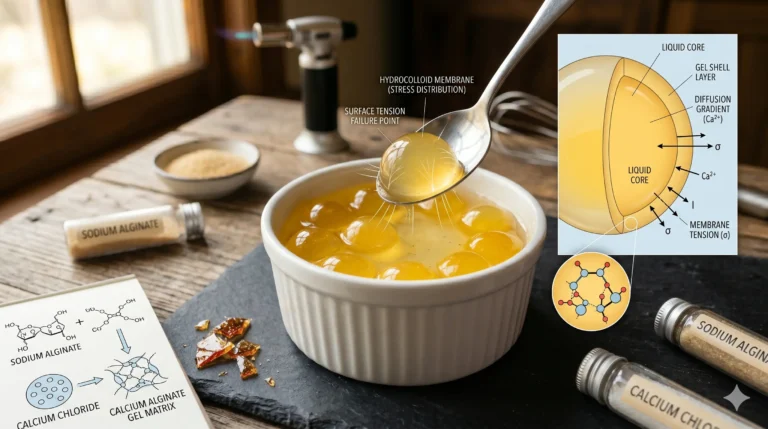
If spherification is about encapsulating liquids, culinary foams are about the structural capture of air. In modern gastronomy, a foam is not just a bubble; it is a colloidal dispersion where gas is the internal phase and a flavored liquid is the continuous phase. While a classical French mousse relies on heavy fats and proteins to hold air, modern foams use hydrocolloids and surfactants to create stable, ethereal textures that vanish on the tongue, leaving only the concentrated essence of the flavor.To master culinary foams, one must understand the relationship between surface tension reduction and interfacial rheology.Part 1: The Surfactant – Engineering the Bubble WallA bubble of air in pure water will collapse instantly because the surface tension of the water is too high. To create a stable foam, the chef must introduce a surfactant—a molecule that lowers surface tension.Soy Lecithin: The most common modern foaming agent. Like the lecithin in egg yolks used for Hollandaise, soy lecithin has a dual-ended molecular structure. In a foam, the hydrophobic tails point into the air bubble, while the hydrophilic heads stay in the liquid.The "Air" Technique: By using a handheld immersion blender at the surface of a lecithin-rich liquid, the chef incorporates air. The lecithin molecules instantly coat these air pockets, creating a monomolecular film that prevents the bubbles from merging and popping.Part 2: The Structural Matrix – Gels vs. EmulsionsWhile lecithin creates "airs" (very light, temporary foams), more robust foams require a more viscous continuous phase to slow down drainage (the liquid flowing out from between the bubbles).Xanthan Gum and Fluid Gels: By adding a minute amount of Xanthan gum ($0.1\% - 0.5\%$), the chef increases the viscosity of the liquid. This "traps" the air bubbles in a thick, shear-thinning matrix. This creates a "heavy" foam or a "syphon foam" that can hold its shape for minutes or even hours.The Siphon (N2O): In a whipping siphon, the liquid is pressurized with Nitrous Oxide ($N_2O$). Under pressure, the gas dissolves into the liquid. When the trigger is pulled, the sudden drop in atmospheric pressure causes the gas to rapidly expand and exit the liquid, inflating the structural matrix from the inside out.Part 3: The Thermal Variable – Hot vs. Cold FoamsThe stability of a foam is a race against temperature and evaporation.Cold Foams: Typically stabilized by fats (cream) or gelatin. These rely on the solid-phase setting of the stabilizer to hold the air.Hot Foams: These require stabilizers that do not melt at high temperatures. Methylcellulose is the engineer’s choice here; unlike gelatin, it actually sets into a gel when heated. A methylcellulose foam can be served on top of a hot steak or soup without collapsing into a puddle.Conclusion: The Physics of Flavor DensityCulinary foams prove that volume does not equal weight. By manipulating surface tension and using hydrocolloids to manage drainage, the modern chef can transform a heavy sauce into a cloud-like texture. It is the physics of aeration—a method of delivering intense flavor while occupying minimal mass.

April 27, 2026

Spherification – The Physics of the Hydrocolloid Membrane

As we transition from Classical French technique into the realm of Molecular Gastronomy, we begin with the most iconic modern technique:...

Read More
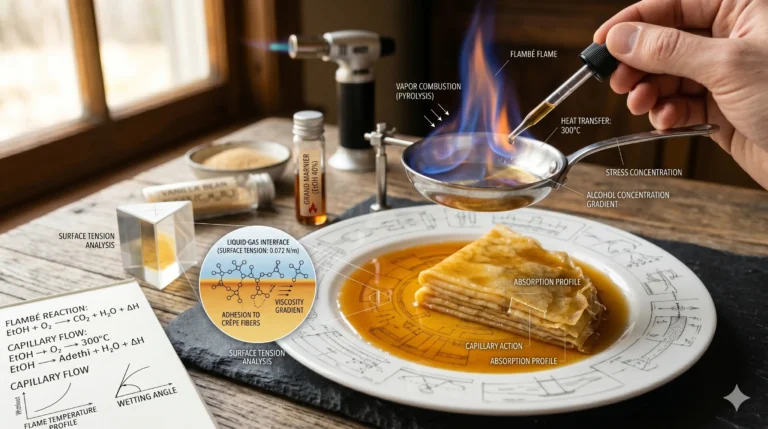
Crêpe Suzette – The Physics of the Flambé and Surface Tension

April 26, 2026

Crêpe Suzette – The Physics of the Flambé and Surface Tension

We conclude this technical series with the Crêpe Suzette, a dish that represents the transition of French cooking from the kitchen...

Read More
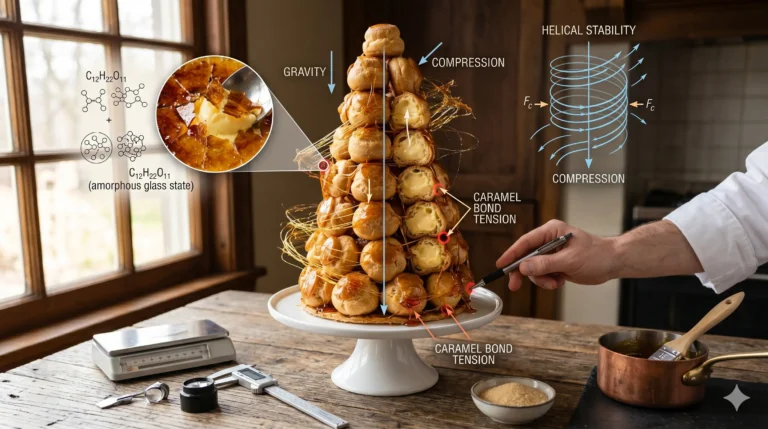
The Croquembouche – The Structural Physics of the Caramel-Bonded Tower

April 26, 2026

The Croquembouche – The Structural Physics of the Caramel-Bonded Tower

We transition from the fluid dynamics of sauces to the architectural engineering of the Croquembouche. Traditionally served at French weddings and...

Read More

We transition from the fluid dynamics of sauces to the architectural engineering of the Croquembouche. Traditionally served at French weddings and baptisms, this centerpiece is a cone-shaped tower of cream-filled Pâte à Choux puffs. It is not held together by frosting or cream; it is bonded by hard-crack stage sucrose, utilizing the principles of tensile strength and thermal adhesion to defy gravity.To master the Croquembouche, one must understand the relationship between sugar glass transition and structural load distribution.Part 1: The Adhesive – Engineering the Hard-Crack BondThe "glue" of the Croquembouche is sucrose cooked to the Hard-Crack stage ($150^{\circ}C$ to $155^{\circ}C$). At this precise temperature, almost 100% of the water has evaporated.The Thermal Window of Adhesion: The chef must work within a narrow cooling window. While the sugar is molten, it acts as a liquid adhesive with high surface tension. As it cools below $130^{\circ}C$, it transitions into a rigid, amorphous solid (glass).The Bond Geometry: Each choux puff is dipped into the hot sugar and placed against its neighbors. The sugar creates a "bridge" between the curved surfaces. Once hardened, these bridges provide the compressive strength necessary to support the weight of the layers above.Part 2: The Conical Geometry – Distributing the LoadA Croquembouche is essentially a self-supporting masonry dome. Its stability relies on its conical shape.The Inward Lean: By building the puffs in concentric circles that decrease in diameter as they rise, the chef shifts the center of gravity inward. This ensures that the weight of the upper puffs pushes down and into the structure rather than outward.The Foundation Layer: The bottom ring of puffs must be perfectly level and securely bonded to the base (often a Nougatine disc). Any irregularity at the base is magnified as the tower rises, leading to structural lean or "toppling" failure.Part 3: The Threat of Humidity – Hygroscopic FailureThe greatest enemy of the Croquembouche is not gravity, but atmospheric moisture.Hygroscopy: Sugar in its glass state is highly hygroscopic, meaning it actively attracts water molecules from the air.The Plasticity Shift: As the sugar bonds absorb moisture, they transition from a brittle glass back into a soft, sticky syrup. This loss of rigidity causes the structural "bridges" to fail. In high humidity, a perfectly engineered Croquembouche can undergo a total structural collapse in under an hour as the adhesive turns back into a liquid.Conclusion: Architecture in SugarThe Croquembouche is proof that pastry is a form of civil engineering. By utilizing the phase changes of sucrose to create high-strength adhesive bonds and employing conical geometry to manage load distribution, the French chef builds a monument that is as much a triumph of physics as it is of flavor.

April 26, 2026

Hollandaise – The Physics of the Unstable Emulsion

If the Brown Stock is the foundation, then Hollandaise is the high-wire act of French saucery. It is a warm fat-in-water...

Read More
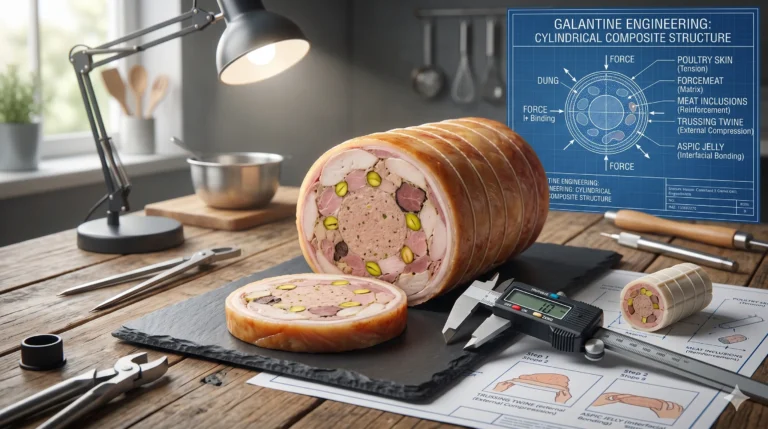
The Galantine – The Engineering of the Cylindrical Meat Composite

April 26, 2026

The Galantine – The Engineering of the Cylindrical Meat Composite

We move from the delicate thermal management of desserts to the advanced structural deconstruction of the Galantine. In the hierarchy of...

Read More
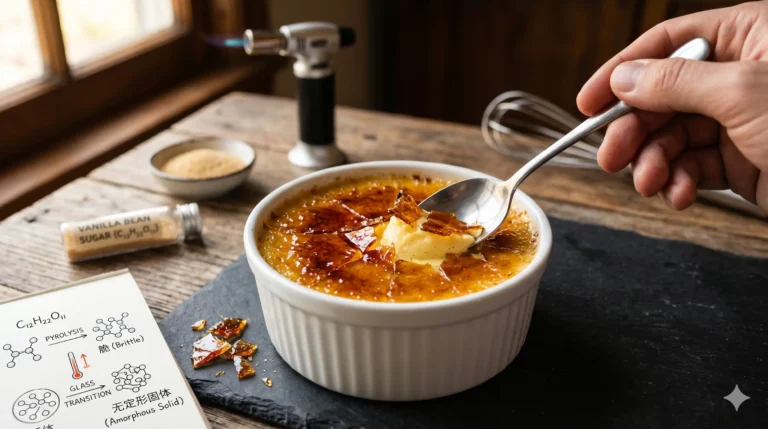
Crème Brûlée – The Physics of the "Sugar Glass" Barrier

April 26, 2026

Crème Brûlée – The Physics of the “Sugar Glass” Barrier

We transition from the structural containment of meats to the thermodynamic management of dairy and glucose. Crème Brûlée is a study...

Read More
Back Next

Sign up for our email list

This is placeholder text which will be replaced by your content.

Email Address

Sign Up

*Replace this mock form with your preferred form plugin