
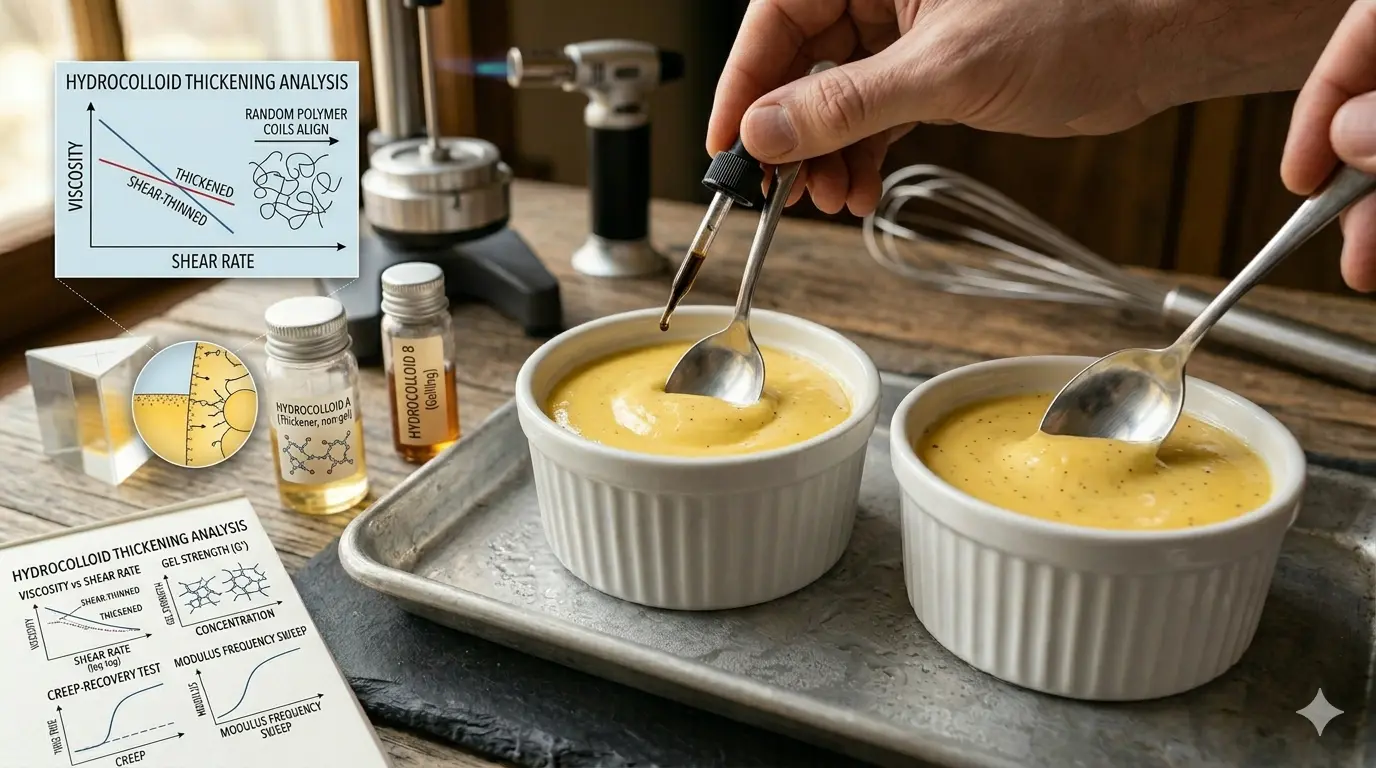
In the final stages of our molecular exploration, we move from extreme temperatures to the rheology of fluids. In modern gastronomy, the goal of thickening is no longer just “adding body” (as with a flour-based roux); it is about precision viscosity management. By using specific hydrocolloids like Xanthan Gum and Gellan Gum, a chef can engineer liquids that behave like solids when at rest but flow like water when moved—a property known as shear-thinning.
To master modern thickening, one must understand the relationship between polysaccharide entwinement and fluid yield stress.
Part 1: Xanthan Gum – The King of Shear-Thinning
Xanthan gum is a high-molecular-weight polysaccharide produced through fermentation. It is the industry standard for creating “stable suspensions.”
- The “Net” Effect: In a liquid, Xanthan molecules form a complex, tangled network. This network is strong enough to hold solid particles (like herbs or spices) in permanent suspension, preventing them from sinking or floating.
- Shear-Thinning (Pseudoplasticity): Xanthan is highly sensitive to physical force. When you whisk it or pour it, the tangled molecular chains align themselves in the direction of the flow, causing the viscosity to drop instantly. This allows a thick sauce to feel light and “clean” on the palate rather than heavy or pasty.
- Synergy: Xanthan is often used in combination with other gums (like Locust Bean Gum) to create elastic gels that neither ingredient could produce alone.
Part 2: Gellan Gum – Engineering the “Fluid Gel”
While Xanthan manages viscosity, Gellan Gum is used to manage gel architecture. Gellan is capable of creating gels that are incredibly clear and thermally stable (some won’t melt even at $100^{\circ}C$).
- High-Acyl vs. Low-Acyl: * High-Acyl Gellan creates soft, elastic, opaque gels.
- Low-Acyl Gellan creates firm, brittle, transparent gels.
- The Fluid Gel Technique: This is a hallmark of modern plating. A chef creates a solid Gellan gel, then shears it (blends it) into a smooth, pipeable paste. Because of Gellan’s high yield stress, the resulting “fluid gel” holds its exact shape on the plate but has the mouthfeel of a silky cream.
Part 3: The Concentration Variable – Engineering Mouthfeel
The technical failure in modern thickening is “over-stabilization,” which results in a “slimy” or “snotty” texture.
- The 0.1% Threshold: Most modern hydrocolloids are effective at extremely low concentrations (typically $0.1\%$ to $0.8\%$ of total weight).
- Clarity and Refraction: Unlike starch, which turns liquids opaque, hydrocolloids allow for total transparency. This is vital for maintaining the visual “Liquid Crystal” standard of a high-end consommé or fruit extract.
Conclusion: The Physics of the Pour
Hydrocolloid thickening proves that texture is a tunable variable. By selecting the right polymer and managing its shear-thinning properties, the modern chef can engineer a sauce that is visually stunning, structurally stable, and texturally weightless. It is the science of fluid architecture.