
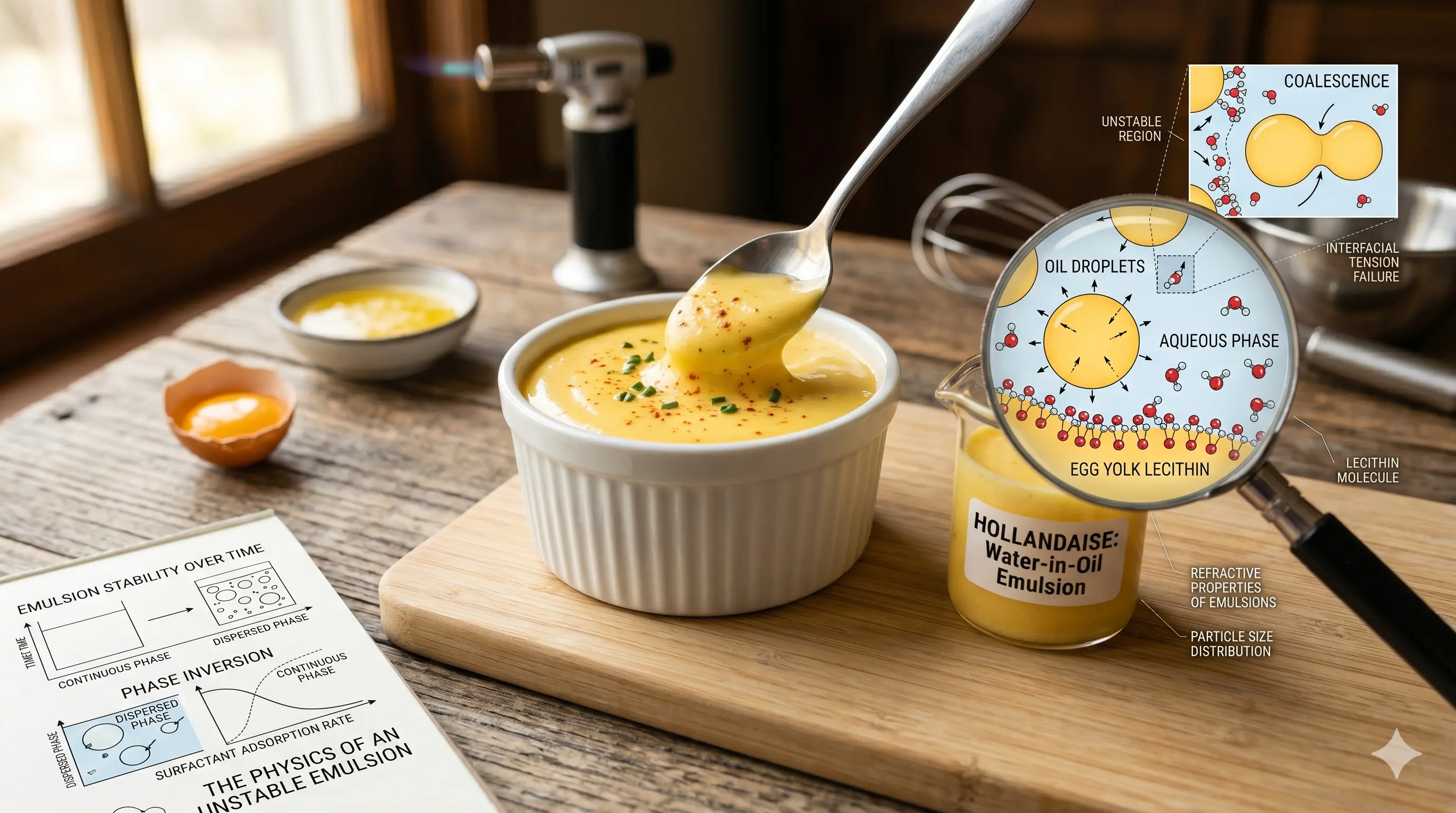
If the Brown Stock is the foundation, then Hollandaise is the high-wire act of French saucery. It is a warm fat-in-water emulsion, a technical paradox where two naturally repellent substances—clarified butter and lemon juice—are forced into a stable, velvety bond using egg yolks as the biological mediator.
To master Hollandaise, one must understand the hydrophobic-hydrophilic balance and the critical thermal failure point of lecithin.
Part 1: The Emulsifier – Lecithin and the Molecular Bridge
At the center of this physics experiment is the egg yolk. Yolks contain lecithin, a phospholipid with a unique molecular geometry: a hydrophilic (water-loving) head and a hydrophobic (fat-loving) tail.
- The Mechanical Shear: By whisking the yolks with an acidic reduction (vinegar or lemon juice), the chef creates a foam of microscopic air bubbles and water droplets.
- The Bridge Formation: When the clarified butter is added, the lecithin molecules position themselves at the interface. The tails “grab” the tiny fat globules, while the heads anchor them into the water-based liquid. This prevents the fat droplets from coalescing back into a greasy slick.
Part 2: The Lipid Variable – Why Clarified Butter?
In professional Hollandaise, whole butter is rarely used. Instead, chefs use Clarified Butter (pure milk fat).
- Removal of the “Interfering” Solids: Whole butter contains water and milk solids. These can introduce unpredictable variables into the emulsion’s viscosity. By using pure lipid, the chef has total control over the ratio of fat to water.
- The Saturation Point: There is a limit to how much fat a single egg yolk can hold. Typically, one yolk can emulsify about 50g to 75g of butter. Exceeding this “saturation point” causes the emulsion to collapse, as there are no longer enough lecithin “bridges” to hold the fat globules apart.
Part 3: The Thermal Tightrope – Managing Coagulation
The most difficult aspect of Hollandaise is that it must be served warm, yet heat is its greatest enemy.
- The Kinetic Energy of Whisking: The chef uses a Bain-Marie to gently heat the yolks. Heat increases the kinetic energy, helping the lecithin to wrap around the fat droplets more quickly.
- The Breakdown Threshold: If the sauce exceeds $62^{\circ}C$ to $65^{\circ}C$, the egg proteins in the yolks will coagulate (scramble). Once the proteins harden, they lose their ability to hold the fat in suspension. The sauce “breaks,” turning into a grainy mess of cooked eggs and yellow oil.
- The Cold Break: Conversely, if the sauce becomes too cold, the butter begins to solidify, causing the emulsion to tear. Hollandaise exists in a narrow $15$-degree thermal window.
Conclusion: The Mastery of Suspension
Hollandaise is proof that flavor is a function of stability. By utilizing mechanical shear to create micro-droplets and managing the thermal limits of phospholipids, the French chef creates a sauce that is technically “broken” but visually and texturally seamless. It is the height of culinary fluid dynamics—a delicate balance of fat, acid, and heat.