
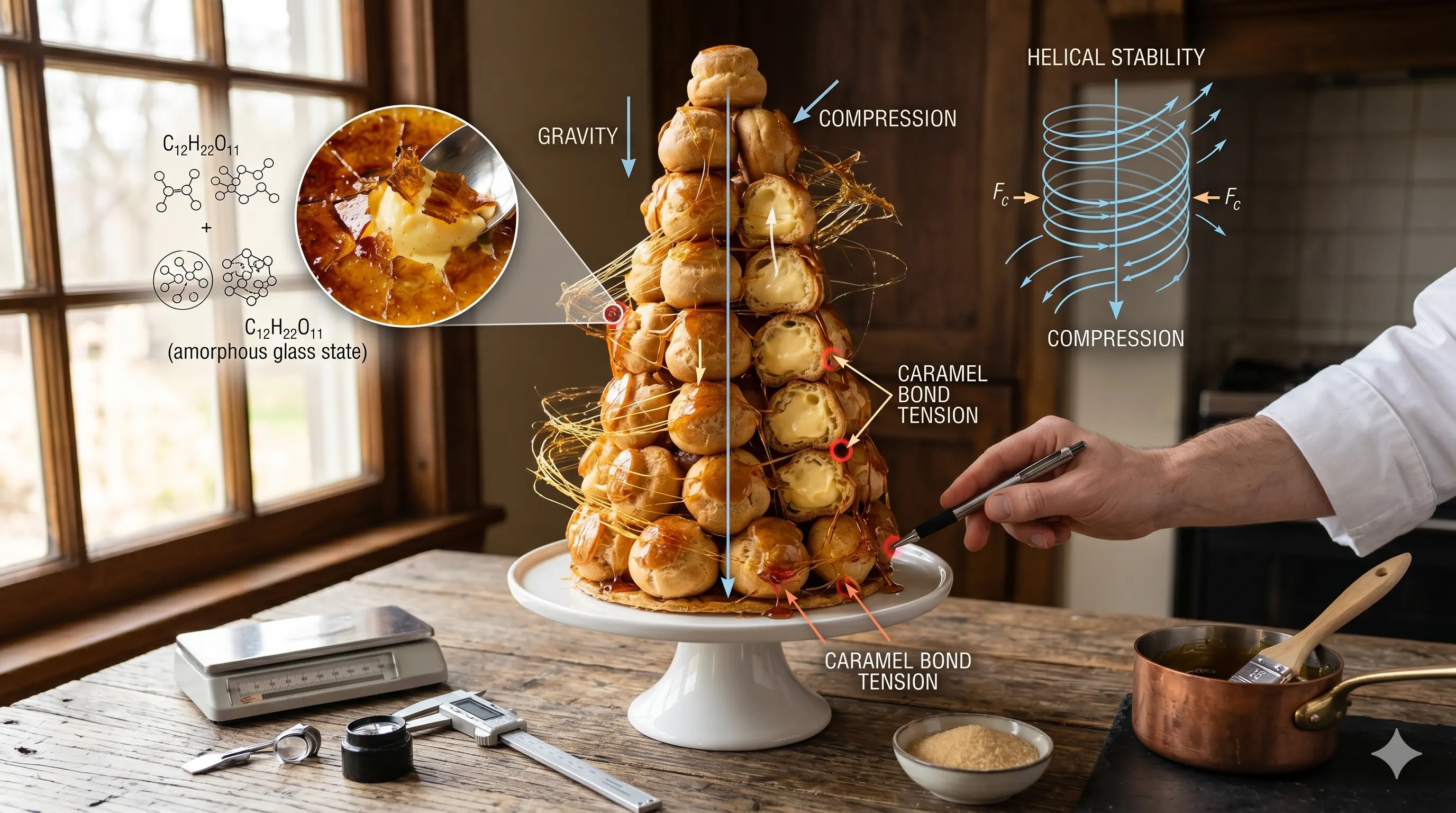
We transition from the fluid dynamics of sauces to the architectural engineering of the Croquembouche. Traditionally served at French weddings and baptisms, this centerpiece is a cone-shaped tower of cream-filled Pâte à Choux puffs. It is not held together by frosting or cream; it is bonded by hard-crack stage sucrose, utilizing the principles of tensile strength and thermal adhesion to defy gravity.
To master the Croquembouche, one must understand the relationship between sugar glass transition and structural load distribution.
Part 1: The Adhesive – Engineering the Hard-Crack Bond
The “glue” of the Croquembouche is sucrose cooked to the Hard-Crack stage ($150^{\circ}C$ to $155^{\circ}C$). At this precise temperature, almost 100% of the water has evaporated.
- The Thermal Window of Adhesion: The chef must work within a narrow cooling window. While the sugar is molten, it acts as a liquid adhesive with high surface tension. As it cools below $130^{\circ}C$, it transitions into a rigid, amorphous solid (glass).
- The Bond Geometry: Each choux puff is dipped into the hot sugar and placed against its neighbors. The sugar creates a “bridge” between the curved surfaces. Once hardened, these bridges provide the compressive strength necessary to support the weight of the layers above.
Part 2: The Conical Geometry – Distributing the Load
A Croquembouche is essentially a self-supporting masonry dome. Its stability relies on its conical shape.
- The Inward Lean: By building the puffs in concentric circles that decrease in diameter as they rise, the chef shifts the center of gravity inward. This ensures that the weight of the upper puffs pushes down and into the structure rather than outward.
- The Foundation Layer: The bottom ring of puffs must be perfectly level and securely bonded to the base (often a Nougatine disc). Any irregularity at the base is magnified as the tower rises, leading to structural lean or “toppling” failure.
Part 3: The Threat of Humidity – Hygroscopic Failure
The greatest enemy of the Croquembouche is not gravity, but atmospheric moisture.
- Hygroscopy: Sugar in its glass state is highly hygroscopic, meaning it actively attracts water molecules from the air.
- The Plasticity Shift: As the sugar bonds absorb moisture, they transition from a brittle glass back into a soft, sticky syrup. This loss of rigidity causes the structural “bridges” to fail. In high humidity, a perfectly engineered Croquembouche can undergo a total structural collapse in under an hour as the adhesive turns back into a liquid.
Conclusion: Architecture in Sugar
The Croquembouche is proof that pastry is a form of civil engineering. By utilizing the phase changes of sucrose to create high-strength adhesive bonds and employing conical geometry to manage load distribution, the French chef builds a monument that is as much a triumph of physics as it is of flavor.