
If spherification is about encapsulating liquids, culinary foams are about the structural capture of air. In modern gastronomy, a foam is not just a bubble; it is a colloidal dispersion where gas is the internal phase and a flavored liquid is the continuous phase. While a classical French mousse relies on heavy fats and proteins to hold air, modern foams use hydrocolloids and surfactants to create stable, ethereal textures that vanish on the tongue, leaving only the concentrated essence of the flavor.To master culinary foams, one must understand the relationship between surface tension reduction and interfacial rheology.Part 1: The Surfactant – Engineering the Bubble WallA bubble of air in pure water will collapse instantly because the surface tension of the water is too high. To create a stable foam, the chef must introduce a surfactant—a molecule that lowers surface tension.Soy Lecithin: The most common modern foaming agent. Like the lecithin in egg yolks used for Hollandaise, soy lecithin has a dual-ended molecular structure. In a foam, the hydrophobic tails point into the air bubble, while the hydrophilic heads stay in the liquid.The "Air" Technique: By using a handheld immersion blender at the surface of a lecithin-rich liquid, the chef incorporates air. The lecithin molecules instantly coat these air pockets, creating a monomolecular film that prevents the bubbles from merging and popping.Part 2: The Structural Matrix – Gels vs. EmulsionsWhile lecithin creates "airs" (very light, temporary foams), more robust foams require a more viscous continuous phase to slow down drainage (the liquid flowing out from between the bubbles).Xanthan Gum and Fluid Gels: By adding a minute amount of Xanthan gum ($0.1\% - 0.5\%$), the chef increases the viscosity of the liquid. This "traps" the air bubbles in a thick, shear-thinning matrix. This creates a "heavy" foam or a "syphon foam" that can hold its shape for minutes or even hours.The Siphon (N2O): In a whipping siphon, the liquid is pressurized with Nitrous Oxide ($N_2O$). Under pressure, the gas dissolves into the liquid. When the trigger is pulled, the sudden drop in atmospheric pressure causes the gas to rapidly expand and exit the liquid, inflating the structural matrix from the inside out.Part 3: The Thermal Variable – Hot vs. Cold FoamsThe stability of a foam is a race against temperature and evaporation.Cold Foams: Typically stabilized by fats (cream) or gelatin. These rely on the solid-phase setting of the stabilizer to hold the air.Hot Foams: These require stabilizers that do not melt at high temperatures. Methylcellulose is the engineer’s choice here; unlike gelatin, it actually sets into a gel when heated. A methylcellulose foam can be served on top of a hot steak or soup without collapsing into a puddle.Conclusion: The Physics of Flavor DensityCulinary foams prove that volume does not equal weight. By manipulating surface tension and using hydrocolloids to manage drainage, the modern chef can transform a heavy sauce into a cloud-like texture. It is the physics of aeration—a method of delivering intense flavor while occupying minimal mass.

As we transition from Classical French technique into the realm of Molecular Gastronomy, we begin with the most iconic modern technique: Spherification. Developed by Ferran Adrià at elBulli, this process treats liquids not as ingredients, but as encapsulated volumes. It utilizes the ion-exchange properties of seaweed-derived polymers to create a delicate, “pop-in-the-mouth” membrane that holds a liquid core.

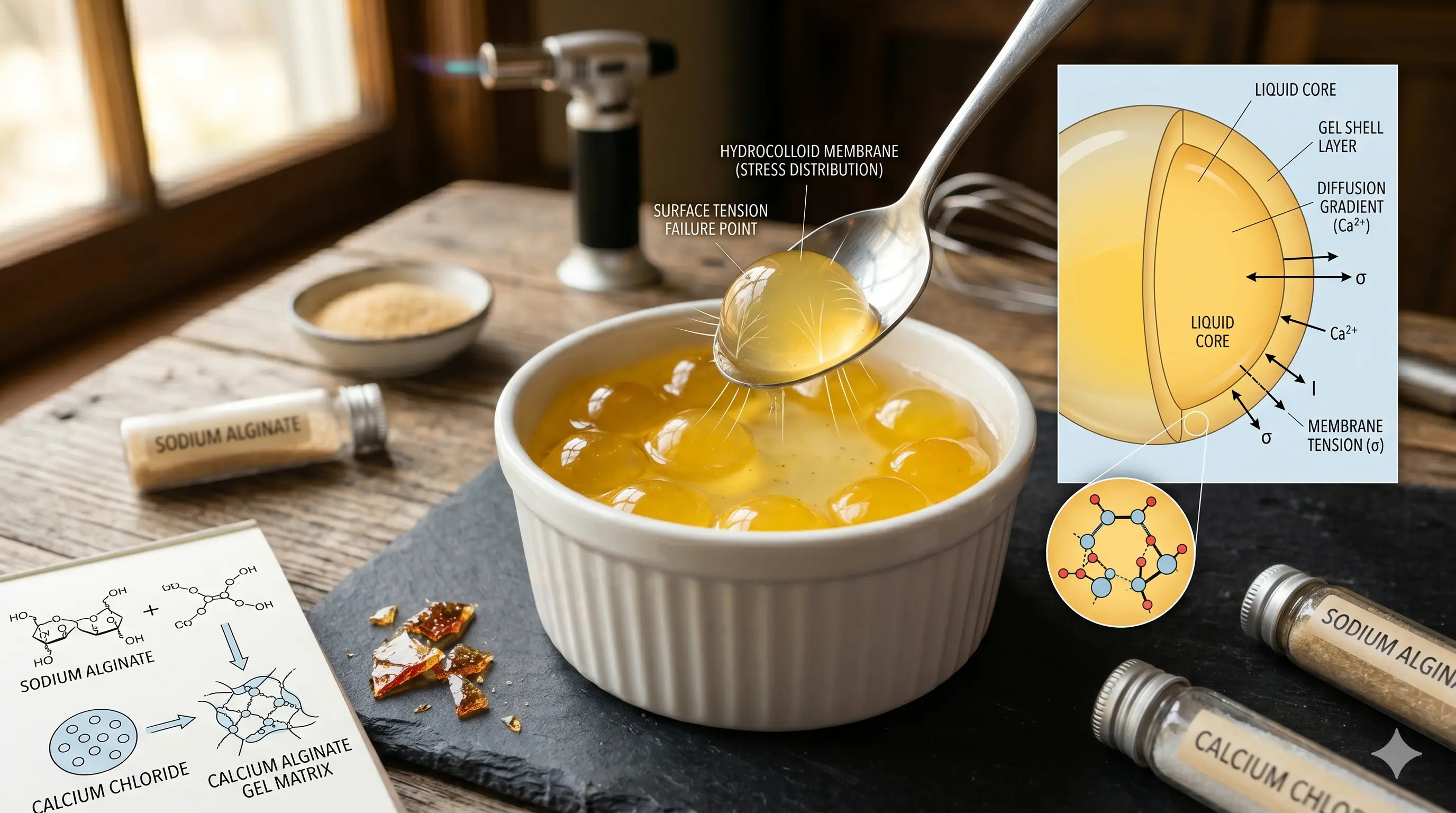
To master Spherification, one must understand the relationship between Sodium Alginate and Calcium Cation cross-linking.

Part 1: The Polymer Matrix – Sodium Alginat

The core “engine” of spherification is Sodium Alginate, a polysaccharide extracted from brown algae.

  • The Molecular Chain: In its powdered form, sodium alginate is a long-chain polymer. When dissolved in a liquid (like fruit juice or a savory stock), these chains float freely, making the liquid slightly more viscous but still fluid.
  • The Ionic Trigger: These polymer chains remain separate until they encounter Calcium ions ($Ca^{2+}$). Calcium ions act as “molecular staples.” Because they have a double positive charge, they can grab onto two different alginate chains simultaneously.

Part 2: Basic vs. Reverse Spherification – The Diffusion Direction

There are two primary engineering methods to create a sphere, determined by which component contains the calcium.

1. Basic Spherification (Alginate in Juice $\rightarrow$ Calcium Bath)

  • The Process: Sodium alginate is dissolved into the flavored liquid, which is then dropped into a bath of calcium chloride.
  • The Result: A thin membrane forms instantly. However, the calcium continues to diffuse inward. Over time, the entire sphere will turn into a solid jelly “marble.” This method requires immediate service.

2. Reverse Spherification (Calcium in Juice $\rightarrow$ Alginate Bath)

  • The Process: Calcium (usually Calcium Lactate Gluconate) is added to the flavored liquid, which is then dropped into a bath of sodium alginate.
  • The Result: The membrane forms on the outside of the droplet. Because the alginate is in the bath and not in the flavored core, the reaction stops once the sphere is removed from the bath. This allows for a permanent liquid center and long-term storage.

Part 3: Surface Tension and the “Sphere” Geometry

Achieving a perfect sphere is an exercise in fluid dynamics.

  • The Viscosity Match: If the flavored liquid is too thin, it will splash and deform upon hitting the bath, resulting in “tadpoles” rather than spheres. The bath must be slightly thickened (often with Xanthan gum) to match the density of the droplet, allowing it to maintain its spherical shape through surface tension as the membrane solidifies.
  • The pH Constraint: Alginate is highly sensitive to acidity. If the flavored liquid has a pH below $3.6$, the alginate will not hydrate properly, and the membrane will fail to form. In these cases, a buffer like Sodium Citrate must be used to raise the pH.

Conclusion: The Encapsulated Flavor

Spherification is proof that culinary boundaries are porous. By engineering a biological polymer membrane through ionic cross-linking, the modern chef can manipulate the physical state of a liquid, creating a “faux-caviar” or a “liquid ravioli” that relies entirely on the physics of diffusion and surface tension.


Writer - Daniel Carter

Daniel Carter

Daniel Carter is a Seattle-based food writer specializing in sushi, poke, and modern Japanese dining. With over seven years of experience reviewing local restaurants, he provides clear, unbiased insights to help diners understand menus, pricing, portion quality, and overall value. His straightforward writing style makes sushi easy to enjoy for both first-time visitors and regulars.

Leave a Comment