
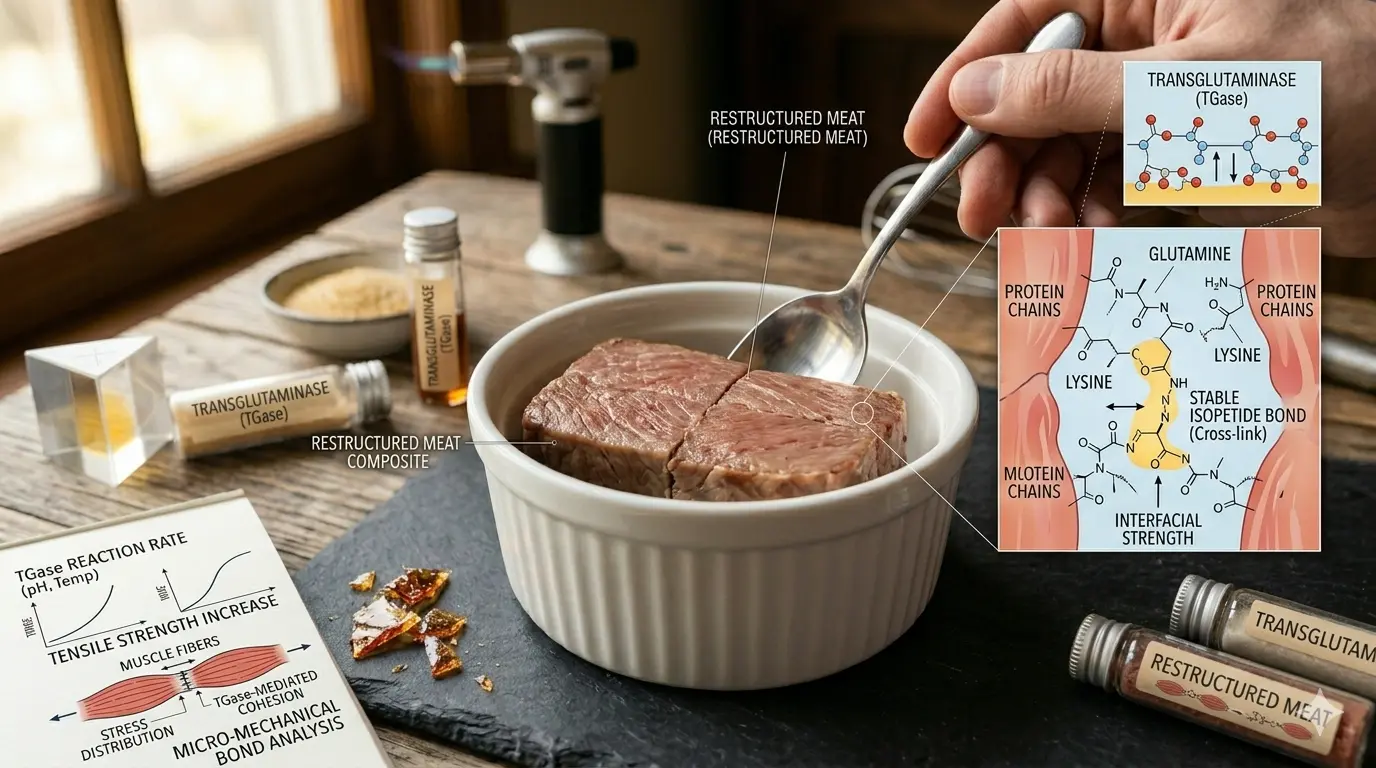
We move from the ethereal physics of foams to the mechanical world of structural protein bonding. Transglutaminase (TG), colloquially known as “Meat Glue,” is an enzyme that catalyzes the formation of covalent bonds between the amino acids lysine and glutamine. In modern gastronomy, TG is used to engineer entirely new protein geometries, allowing the chef to fuse disparate pieces of meat into a single, seamless muscle mass or to create “meat noodles” without the use of starch.
To master Transglutaminase, one must understand the relationship between enzyme kinetics and covalent cross-linking.
Part 1: The Molecular Staple – How TG Works
Unlike traditional “binding” agents like eggs or starch, which act as a sticky physical glue, Transglutaminase operates at the molecular level.
- The Covalent Bond: TG facilitates a chemical reaction that creates a peptide bond. This is one of the strongest bonds in nature. Once the bond is formed, it is thermally stable; it will not melt or break even if the meat is later cooked to high temperatures ($100^{\circ}C+$).
- The Protein Requirement: For TG to work, the proteins must be “available.” This usually requires a light dusting of the enzyme powder on the surfaces of raw meat. The reaction begins the moment the enzyme bridges the gap between two protein chains.
Part 2: Structural Engineering – The “Meat Mosaic”
The primary application of TG is the creation of uniform, high-yield portions from irregular cuts.
- Reconstituted Anatomy: A chef can take several small beef tenderloins, coat them in TG, wrap them tightly in plastic film (creating hydrostatic pressure), and refrigerate them. After 4 to 12 hours, the individual pieces fuse into a single, solid cylinder. When sliced, the “seams” are invisible, and the meat behaves as if it grew as a single muscle.
- Hybrid Proteins: TG allows for the fusion of different species. A chef can bond a sheet of salmon to a sheet of sea bass, or wrap a chicken breast in a layer of bacon so tightly that the bacon never unravels during the sear.
Part 3: The Kinetics of Setting – Time and Temperature
The “bond strength” of TG is a function of the enzyme’s active window.
- The Cold-Set: Most TG applications are done in the refrigerator ($4^{\circ}C$). At this temperature, the enzyme works slowly, allowing for a precise 12-hour “set.”
- The Thermal Inactivation: Like all enzymes, TG is a protein itself. If the meat is heated above $65^{\circ}C$ before the bonds have fully formed, the enzyme will denature and become inactive, and the bond will fail. However, once the bonds are formed, they are permanent.
- Safety and Hygiene: Because TG bonds raw meat surfaces together, any surface bacteria can be trapped inside the newly formed muscle. Professional engineering requires meticulous sanitation of the meat surfaces before bonding to ensure food safety.
Conclusion: Redefining Protein Geometry
Transglutaminase is proof that the “natural” shape of an ingredient is just a suggestion. By utilizing enzymatic covalent bonding, the modern chef becomes a biological architect, capable of restructuring protein into any form required for the dish. It is the physics of permanent adhesion—a way to build a better steak through molecular chemistry.