
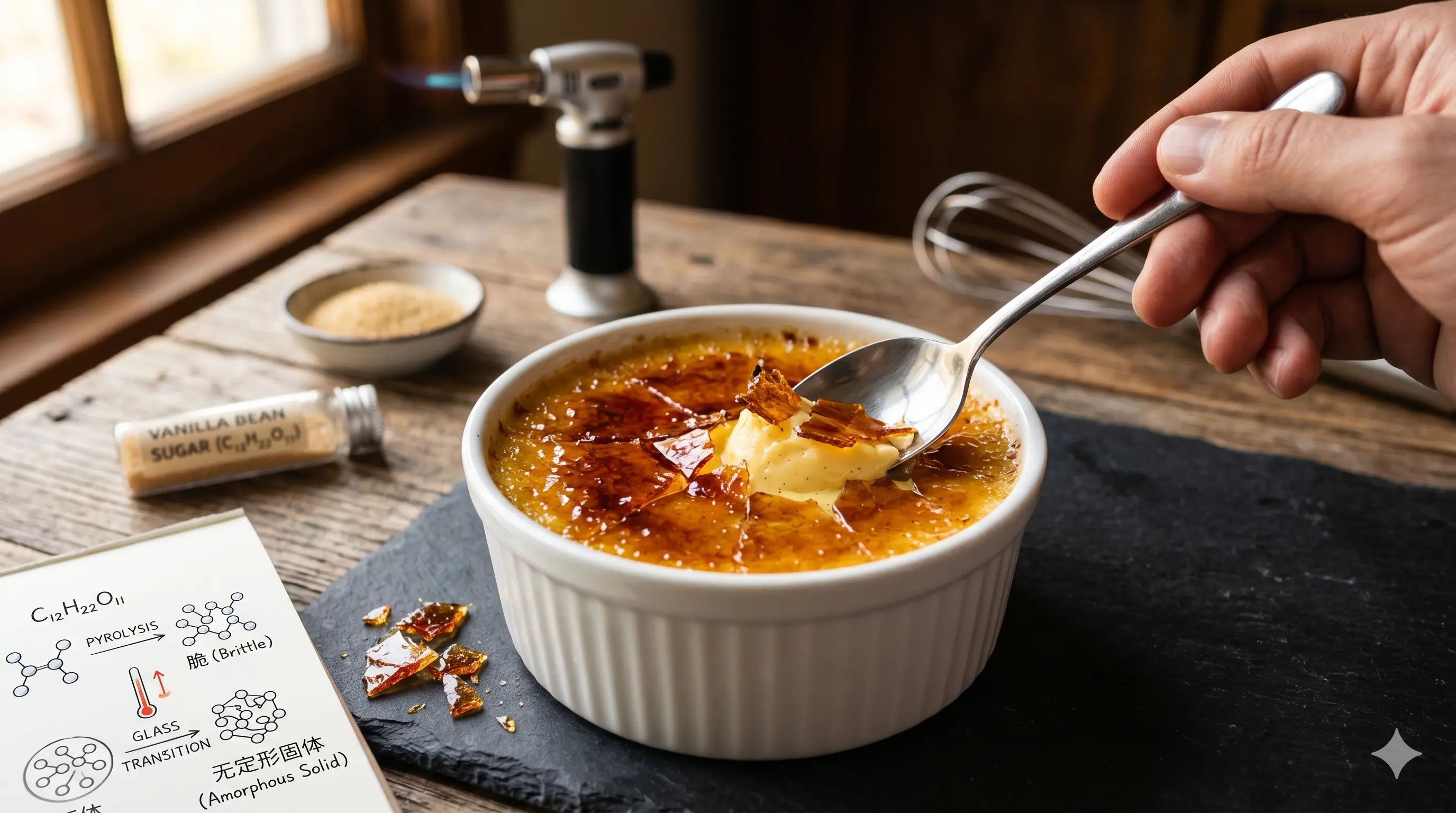
We transition from the structural containment of meats to the thermodynamic management of dairy and glucose. Crème Brûlée is a study in differential thermal processing. It requires the chef to maintain two contradictory states in the same vessel: a cold, delicate egg-protein custard and a brittle, scorching-hot glass-phase sugar crust.
To master Crème Brûlée, one must understand the relationship between sucrose phase changes and the specific heat capacity of lipids.
Part 1: The Custard – Engineering the Low-Temperature Gel
The base of a Crème Brûlée is a heavy cream custard. Unlike a flan, which must be firm enough to stand on its own, this custard is engineered for maximum creaminess and lipid density.
- The Protein-Fat Ratio: By using only egg yolks and heavy cream, the chef creates a high-fat environment that interferes with protein bonding. This ensures a soft, silky gel rather than a rubbery one.
- The Bain-Marie (Water Bath): Water has a high specific heat capacity and a boiling point of $100^{\circ}C$. By baking the ramekins in a water bath, the chef ensures the custard never exceeds the critical coagulation threshold of $82^{\circ}C$ to $85^{\circ}C$. This prevents the eggs from scrambling and the fat from separating.
Part 2: The Brûlée – The Caramelization vs. Maillard Paradox
The “burnt” top is the technical hallmark of the dish. It is a rapid application of intense thermal energy to create a solid glass phase.
- Sucrose Pyrolysis: When a blowtorch is applied to a thin layer of granulated sugar, the sucrose molecules undergo thermal decomposition. At approximately $160^{\circ}C$, the sugar melts into a liquid. At $170^{\circ}C$, it begins to turn amber as it undergoes caramelization.
- The Glass Transition: As the heat is removed, the molten sugar cools rapidly. Because it happens so fast, the sugar molecules do not have time to reorganize into a crystal lattice. Instead, they form an amorphous solid—essentially a sheet of edible glass.
Part 3: The Thermal Barrier – Protecting the Core
The greatest technical challenge is the “Cold/Hot Paradox.” The sugar must be scorched, but the custard must remain cold.
- Conduction Resistance: Custard is an excellent insulator due to its high fat and water content. However, the time the torch is applied must be minimized to prevent thermal conduction from melting the top layer of the gel into a soup.
- The Sugar Particle Variable: The sugar must be perfectly even. If the layer is too thick, the time required to melt it will heat the custard. If too thin, the “glass” will be too fragile to survive the spoon’s impact.
Conclusion: The Architecture of Contrast
Crème Brûlée is proof that temperature is a textural ingredient. By engineering a low-temperature protein gel and topping it with a high-temperature amorphous solid, the French chef creates a sensory experience built entirely on the physics of contrast: hot and cold, brittle and smooth.