
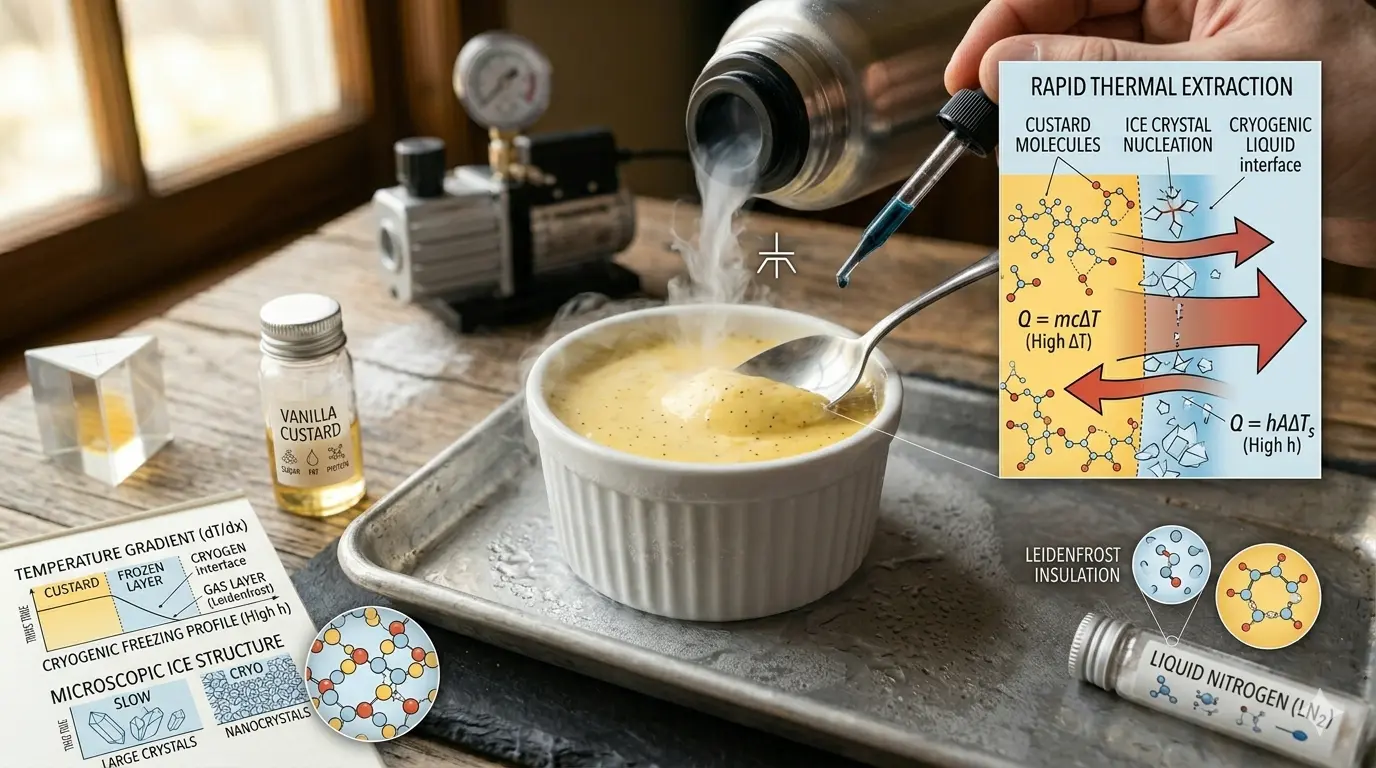
We transition from molecular bonding to the extreme frontier of thermal thermodynamics. Liquid Nitrogen ($LN_2$), with a boiling point of $-196^{\circ}C$, is the primary tool for Cryogenic Cooking. In the modern kitchen, it is not used for its flavor, but as a high-speed heat exchanger. It allows for the instantaneous phase change of liquids into solids, creating textures—like “powdered” fats or “shattered” foams—that are physically impossible at conventional freezer temperatures.
To master Cryogenic Cooking, one must understand the relationship between Leidenfrost insulation and nucleation kinetics.
Part 1: The Leidenfrost Effect – The Vapor Barrier
The most counterintuitive aspect of working with Liquid Nitrogen is that it often refuses to touch the food. This is due to the Leidenfrost Effect.
- The Gas Cushion: Because the temperature differential between the food ($+20^{\circ}C$) and the $LN_2$ ($-196^{\circ}C$) is so massive, the nitrogen immediately boils upon approach. This creates a thin layer of nitrogen gas that surrounds the food, acting as a thermal insulator.
- The Engineering Fix: To achieve rapid freezing, the chef must overcome this gas barrier. This is usually done through aggressive agitation or by using high-surface-area techniques (like a “Nitro-Siphon” spray) to force the liquid into direct contact with the ingredient.
Part 2: Flash-Freezing – Managing Crystal Size
The technical superiority of $LN_2$ over a standard freezer lies in the speed of crystallization.
- Micro-Crystallization: In a standard freezer, ice crystals grow slowly, forming large, jagged structures that rupture cell walls (leading to “mushy” textures upon thawing).
- The Glass Transition: Liquid nitrogen freezes water so rapidly that ice crystals don’t have time to grow. This results in micro-crystals or even vitrification (turning a liquid into a “glass” without a crystal structure). This is how modern chefs create ultra-smooth ice creams with zero graininess.
Part 3: Shattering and Powdering – The Physics of Brittleness
At $-196^{\circ}C$, materials that are usually flexible become extremely brittle due to the loss of molecular kinetic energy.
- Cryogenic Shattering: A fresh herb leaf or a piece of fruit dipped in $LN_2$ becomes as fragile as glass. It can be shattered into “dust” using a mortar and pestle.
- Nitro-Powdered Fats: High-fat liquids like olive oil or heavy cream, which usually remain viscous, can be dripped into $LN_2$ to create “fat pearls” or “oil snow.” These provide an intense flavor release as they instantly melt on the warm tongue of the diner.
Conclusion: The Thermal Limit
Cryogenic cooking proves that cold is just the absence of heat, and at the extreme end of the scale, physics behaves differently. By managing the Leidenfrost effect and leveraging the speed of micro-crystallization, the modern chef can manipulate the physical state of matter with surgical precision. It is the physics of the “Instant Freeze”—a way to capture flavor in a shattered, crystalline form.