
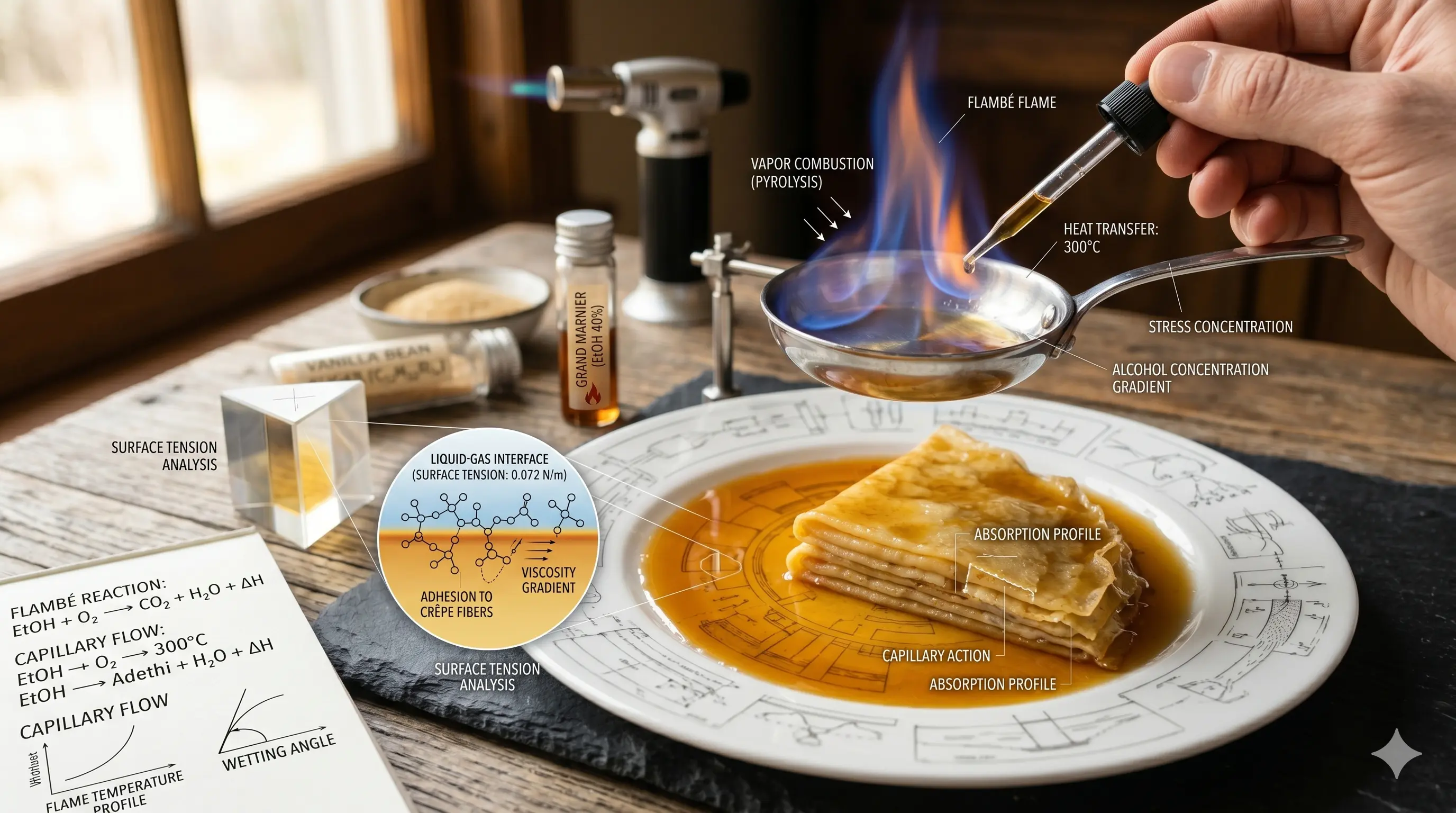
We conclude this technical series with the Crêpe Suzette, a dish that represents the transition of French cooking from the kitchen to the “tableside performance.” While it appears to be a simple dessert of pancakes in orange sauce, the Crêpe Suzette is a study in alcohol combustion kinetics and low-viscosity emulsification. The highlight, the Flambé, is not a mere visual trick; it is a thermal tool used to rapidly alter the chemical profile of the sauce.
To master the Crêpe Suzette, one must understand the flash point of ethanol and the reduction of surface tension through butter-acid integration.
Part 1: The Crêpe – Engineering a Paper-Thin Matrix
A crêpe is a “liquid-phase” dough. Unlike bread or puff pastry, it relies on a high ratio of liquid (milk and eggs) to flour to create a delicate, flexible membrane.
- Gluten Relaxation: The batter must rest for at least one hour. This allows the gluten proteins to relax and the starch granules to fully hydrate. Without this rest, the crêpe will be “snappy” or rubbery rather than tender.
- The Thermal Set: When the thin batter hits the hot pan, the proteins and starches set almost instantly. The goal is a thickness of less than 1mm—a structural sheet just strong enough to hold a sauce but thin enough to be translucent.
Part 2: The Beurre Suzette – Low-Viscosity Emulsification
The sauce is a Beurre Blanc variation, using orange juice and zest. The technical challenge is creating a stable sauce without the heavy thickening of a roux.
- The Zest Infusion: The essential oils (limonene) in the orange zest are hydrophobic. By rubbing sugar cubes against the orange skin (the Zeste), the chef captures these oils in a sugar matrix, which later dissolves into the sauce.
- The Emulsion: As butter is whisked into the boiling orange juice, the milk solids and natural pectins in the juice act as weak emulsifiers. This creates a “syrupy” consistency that coats the crêpe through capillary action, soaking into the pores of the thin dough.
Part 3: The Flambé – Alcohol Combustion and Pyrolysis
The final act is the addition of Grand Marnier or Cognac, followed by ignition. This is a controlled chemical reaction.
- The Flash Point: Alcohol (ethanol) has a flash point of approximately $13^{\circ}C$, but it will only sustain a flame when heated to its fire point (usually around $26^{\circ}C$ to $30^{\circ}C$ in a sauce). By adding the liqueur to the hot pan, the chef vaporizes the alcohol.
- Aroma Transformation: The flame reaches temperatures upwards of $500^{\circ}C$. This high heat causes pyrolysis—the chemical decomposition of the sugars and alcohols in the sauce. It burns off the “harsh” ethanol bite, leaving behind the complex, woody esters of the spirit and creating a deep, caramelized depth that a simple simmer cannot achieve.
Conclusion: The Final Performance
The Crêpe Suzette is the perfect finale for the “Technique is Everything” series. It combines the precise dough engineering of the pastry chef with the fluid dynamics and thermal management of the saucier. By using fire as a literal ingredient to catalyze chemical change, the French chef transforms a simple pancake into a technical masterpiece of aroma and light.