
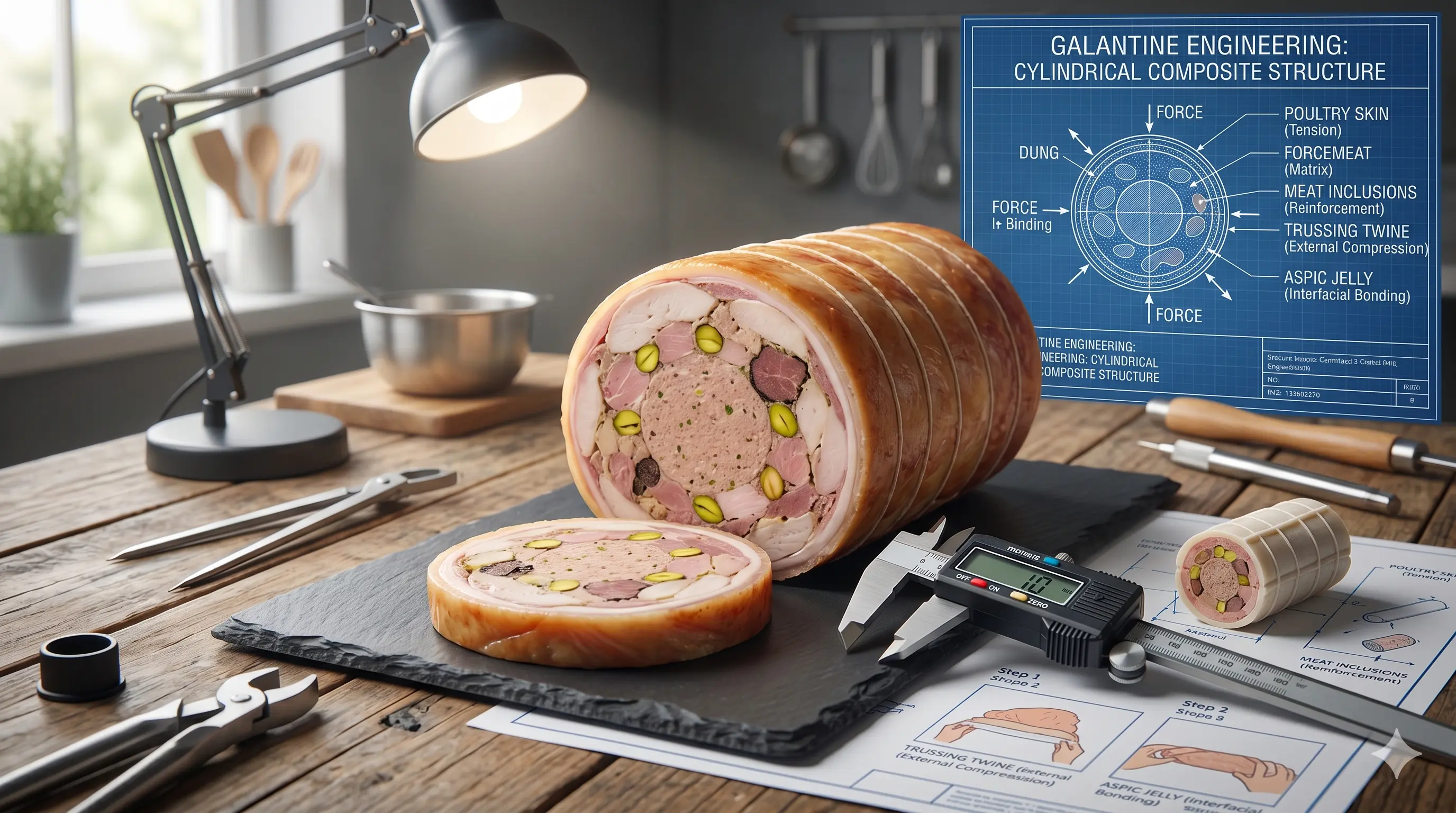
We move from the delicate thermal management of desserts to the advanced structural deconstruction of the Galantine. In the hierarchy of the Garde Manger (the cold kitchen), the Galantine is a masterclass in anatomic reorganization. It involves the complete deboning of a bird—traditionally a chicken or duck—leaving the skin entirely intact to act as a biological pressure vessel for a complex meat emulsion.
To master the Galantine, one must understand the relationship between integumentary elasticity and protein cross-linking.
Part 1: The Anatomic Deconstruction – The Zero-Rupture Mandate
The technical foundation of a Galantine is the “ballotine-style” deboning. Unlike standard butchery, the goal here is to remove the entire skeletal structure while keeping the skin and a thin layer of subcutaneous fat completely seamless.
- The Integumentary Barrier: The skin acts as the structural container. Any puncture or tear during the deboning process creates a point of failure; under the internal pressure of the cooking process, a small tear will expand, causing the “vessel” to burst.
- The Flat-Map Projection: Once deboned, the bird is laid flat, essentially creating a rectangular “sheet” of biological tissue. This sheet must be engineered to have a uniform thickness to ensure an even roll and consistent thermal conduction.
Part 2: The Farce – Engineering the Emulsion
The interior of the Galantine is a Farce Fine—a high-performance meat emulsion.
- The Protein Matrix: Lean meat is pureed with heavy cream and egg whites. This creates a matrix of actin and myosin filaments suspended in a fat-in-water emulsion.
- The Garnish Inlays: Professional Galantines often feature geometric inlays of tongue, truffle, or pistachio. These are not just for flavor; they require precise placement so that every cross-section of the finished cylinder reveals a perfect, symmetrical pattern. This is culinary internal mapping.
Part 3: The Poaching and the Press – Thermal Setting
The Galantine is rolled into a tight cylinder using cheesecloth and twine, then poached in a rich stock.
- Hydrostatic Pressure: By tying the roll tightly, the chef applies constant external pressure. As the proteins inside denature and coagulate, they “lock” around the garnishes, creating a solid, cohesive mass with zero air pockets.
- The Gelatin Bridge: After poaching, the Galantine is chilled under a weight (the “press”). This forces any remaining juices into the gaps, where they set into a natural gelatin. This ensures that the final product can be sliced into paper-thin, structurally sound rounds.
Conclusion: The Reconstructed Bird
The Galantine is proof that anatomy is merely a starting point. By deconstructing a bird and re-engineering it into a pressurized, emulsified cylinder, the French chef creates a dish that is a triumph of structural biology. It is the ultimate expression of the Garde Manger’s ability to transform raw tissue into a precision-engineered cold cut.