
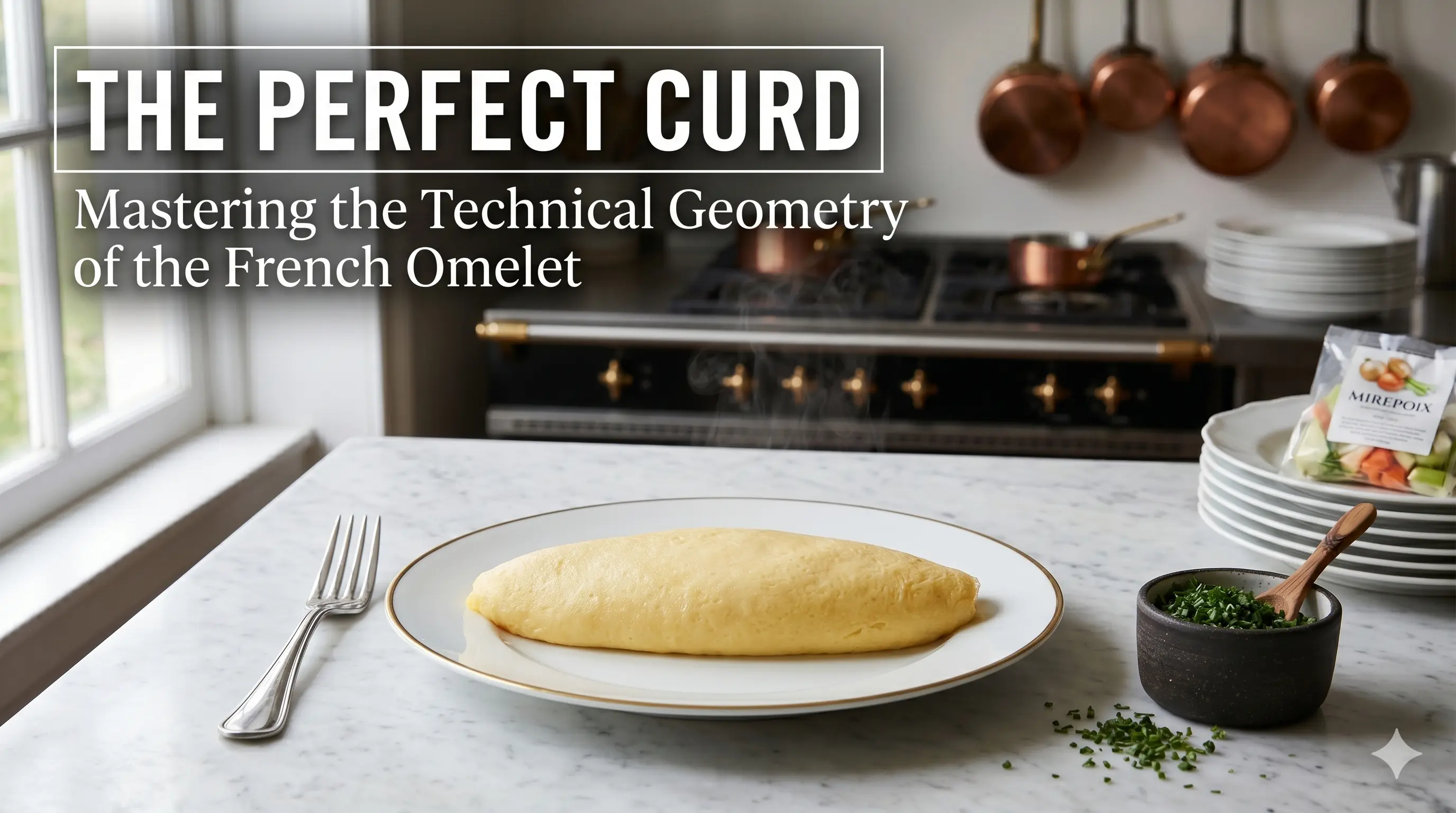
While often dismissed as a simple breakfast dish, the Classical French Omelet is technically one of the most demanding exercises in rapid thermal management and protein coagulation control. The objective is a smooth, unblemished, golden exterior (without a Maillard reaction) and a semi-liquid, custard-like interior (Baveuse).
Achieving this requires precise control over the formation, size, and hydration of egg-protein curds.
Part 1: The Physics of the Beating – Pre-Denaturation
The technical process begins before the eggs hit the pan. Beating the eggs serves two critical engineering functions:
- Homogenization: Eggs are a suspension of fat (yolk) and protein (white). A successful French omelet requires a perfectly homogeneous mixture where the fat is evenly distributed. This fat acts as an interfering agent, coating the white’s proteins and preventing them from forming tight, rubbery bonds later.
- Shearing and Aeration: Aggressive whisking with a fork applies mechanical shear, unraveling (denaturing) some of the egg proteins. More importantly, it incorporates microscopic air bubbles. When heated, these bubbles expand, creating the signature light, delicate structure. If under-beaten, the omelet is heavy and flat.
Part 2: The Thermal Window – Managing Curd Formation
The core of the French technique is dynamic, non-stop movement inside the critical thermal window ($60^{\circ}C$ to $70^{\circ}C$).
- The Agitation Rule: As soon as the eggs enter the hot, butter-coated pan, the chef must use a fork to keep them in constant motion. Why?
- The Geometry of the Curd: When egg proteins coagulate, they lock together, forming a solid net (a curd). If left undisturbed, these nets are large and tough (like scrambled eggs). Constant agitation breaks these large protein networks before they can fully set, resulting in micro-curds. This is what creates the smooth, velvety, and cohesive structure. The chef is physically engineering the size of the protein structure in real-time.
- The “Zero-Maillard” Mandate: Unlike other cuisines that value a browned exterior, the classic French omelet must remain soft and delicate. This requires the chef to maintain the pan temperature precisely. A skilled chef uses the pan’s thermal mass to cook the omelet rapidly (under 60 seconds) but takes it off the heat before the surface reaches $140^{\circ}C$, the threshold for browning.
Part 3: The Rolling and Baveuse Paradox
The defining characteristic of the French omelet is the internal consistency. The exterior is cooked just enough to be stable, but the core must be Baveuse (literally “drooling” or semi-liquid).
- Residual Thermal Cooking: This semi-liquid state is not achieved by undercooking; it is achieved by leveraging residual heat.
- The Folding Geometry: When the agitation stops and the surface begins to set, the pan is tilted. The rapid motion has created a smooth, solid sheet on the bottom. The chef rolls this sheet over the semi-liquid micro-curds in the center. The moment the omelet is turned out onto the plate, the residual heat of the exterior continues to cook the baveuse core gently from $65^{\circ}C$ to a safe and velvety $70^{\circ}C$, trapping the moisture and preventing it from weeping. It is a time-locked engineering phase-change.
Conclusion: The Ultimate Test of the Line Cook
The French Omelet is not just food; it is a live performance of protein manipulation. By understanding how to pre-denature proteins with mechanical shear, dynamically break protein networks with thermal agitation, and manage residual cooking with folding geometry, the chef transforms three simple eggs into a technical masterpiece. It is the final proof that in classical French cooking, technique is everything.