
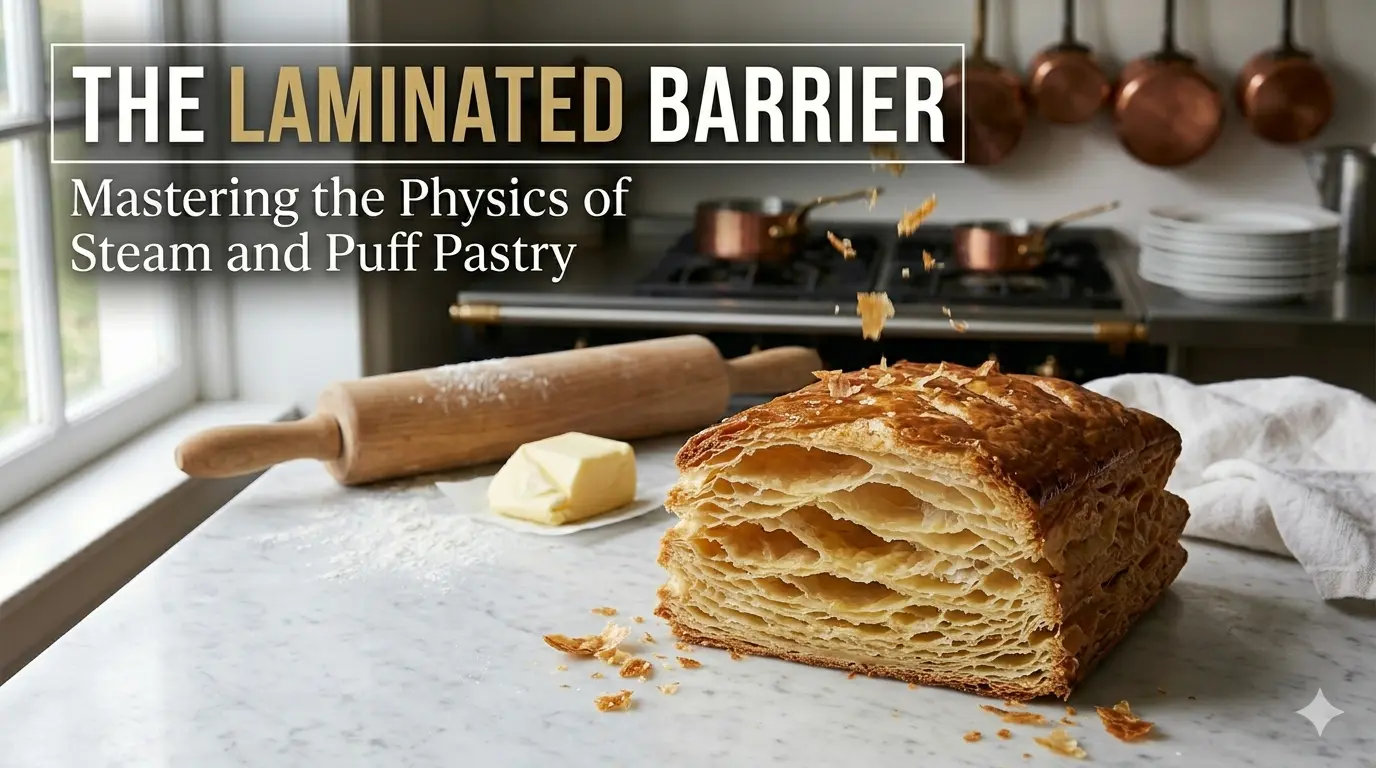
We move from the liquid purities of the consommé to the structural complexities of French pastry. Pâte Feuilletée (Puff Pastry) is the ultimate study in lamination physics. It is a composite material engineered to consist of hundreds of alternating, microscopic layers of dough and fat. When subjected to intense thermal energy, these layers undergo a massive mechanical expansion, transforming a dense block of dough into a light, shattered-glass structure.
To master Puff Pastry, one must understand the relationship between Water Activity ($a_w$) and the Physical Barrier Effect of cold lipids.
Part 1: The Détrempe and the Beurrage – Creating the Composite
Puff Pastry is not a mixture; it is a stratified stack. It begins as two distinct components:
- The Détrempe: A lean dough made of flour and water. Its technical purpose is to provide the structural gluten matrix.
- The Beurrage: A block of high-fat, pliable butter. Its purpose is to act as a physical separator.
The Engineering Goal:
The objective is to encase the butter within the dough and then perform a series of “turns” (folding and rolling). Each turn exponentially multiplies the number of layers. A standard “six-turn” puff pastry technically contains $729$ layers of butter separated by $730$ layers of dough.
Part 2: The Leidenfrost Effect – The Engine of the Rise
The “puff” in puff pastry is not caused by yeast or chemical leaveners; it is an act of pure steam-driven mechanical engineering.
- Moisture Migration: The dough layers contain water. When the pastry enters a high-temperature oven ($200^{\circ}C$), the water in the dough layers flashes into steam.
- The Lipid Barrier: Because the butter layers have a high fat content, they are hydrophobic. Steam cannot pass through fat. Therefore, as the steam expands, it is trapped beneath the butter layer, physically lifting the dough layer above it.
- The Vertical Expansion: This process happens simultaneously across all $1,459$ layers. The result is a vertical lift that can increase the volume of the dough by over $10$ times its original height.
Part 3: The Plasticity Window – Managing the “Smear”
The primary technical failure in Puff Pastry is thermal leakage.
- The Temperature Threshold: If the butter becomes too warm ($>24^{\circ}C$), it loses its solidity and begins to soak into the dough layers. This destroys the lamination, turning the composite into a simple “shortcrust” dough that will not rise.
- The Gluten Tension: Conversely, if the dough is worked too quickly without “rest” periods, the gluten becomes too elastic and will shrink or deform during baking.
- The Solution: Constant refrigeration between turns to maintain the butter’s plasticity—the state where it is soft enough to roll but solid enough to remain a distinct layer.
Conclusion: The Architecture of the Crunch
Pâte Feuilletée is proof that texture is a product of geometry. By engineering hundreds of moisture-rich barriers separated by fat, the French pastry chef creates a material that utilizes the power of steam to build its own internal architecture. It is the height of culinary lamination—a fragile, golden tower of physics.