
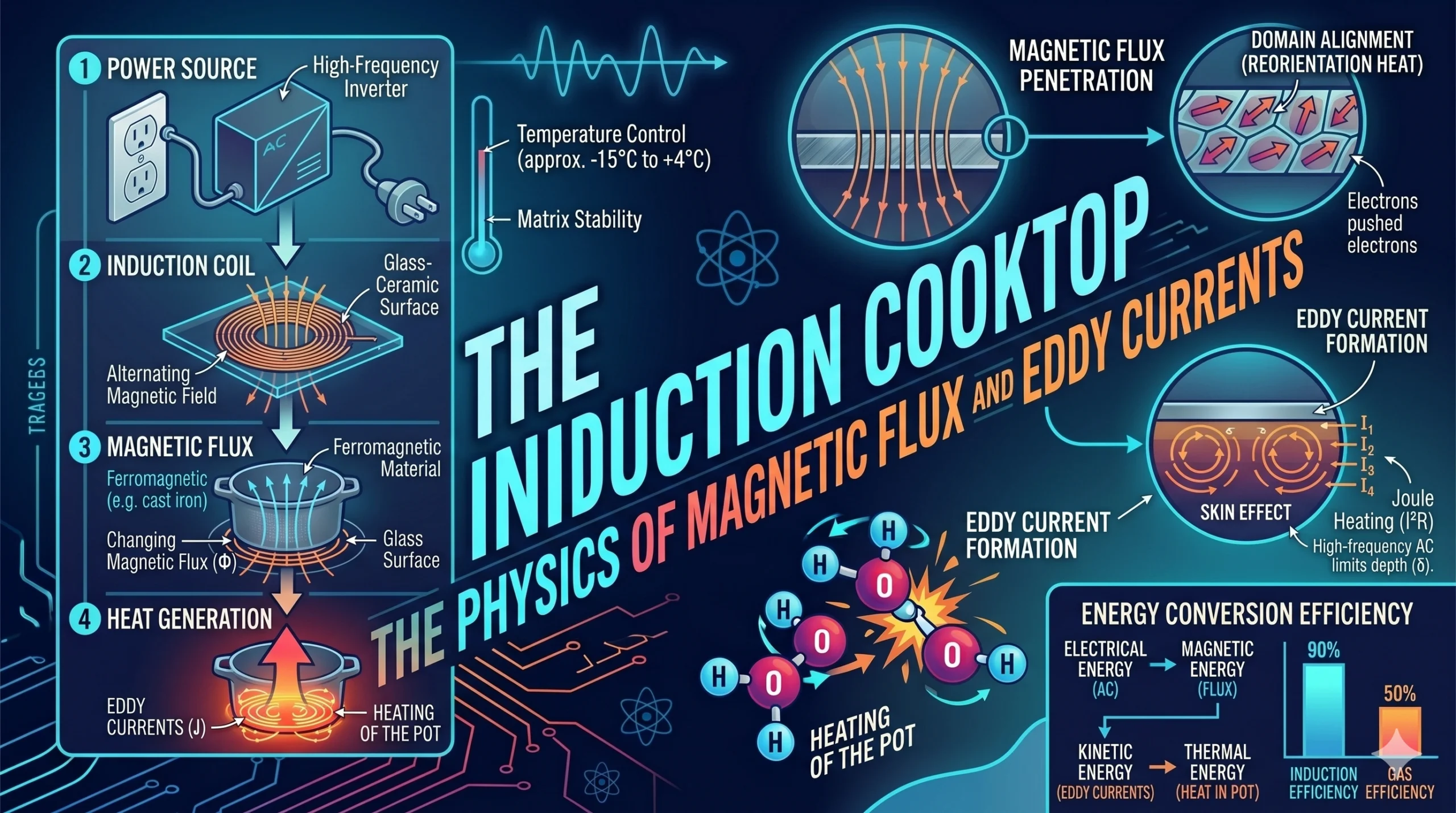
We move from the molecular structure of gelatin to the electromagnetic engineering of the Induction Cooktop. Unlike gas or traditional electric stoves, which rely on thermal conduction (transferring heat from a hot surface to a cold pan), induction is a method of internalized heat generation. It transforms the cookware itself into the heat source using the principles of electromagnetism and resistance.
To master induction, one must understand the relationship between magnetic flux and Joules’s First Law.
Part 1: The Electromagnetic Field – Generating the Flux
The heart of an induction cooktop is a coil of copper wire. When the unit is turned on, an alternating current (AC) flows through this coil.
- The Magnetic Field: According to Ampere’s Law, this current creates an oscillating magnetic field that passes through the ceramic glass surface of the cooktop.
- The Wireless Transfer: This field is invisible and produces no heat on the glass itself. It only interacts with materials that have specific magnetic properties (ferromagnetic metals).
Part 2: Eddy Currents – The Internal Agitation
When a pan made of a magnetic material (like cast iron or clad stainless steel) is placed within this field, the magnetic flux induces Eddy Currents within the metal of the pan.
- Faraday’s Law of Induction: The changing magnetic field “pushes” the electrons in the metal of the pan, forcing them to move in circular loops (Eddy currents).
- The Resistance Factor: As these electrons flow, they encounter resistance from the molecular structure of the metal. According to Joule’s First Law, this resistance converts the kinetic energy of the electrons into thermal energy. The pan doesn’t just “get hot”; it generates heat from within its own atomic structure.
Part 3: Hysteresis and Thermal Control
Beyond Eddy currents, induction also utilizes Magnetic Hysteresis to maximize efficiency.
- Molecular Friction: In ferromagnetic materials, the magnetic “domains” (tiny molecular magnets) flip back and forth billions of times per second to align with the oscillating field. This internal friction generates additional heat.
- Precision Response: Because there is no “middleman” (no hot coil or flame heating the pan), the thermal response is instantaneous. When you turn the dial down, the magnetic field stops immediately, and the heat generation within the pan ceases, providing a level of control that rivals or exceeds gas.
Conclusion: The Engineering of Efficiency
The Induction Cooktop proves that heat is a byproduct of energy transformation. By utilizing magnetic flux to trigger electron resistance directly within the cookware, the chef achieves a high-efficiency system where the kitchen remains cool while the pan reaches searing temperatures. It is the physics of non-contact thermal engineering.