
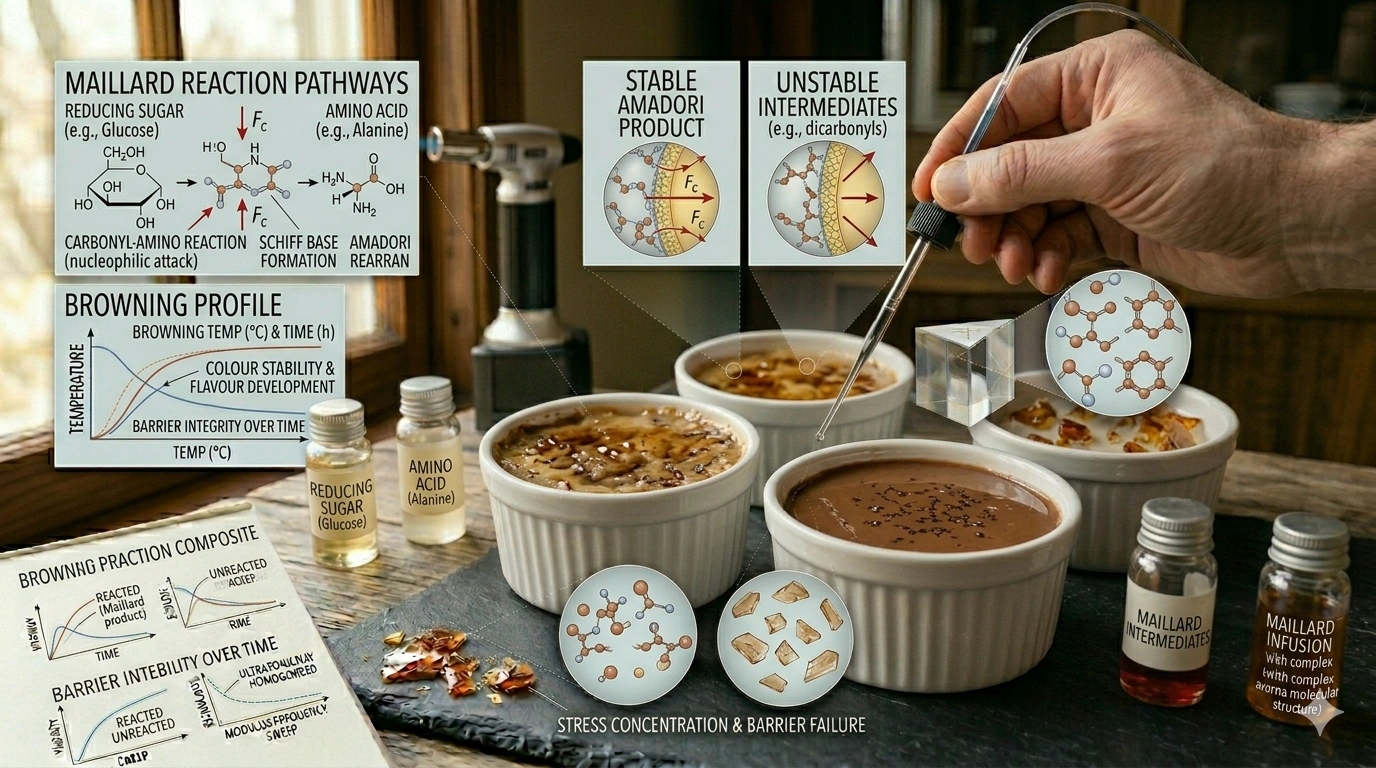
We transition from the structural engineering of meat to the fundamental chemical engine behind almost every savory flavor in the kitchen: the Maillard Reaction. Named after French chemist Louis-Camille Maillard, this is not a single reaction but a complex series of chemical rearrangements between amino acids (the building blocks of proteins) and reducing sugars. It is the process that transforms the bland, gray surface of raw meat or dough into a complex, mahogany-colored landscape of flavor and aroma.
To master the Maillard Reaction, one must understand the relationship between pH levels, thermal energy, and water activity.
Part 1: The Initial Phase – The Carbonyl-Amino Bond
The reaction begins long before the color changes. It requires the presence of a reducing sugar (like glucose or lactose) and a free amino acid.
- The Nucleophilic Attack: When heat is applied, the carbonyl group of the sugar reacts with the amino group of the protein. This creates an unstable molecule called an N-substituted glycosylamine.
- The Amadori Rearrangement: This unstable molecule then undergoes a structural shift into “Amadori compounds.” At this stage, there is still no visible browning or distinct aroma, but the chemical foundation for flavor is set.
Part 2: The Cascade Phase – Creating the “Flavor Compounds”
Once the Amadori compounds are formed, the reaction splits into hundreds of simultaneous pathways, depending on the temperature and the specific amino acids involved.
- Ketosamines and Reductones: The compounds break down further, producing potent aroma molecules.
- Specific Aromas:
- Pyrazines: Responsible for roasted, toasted, and nutty flavors.
- Thiophenes: Provide meaty and savory notes.
- Furans: Contribute sweet, caramel-like scents.
- The Difference from Caramelization: Unlike caramelization, which only involves the pyrolysis of sugars at high temperatures ($160^{\circ}C+$), the Maillard reaction can begin at much lower temperatures ($120^{\circ}C+$) because of the catalytic effect of the amino acids.
Part 3: The Final Phase – Melanoidins and Color
The final stage is the polymerization of these intermediate compounds into large, complex molecules called Melanoidins.
- Visual Indicators: Melanoidins are brown, nitrogenous pigments. They are responsible for the dark crust on bread, the sear on a steak, and the color of roasted coffee.
- The Role of pH: The Maillard reaction is highly sensitive to the environment. In an acidic environment, the reaction is slowed. By slightly increasing the alkalinity (e.g., adding a pinch of baking soda to onions or a pretzel lye bath), the chef can accelerate the reaction, achieving deep browning at lower temperatures or in shorter times.
- Water Activity ($a_w$): Because the Maillard reaction produces water as a byproduct, excess surface moisture inhibits it. This is why “patting the meat dry” is a critical engineering step—it allows the surface temperature to rise above $100^{\circ}C$ immediately, rather than waiting for surface water to evaporate.
Conclusion: The Engineering of Deliciousness
The Maillard Reaction proves that browning is a form of molecular synthesis. By managing the surface moisture, temperature, and pH, the chef acts as a high-heat chemist, synthesizing hundreds of aromatic compounds that do not exist in the raw ingredient. It is the physics of flavor creation—the most essential transformation in the culinary arts.