
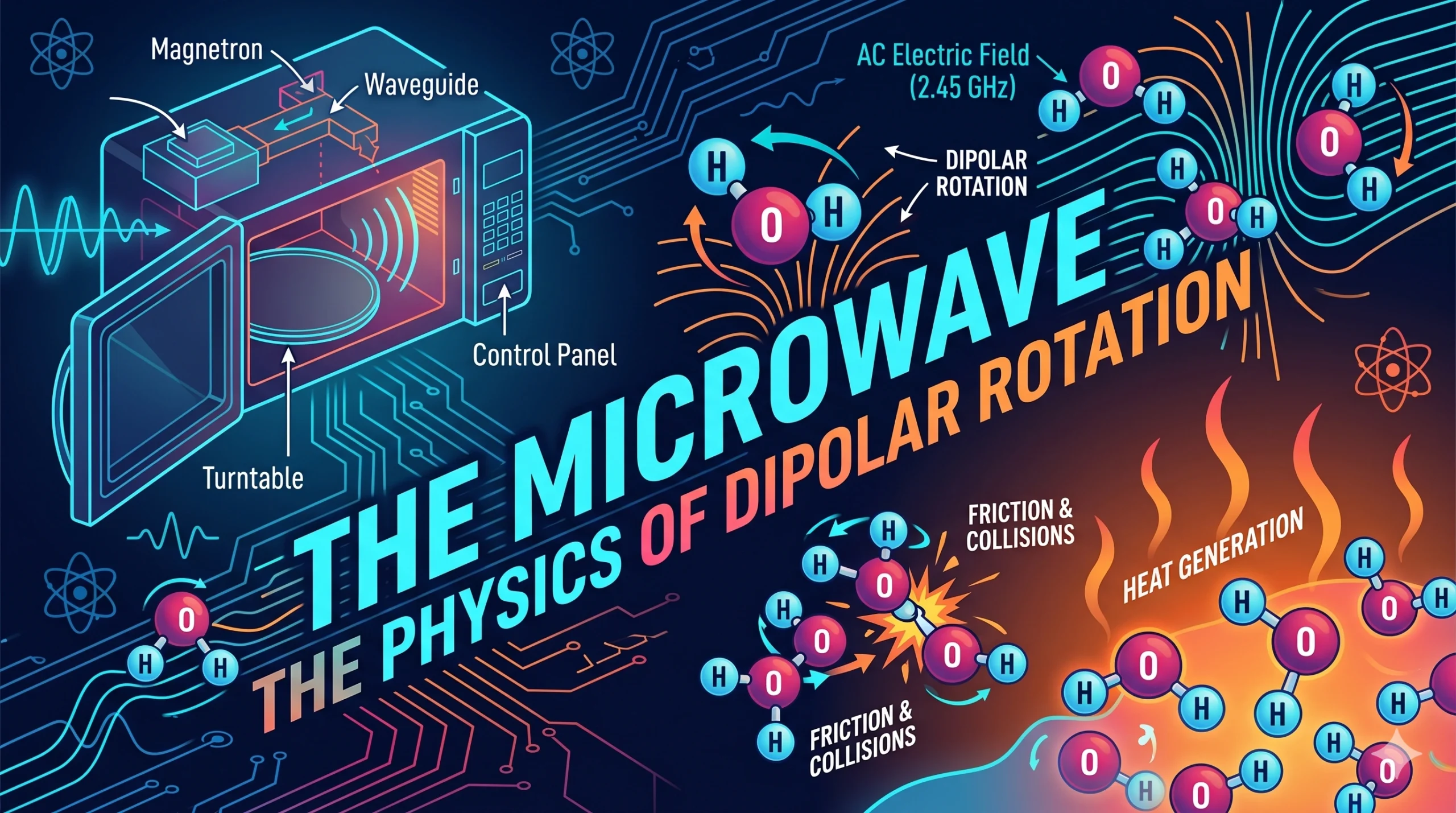
We move from the high-pressure conduction of the pressure cooker to the electromagnetic engineering of the Microwave. Often misunderstood as “cooking from the inside out,” the microwave actually utilizes non-ionizing radiation to target specific molecules. It is a study in dielectric heating, where energy is transferred not through contact with a hot surface, but through the high-speed manipulation of molecular orientation.
To master the Microwave, one must understand the relationship between dipolar rotation and thermal penetration depth.
Part 1: Dipolar Rotation – The Molecular Tug-of-War
The microwave functions by emitting electromagnetic waves (usually at a frequency of 2.45 GHz). This frequency is specifically calibrated to interact with polar molecules, most notably water.
- The Dipole Moment: A water molecule ($H_2O$) is a dipole; it has a partial positive charge near the hydrogen atoms and a partial negative charge near the oxygen atom.
- Molecular Friction: As the electromagnetic field oscillates 2.45 billion times per second, the water molecules rapidly rotate to align themselves with the field. This constant, high-speed flipping creates molecular friction, which is converted into thermal energy.
Part 2: Dielectric Properties – Why Only Some Foods Heat
The efficiency of microwave cooking is determined by a material’s dielectric constant—its ability to absorb and store electrical energy.
- Selective Heating: Water, fats, and sugars have high dielectric constants and heat rapidly. Conversely, air, glass, and most ceramics are “transparent” to microwaves because they lack polar molecules that can rotate.
- The Problem with Ice: Counterintuitively, frozen water (ice) is difficult to heat in a microwave. In its solid crystalline lattice, water molecules are locked in place and cannot rotate freely. This is why the “defrost” setting pulses the energy—it allows time for small amounts of liquid water to form and conduct heat to the surrounding ice through traditional conduction.
Part 3: Penetration Depth and Standing Waves
A common technical failure in microwave engineering is uneven heating, caused by the physics of wave interference.
- Standing Waves: As microwaves bounce off the metal walls of the oven, they interfere with one another, creating “hot spots” (constructive interference) and “cold spots” (destructive interference). This is the mechanical reason for the rotating turntable.
- Penetration Depth: Microwaves do not penetrate infinitely. Depending on the density and salt content of the food, the waves usually only penetrate 2 to 4 cm into the surface. The center of a thick item is actually cooked via conduction from the outer layers, much like a traditional oven.
- The Salt Effect: Salt increases the conductivity of the outer layer of food, which actually decreases penetration depth. A highly salted exterior can shield the interior of the food from the waves, leading to a hot surface and a cold center.
Conclusion: Engineering with Radiation
The Microwave proves that heat can be generated without a flame or a coil. By leveraging the polar nature of water and the physics of electromagnetic oscillation, the chef can achieve nearly instantaneous thermal increases. It is the physics of volumetric heating—a tool that, when mastered, offers unparalleled speed and precision in the modern kitchen.