
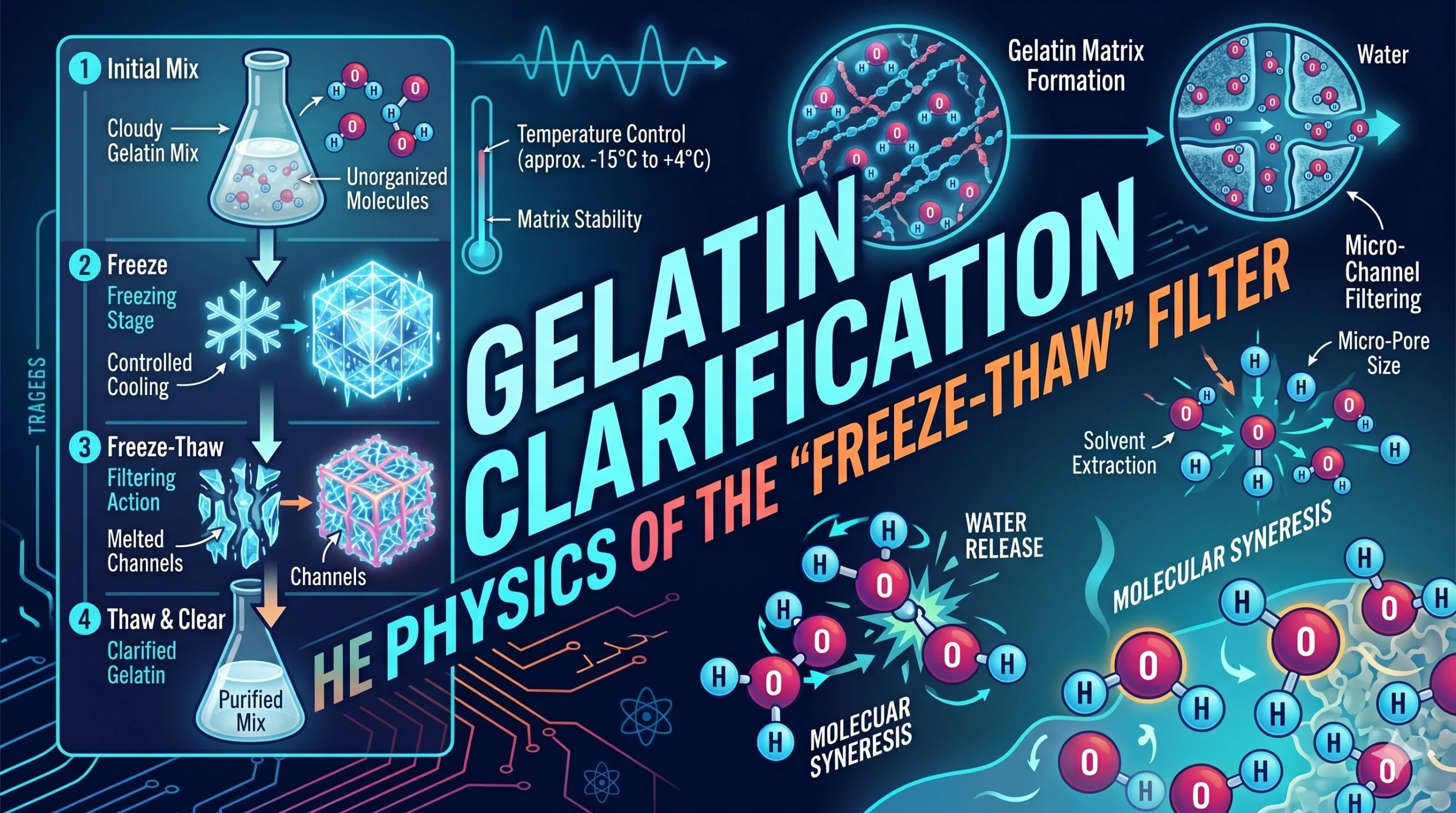
We move from electromagnetic rotation to the structural thermodynamics of Gelatin Clarification. While the Consommé (Article 65) uses a “raft” for active filtration, gelatin clarification is a passive, molecular process that utilizes the formation of a cryogenic protein lattice. This technique allows a chef to clarify liquids—even those with high fat or solids—without the flavor loss often associated with heat-based filtration.
To master gelatin clarification, one must understand the relationship between hydrogel formation and solute migration.
Part 1: The Hydrogel Matrix – Building the Trap
The process begins by ensuring the liquid to be clarified (a juice, stock, or infusion) contains approximately 0.5% to 1.0% gelatin.
- Protein Networking: When the liquid is chilled, the gelatin molecules undergo a phase transition from a random coil to a triple-helix structure.
- The Macroporous Network: This creates a three-dimensional hydrogel—a “cage” of protein that holds the water and flavor molecules in place. Crucially, it also traps all the large, light-scattering particles (fats and proteins) that cause cloudiness.
Part 2: The Freeze-Thaw Cycle – Syneresis and Separation
Once the gel is set, it is frozen solid. This is where the mechanical engineering of the clarification occurs.
- Ice Crystal Growth: As the water freezes, it forms ice crystals that physically push the gelatin network aside, concentrating the protein into dense, thin walls.
- The Thawing Filter: The frozen block is placed in a perforated container over a bowl in the refrigerator. As the ice melts, the water and dissolved flavor compounds (small molecules) escape the “cage” and drip out.
- The Catch: The microscopic particles and fats are too large to pass through the tightly compressed gelatin network. They remain trapped in the “scum” left behind in the filter, while the liquid that collects below is perfectly transparent.
Part 3: The Advantage of Cold – Flavor Preservation
Unlike traditional boiling and clarifying, the freeze-thaw method operates entirely at low temperatures.
- Volatile Retention: Many aromatic compounds are volatile and are lost when a stock is boiled to create a raft. Gelatin clarification preserves the “fresh” or “raw” profile of the base ingredient.
- Clarity vs. Viscosity: Because the gelatin stays in the filter, the resulting liquid is not only clear but also thin and “clean” on the palate, lacking the sticky mouthfeel of a high-gelatin stock.
Conclusion: The Molecular Sieve
Gelatin clarification proves that the most effective filters are built at the molecular level. By leveraging the phase changes of water and the structural properties of gelatin, the chef performs a feat of cryogenic chromatography. It is the physics of passive separation—a method to achieve total clarity while protecting the most delicate flavor profiles.