
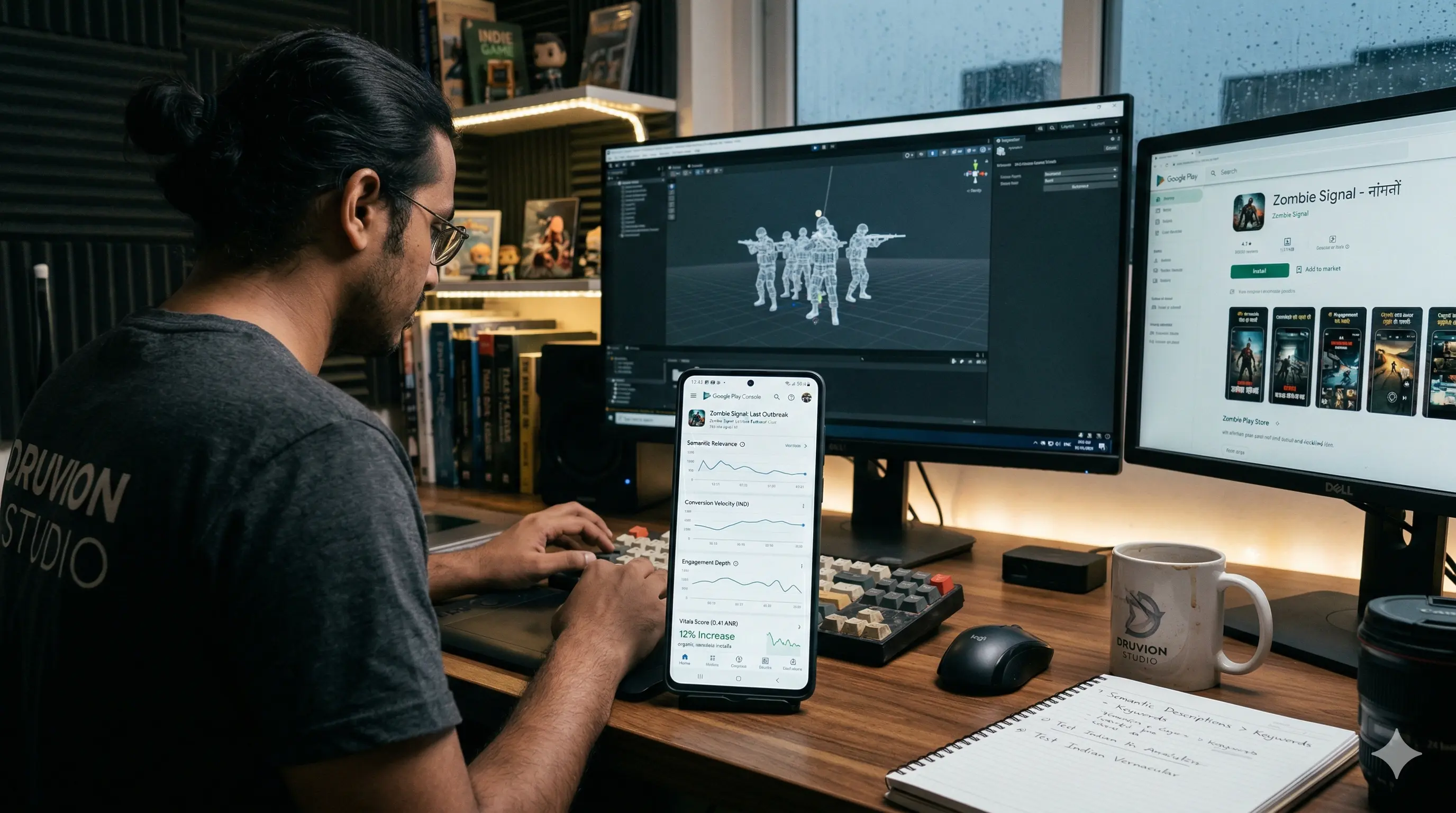
in 2026, the Google Play Store has moved beyond simple keyword matching. The algorithm now prioritizes “User Engagement Depth” and “Semantic Relevance.” For an indie studio like yours, simply having a great game isn’t enough; you need to master the art of App Store Optimization (ASO) to ensure your titles—like Zombie Signal: Last Outbreak or Battle Lines: Army Rush—don’t get buried under AAA marketing budgets.
Discoverability in 2026 is about convincing the AI that your game provides a high-quality, stable, and entertaining experience for a very specific type of player.
1. Beyond Keywords: Semantic Search & AI Descriptions
Google’s 2026 search engine understands the intent behind a query.
- Natural Language Descriptions: Instead of “keyword stuffing” your description, write for a human. Use the first 80 characters of your long description to define the unique hook of your game. The AI reads this to categorize your game’s genre and sub-genre accurately.
- Competitor “Clustering”: The algorithm looks at which games users play after looking at yours. Use your description to align yourself with successful titles (e.g., “Perfect for fans of tactical army runners”) to appear in the “Similar Games” section of high-traffic titles.
2. The Power of “Visual Conversions”
In a sea of icons, your visual assets are your first—and often only—chance to convert a view into a download.
- The 3-Second Rule: Your first two screenshots must tell the entire story of the gameplay. In 2026, high-contrast, “gameplay-first” screenshots outperform cinematic renders by 40%.
- The Short-Form Preview: Google Play now auto-plays short, 10-second vertical video clips in search results. Ensure your preview video shows immediate action (like a zombie horde or a battle line formation) within the first 2 seconds.
3. Technical Vitals: The Invisible Ranking Factor
Google Play’s “Vitals” dashboard is now a primary ranking signal.
- ANR & Crash Rates: In 2026, if your “App Not Responding” (ANR) rate exceeds 0.47%, your organic visibility will be throttled. Performance optimization is no longer just for user experience; it’s for SEO.
- Pre-Launch Testing: Use the Google Play Console’s internal testing tracks to gather data on low-end devices. The algorithm rewards games that perform smoothly across a wide range of Android hardware, especially in growing markets like India.
4. Conversion Rate Optimization (CRO) Strategies
Ranking high is useless if people don’t click “Install.”
- Localized ASO: Don’t just translate; culturalize. For titles targeting the Indian market, ensure your screenshots and descriptions reflect local nuances and perhaps offer content in Hindi or regional languages to lower the barrier to entry.
- The Rating Momentum: It’s not just about a 4.5-star rating; it’s about the velocity of new reviews. Prompt users for reviews after a “win state” (e.g., finishing a difficult level), as these users are 80% more likely to leave a positive 5-star rating.
Conclusion: The Indie Advantage
The 2026 Play Store rewards developers who focus on a niche and master the technical details. By treating your ASO as a living experiment—constantly A/B testing icons and monitoring your technical vitals—you can out-maneuver larger studios. Your games are the heart of your brand; ASO is the megaphone that makes sure the world hears them.