
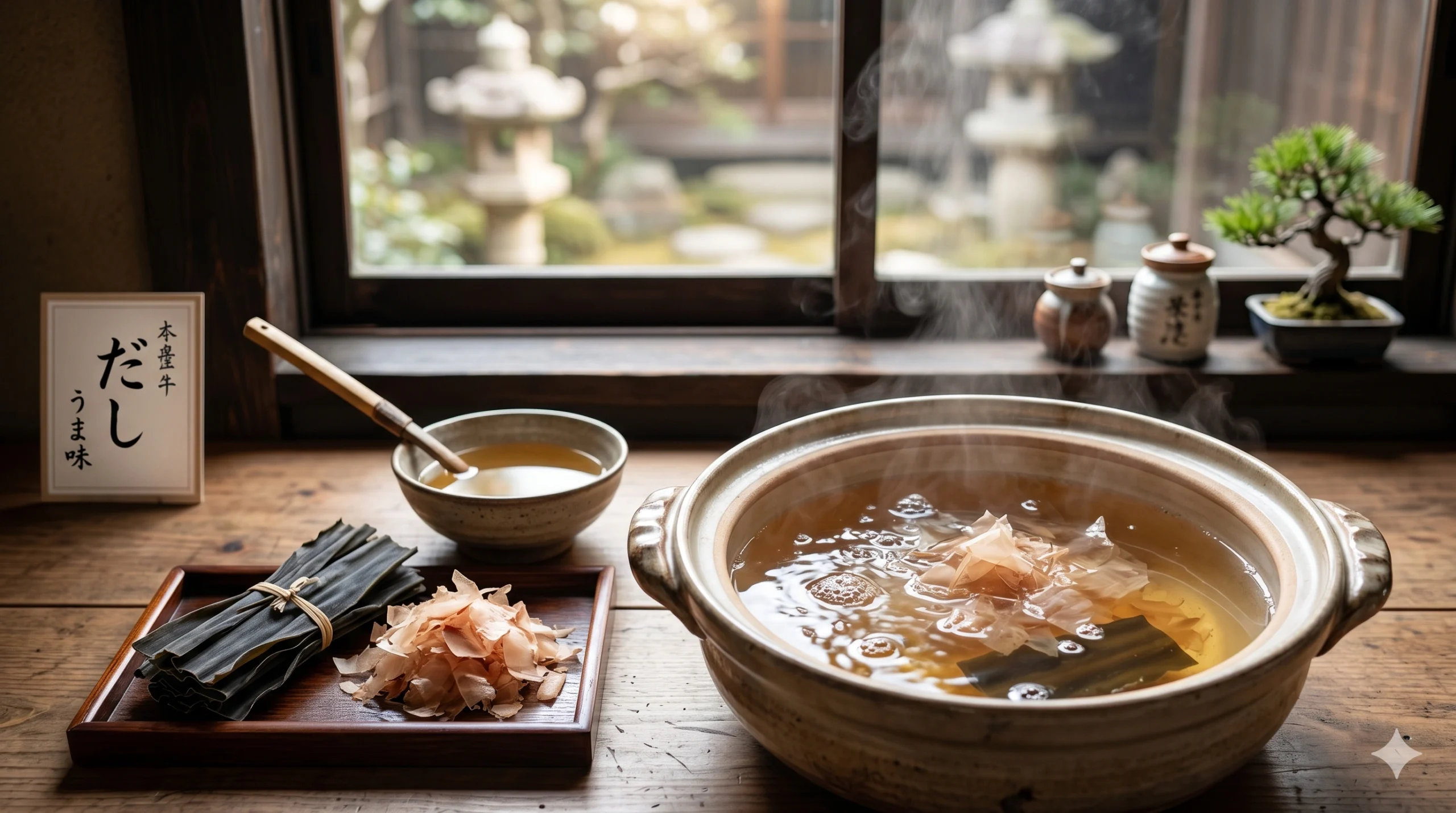
In 2013, Washoku (traditional Japanese cuisine) was added to the UNESCO Intangible Cultural Heritage list. This recognition wasn’t just for the taste of the food, but for the spiritual and social practice of respecting ingredients and harmony. At the very center of this culinary universe lies a clear, humble liquid known as Dashi.
If you wish to master Japanese cooking, you must first master Dashi. It is the “Mother Stock” that provides the invisible scaffold for everything from the simplest miso soup to the most complex Kaiseki (multi-course) meals. Unlike Western stocks, which require hours of simmering bones and mirepoix, Dashi is an extraction of pure flavor that can be achieved in minutes—provided you understand the science of Umami.
The Chemistry of “Deliciousness”
The term Umami was coined by Japanese chemist Kikunae Ikeda in 1908. He identified that the savory sensation we crave comes from glutamates and nucleotides.
Japanese cuisine is unique because it uses “Umami Synergism.” When you combine Kombu (rich in Glutamic acid) with Katsuobushi (rich in Inosinic acid), the perceived taste intensity is not just doubled; it is multiplied. This is why a simple clear soup can feel as satisfying as a heavy steak.
The Essential Toolkit: Sourcing Quality Ingredients
Because Dashi has so few components, there is nowhere for poor quality to hide. For your articles and recipes, you should distinguish between these specific varieties:
1. Kombu (Dried Kelp)
Kombu is the source of the glutamate.
- Ma-Kombu: The “king” of kelp. It is thick and produces a clear, sweet, and refined stock.
- Rishiri-Kombu: Harder and saltier, favored by chefs in Kyoto for its transparent color.
- Hidaka-Kombu: Best for everyday home cooking and for eating the kelp itself after simmering.
2. Katsuobushi (Bonito Flakes)
These are made from skipjack tuna that has been simmered, smoked, and fermented with a specific mold (Aspergillus glaucus) before being shaved into paper-thin ribbons.
- Hanatsuo: Large, thin shavings used for garnishing and light stocks.
- Karebushi: The highest grade, fermented multiple times to remove all fat and create a pure, crystalline broth.
The Technical Process: Making “Ichiban Dashi” (The First Stock)
Ichiban Dashi is the most prized extraction. It is used for clear soups (Owan) where the aroma is the protagonist.
Ingredients:
- 1 liter of filtered water (soft water is preferred for better extraction).
- 20g of Kombu.
- 30g of Katsuobushi.
Step-by-Step Execution:
- The Cold Soak: Place the Kombu in the water and let it soak for at least 30 minutes (up to 6 hours in the fridge). This “wakes up” the glutamates.
- Controlled Heating: Place the pot on medium-low heat. The temperature should rise slowly. Crucial Rule: Just before the water reaches a boil (look for small bubbles around the edges), remove the Kombu. If you boil the Kombu, the stock will become slimy and bitter.
- The Infusion: Bring the liquid to a brief boil, then add a splash of cold water to stabilize the temperature. Add the Katsuobushi. Do not stir. Let it simmer for only 30 to 60 seconds.
- The Sedimentation: Turn off the heat. Let the flakes sink naturally to the bottom of the pot. This takes about 2 to 3 minutes.
- The Filtration: Line a strainer with a fine-mesh cloth or high-quality paper towel. Pour the liquid through. Do not squeeze the flakes. Squeezing releases fishy oils and cloudiness that ruin the “shimmer” of the Dashi.
Niban Dashi: The Sustainable Second Stock
Japanese cooking is inherently zero-waste. The “spent” ingredients from your first batch still hold significant flavor. Niban Dashi (Second Stock) is more robust and is used for braising vegetables (Nimono) or making miso soup where stronger seasonings (like miso paste) will dominate.
To make it, place the used Kombu and Katsuobushi back into 1 liter of fresh water. Bring it to a boil and simmer for 10 minutes. At the end, you can add a small handful of “fresh” bonito flakes to “awaken” the aroma.
Beyond the Sea: Vegan Alternatives
For a purely plant-based profile, Shiitake Dashi is the standard. Dried Shiitake mushrooms are rich in Guanylic acid.
- Process: Soak 3–4 dried mushrooms in 500ml of cold water overnight in the refrigerator.
- Pro Tip: Use the soaking liquid as your base, but always combine it with a little Kombu Dashi to achieve that Umami synergy mentioned earlier.
Practical Application: The 1:1:10 Rule for Starters
To make a high-quality “Golden Soup” (used for Udon or dipping sauces), use this professional ratio:
- 10 parts Dashi
- 1 part Light Soy Sauce (Usukuchi)
- 1 part Mirin
- A pinch of sea salt.
Conclusion
Understanding Dashi is like learning the scales before playing a piano concerto. It is the invisible thread that connects a street-side ramen shop to a three-star Michelin restaurant in Tokyo. By mastering this extraction, you aren’t just making soup; you are mastering the very essence of Japanese flavor.