
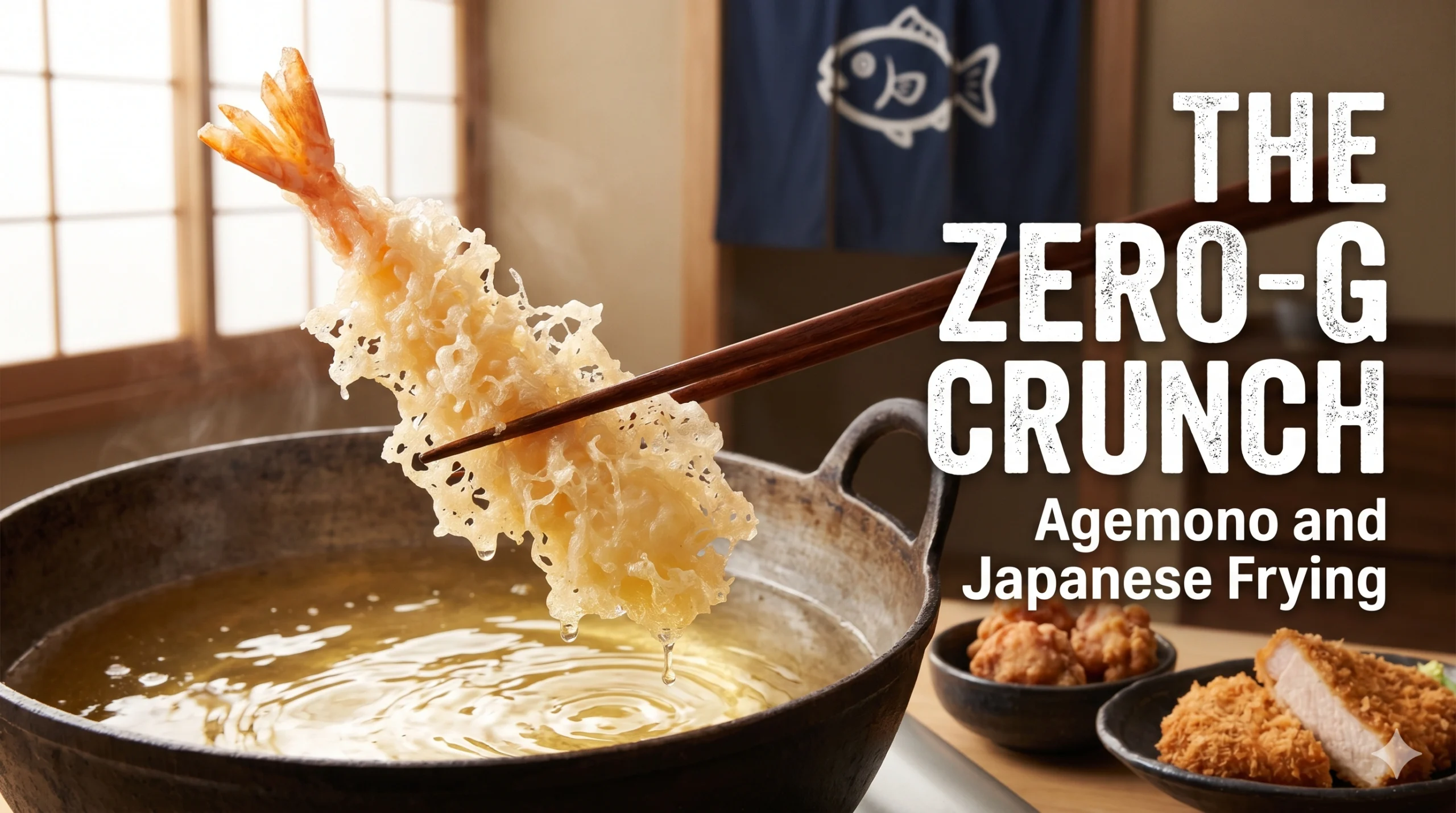
In the spectrum of Japanese cuisine, where purity and raw textures often take center stage, Agemono (deep-fried dishes) provides a contrasting, indulgent satisfaction. However, a high-quality Japanese fry is not defined by greasiness; it is defined by its opposite: an ethereal lightness, a distinct lack of retained oil, and a textured, aerodynamic crunch.
To master Agemono, one must look past the boiling oil and focus on the physics of starch and water vaporization. This article analyzes the three foundational techniques of Japanese frying: Tempura, Karaage, and Tonkatsu, and reveals the precise controls required to achieve a professional finish.
Part 1: Tempura – The “Ethereal” Shroud
Tempura is arguably the most demanding Agemono technique. Its goal is a paradoxical “steamed within a crisp exterior” effect. A master Tempura chef manipulates gluten formation and rapid dehydration to create a coating so delicate it appears translucent and lacy (known as Hana-age or “flower-frying”).
The Science of Cold Batter
The single most important technical rule for professional Tempura is cold. Your water must be ice-cold, and your flour should be chilled.
- The Cold War on Gluten: When you mix flour with water, you activate gluten—the protein network that creates elasticity and chewiness (essential for bread, disastrous for Tempura). Heat and agitation speed up gluten formation. By using ice water and barely mixing the batter, you keep gluten development to an absolute minimum, ensuring a tender, shatteringly crisp crust rather than a heavy, bready one.
- The Mixing Technique: Use chopsticks to gently “cut” the cold water into a light, low-protein pastry flour. Leave the lumps. A lumpy batter is a sign of success.
Dehydration vs. Retention
Oil temperature is vital. The “sweet spot” is 170°C to 180°C. When the cold, wet batter hits the hot oil, the water in the batter instantly vaporizes. This rapid conversion from liquid to gas creates high steam pressure that escapes from the inside, preventing oil from entering and simultaneously cooking the ingredient in its own steam.
Part 2: Karaage – The Marinade and the Starch Shell
Where Tempura aims for lightness, Karaage (most famously Tori no Karaage, or fried chicken) is built for maximum flavor retention and a deeper, more substantial crunch.
The Marinade and “Sake Osmosis”
The technical mastery of Karaage begins with the marinade. To achieve a professional finish, you must use high-quality ingredients to create an emulsion:
- The Emulsion: A standard marinade is equal parts Soy Sauce, Sake, and Mirin, combined with garlic and ginger. The Sake is key; its low boiling point ensures it vaporizes quickly during frying, creating micro-fissures in the crust that enhance the crunch.
- The Injection: For high-end articles and cooking, advocate for “massaging” the marinade into the chicken. This physically breaks down muscle fibers, allowing the seasonings to penetrate deeply.
The Starch Strategy
The coating is just as critical as the marinade. A high-quality Karaage never uses pure wheat flour.
- The Potato Starch (Katakuriko) Secret: Instead, use Potato Starch (Katakuriko). Its large starch molecules do not absorb water well, making it inherently resistant to sogginess. It creates a dry, “dusty” exterior that is the signature texture of authentic Karaage. For an optimized result, try a 2:1 ratio of Potato Starch to wheat flour.
Part 3: Tonkatsu – The Architecture of Panko
Tonkatsu (pork cutlet) is a masterclass in layered textures, a concept in Japanese cooking known as Shokukan. It is a five-step plating architectural process:
- Preparation: A professional Tonkatsu begins with proper meat handling. The pork loin (Ro-su) or fillet (Hi-re) must be trimmed of tough silverskin and the perimeter lightly slashed to prevent curling during frying.
- The Flouring: Coat the seasoned pork in an ultra-fine layer of flour. The Secret: Use a fine-mesh sieve. Any excess flour prevents the egg wash from sticking, which causes the crust to separate from the meat.
- The Egg Wash: Dip in a lightly beaten egg.
- The Panko: Press the cutlet firmly into a bed of fresh, coarse Panko. Do not use fine, dry breadcrumbs. High-quality Tonkatsu uses Nama Panko (fresh breadcrumbs), which contain moisture. This moisture vaporizes in the hot oil, creating a light, airy, aerodynamic structure.
- The Rest: After frying (at 175°C), the cutlet must rest for 3 minutes on a wire rack. During this time, carryover heat finishes the internal cooking, while the crust dries, preventing sogginess.
Conclusion: The Ultimate Zero-G Fry
Agemono is not an act of grease; it is a battle for flavor and texture, fought with the tools of physics and temperature control. A master chef understands the interplay of cold batter and hot oil, the function of Potato Starch over wheat, and the structural difference fresh Panko makes. The result is a crunch that is satisfyingly powerful yet surprisingly clean—the ultimate expression of the Japanese zero-gravity fry.