
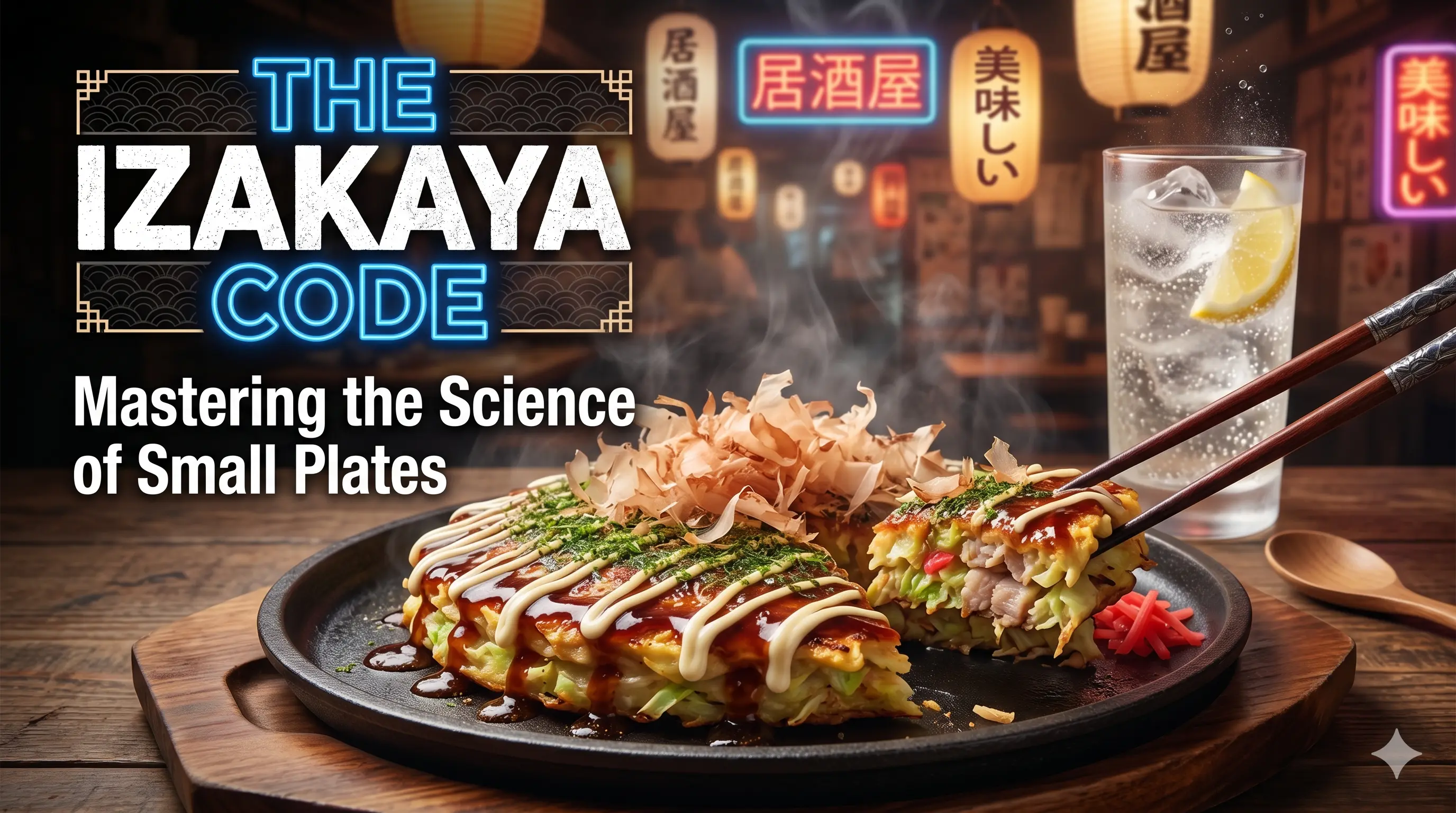
If Teishoku is the disciplined architecture of the Japanese day, the Izakaya is the vibrant, experimental playground of the Japanese night. Often described as a Japanese gastropub, an Izakaya is defined by its serve-style: small, high-impact plates (Osumami) designed to be shared and paired with sake or beer.
However, the “casual” nature of Izakaya food is a technical illusion. The dishes are engineered with high salinity, intense acidity, and specific fat profiles to stand up to the bold flavors of alcohol. This article deconstructs the technical mastery behind three Izakaya essentials: Okonomiyaki, Agedashi Tofu, and the chemistry of the Highball pairing.
Part 1: Okonomiyaki – The Structural Integrity of the Savory Pancake
Okonomiyaki (meaning “as you like it, grilled”) is a study in texture and moisture management. Unlike a Western pancake, which is cake-like and uniform, a professional Okonomiyaki must be a “nest” of ingredients held together by the minimum possible amount of batter.
1. The Nagaimo Secret
A high-quality Okonomiyaki batter does not rely solely on flour and egg. The secret ingredient is Nagaimo (mountain yam). When grated, Nagaimo becomes incredibly mucilaginous and airy.
- The Physics of Fluff: Adding grated Nagaimo introduces a “foamy” structural integrity that allows the pancake to remain light and airy even when packed with heavy ingredients like pork belly, shrimp, and dense cabbage. It prevents the interior from becoming gummy or doughy during the slow-grill process.
2. Cabbage Geometry
The cabbage is not a garnish; it is the structural skeleton of the dish.
- The Technical Cut: For the “Osaka-style” pancake, the cabbage must be cut into small, uniform squares (approx. $1cm$). This geometry allows for maximum air pockets within the batter, ensuring even heat distribution and a consistent “crunch-to-chew” ratio in every bite.
Part 2: Agedashi Tofu – The Dynamics of Surface Tension
Agedashi Tofu (deep-fried tofu in dashi) is an exercise in the physics of surface tension. The goal is to create a shell that is crisp enough to hold its shape while submerged in hot liquid, yet thin enough to melt away instantly on the tongue.
The Starch Membrane
The coating must be Potato Starch (Katakuriko), never wheat flour.
- The Membrane Effect: When Potato Starch hits the moisture of the tofu, it creates a gelatinous membrane. Once fried at $180^{\circ}C$, this membrane transforms into a unique, translucent, “sticky-crisp” shell.
- The Absorption Rule: The tofu must be fried and served immediately. The starch shell is designed to act like a sponge, absorbing the umami-rich Tentsuyu broth. The technical window for the perfect “crisp-soggy” balance is less than three minutes.
Part 3: The Chemistry of the Izakaya Pair
Izakaya food is intentionally seasoned more aggressively than home cooking. This is a calculated move to balance the “palate-scrubbing” effect of Japanese drinks.
1. The Highball Effect (Carbonation and Fat)
The Japanese Whisky Highball is a staple of Izakaya culture.
- Molecular Scrubbing: The high carbonation and acidity of the highball act as a chemical “degreaser” for the palate. This is why it is paired with fatty dishes like Tori no Karaage or Buta no Kakuni (braised pork). The drink strips the fat from the tongue, making the next bite feel as impactful as the first.
2. Salt and Glutamate (The Sake Interaction)
Izakaya snacks like Shiokara (fermented squid) or Edamame are heavy on salt. Salt suppresses the perception of bitterness in Sake while enhancing its natural sweetness and fruitiness. A master Izakaya chef adjusts the salt levels of their small plates based on the specific “dryness” (Nihonshu-do) of the house sake.
Conclusion: The Precision of the Informal
The Izakaya proves that informal dining does not mean imprecise cooking. From the airy foam of a Nagaimo-infused batter to the delicate starch membrane of fried tofu, every “small plate” is a calculated response to the social and sensory environment of the pub. It is a celebration of high-impact flavor, engineered for the shared experience.