
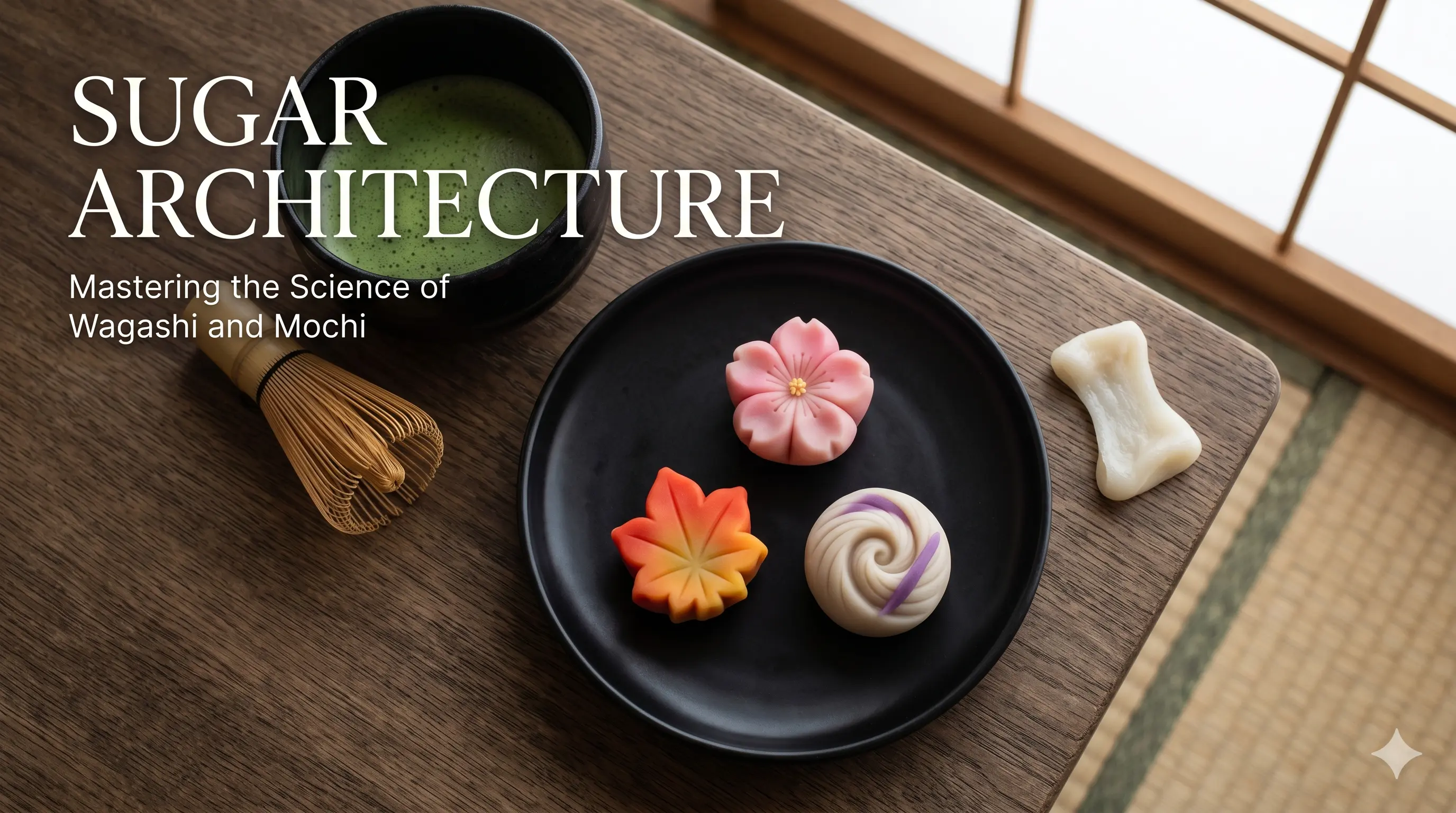
In the Japanese culinary arts, where balance and precision are paramount, Wagashi (traditional sweets) represents a sophisticated culmination. While Western confectionery often leans heavily on dairy, high-fructose syrups, and chemical leaveners, Wagashi is engineered entirely through the precise manipulation of natural polysaccharides—starch, sugar, and moisture.
To master Wagashi, one must understand that these are not mere desserts; they are structured works of art designed to harmonize with the bitterness of Matcha. This article breaks down the foundational chemistry of the two key structured pastes in Japanese sweets: Shiro-an (white bean paste) and the physics of Mochi.
Part 1: Shiro-an – The “White Brick” of Structure
The architectural foundation of many Wagashi, including the complex, sculpted Nerikiri, is Shiro-an (White Bean Paste). Creating a high-quality Shiro-an is a multi-day technical achievement.
The Science of “Anko” Structure
The goal of Anko (bean paste) is not just a smooth texture; it is the correct ratio of bean solids to sugar.
- The Purification Wash (渋抜き): To achieve the pure, neutral flavor necessary for Wagashi, the white beans (usually Shirimame or Otebome) are boiled and then aggressively washed. This step physically removes the shibu (bitter tannins) and the outermost “skin” layer.
- The Starch Release: After mashing, the resulting slurry must be strained through a series of ultra-fine mesh bags (koshi). This creates Koshi-an (fine paste), releasing pure starch molecules (amylose) while trapping any remaining cell walls.
- The Moisture Equilibrium (練り): The final, and most difficult, step is Neri (kneading with sugar). As the paste cooks on low heat, sugar is added gradually. A master chef watches for the specific gloss (Tsuya) and moisture content that ensures the paste is firm enough to hold a carved shape but still soft to the bite.
Part 2: Mochi – The Physics of the Polysaccharide Stretch
Mochi (pounded rice) is often reduced to a simple “sticky rice cake,” but its physics is far more complex. Authentic Mochi must possess Koshi—that paradox of SOFT yet POWERFULLY RESISTANT chew.
The Amylopectin Chain
The source of Mochi’s elasticity is Glutinous Short-Grain Rice (Mochigome). This rice contains $100\%$ amylopectin, a type of highly branched, heavy polysaccharide.
- The Steaming Effect: Before pounding, the rice must be perfectly steamed. If it is boiled, it will turn into a soft mush. The steam activates and gelatinizes the amylopectin, aligning the molecular chains into an elastic network.
- The Pounding Impact (Mochitsuki): The traditional pounding (Mochitsuki) is not merely a social event. The rapid, sequential impact breaks down the remaining cellular structure of the rice grains and physically forces the steamed amylopectin molecules to entangle and cross-link. This created the molecular “memory” that allows a piece of Mochi to stretch for feet and then snap back.
The Home Engineering Alternative (Shiratamako)
For the home cook, replicating Mochitsuki is impossible. The technical workaround is Shiratamako (glutinous rice flour). Unlike standard rice flour, which is milled dry, Shiratamako is milled wet and then dried into small, irregular, chalky chunks. This wet-milling preserves the integrity of the amylopectin chains, resulting in a dumpling (Shiratama) that possesses the authentic Koshi chew without the physical pounding.
Part 3: Nerikiri – The Aesthetic Pinnacle and the Matcha Interaction
The ultimate structured sweet is Nerikiri. It is a specialized dough made by combining Shiro-an with Gyuhi (a soft, sugar-sweetened Mochi paste).
The Balance of Taste
Nerikiri is engineered to be intensely sweet. This is not for indulgence, but for function. It is designed to be eaten immediately before a bowl of hot, frothy Matcha.
- The Interaction: The sugar saturates the palate, masking the aggressive initial bitterness of the powdered green tea, allowing the diner to perceive the tea’s underlying complex sweetness, vegetal notes, and intense umami. Without the extreme sweetness of the Wagashi, the true spectrum of fine Matcha is often lost.
Conclusion: Sugar as Architecture
Wagashi proves that a sweet is more than just a flavor; it is a structural state. Through the precise manipulation of bean starches and rice polysaccharides, Japanese chefs have engineered a category of confectionery that is fundamentally different from anything else in the world—sweets that are at once firm, elastic, and smooth, designed with architectural precision for a complete sensory experience.