
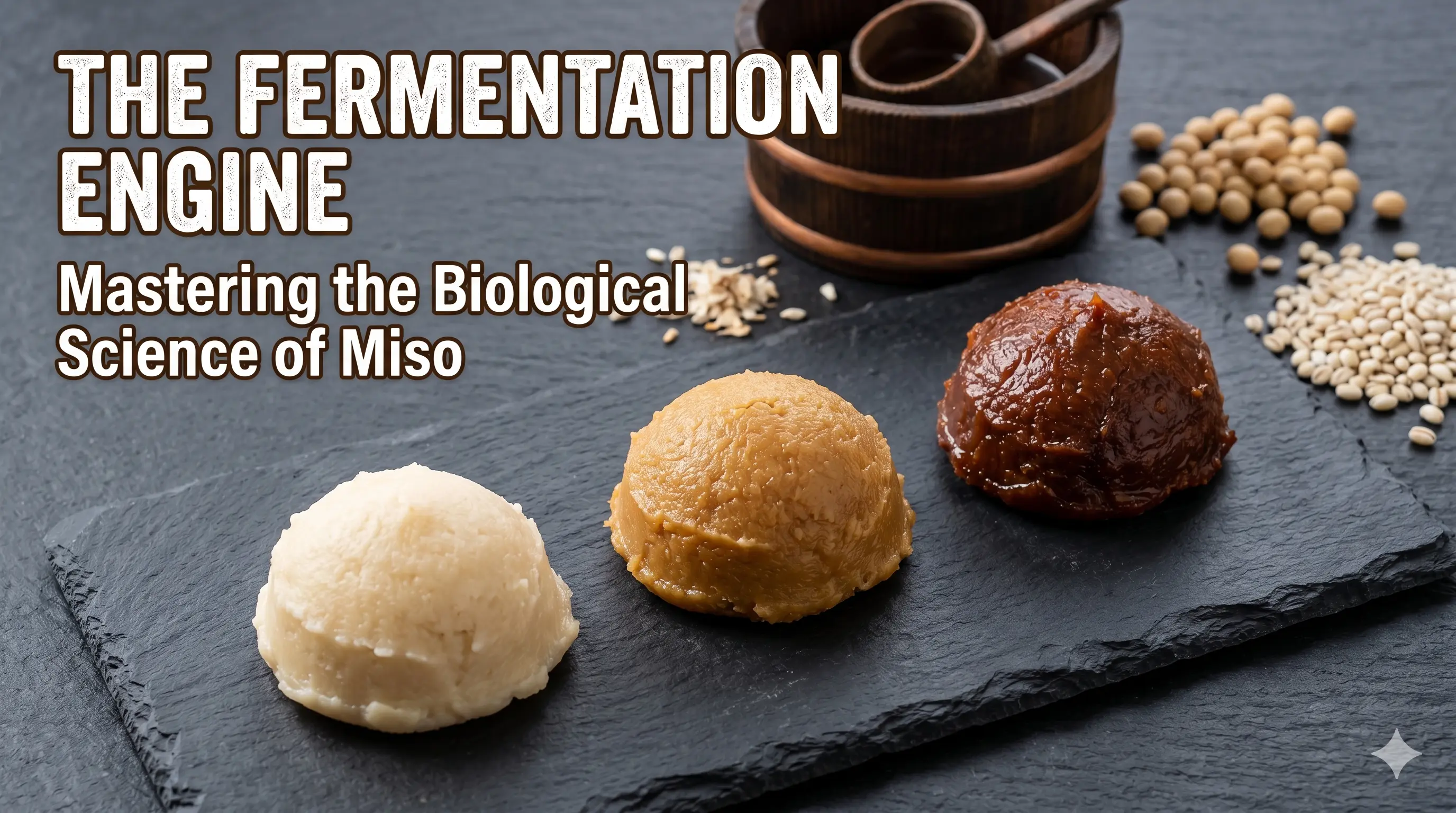
While Dashi is the soul of Japanese flavor, Miso is its primary engine. This fermented soybean paste is a masterpiece of microbial engineering, utilizing the Koji mold (Aspergillus oryzae) to transform inert proteins into a complex spectrum of savory, sweet, and funky flavors.
To master Miso, one must understand that it is a “living” food. Its flavor profile is not determined by a recipe, but by the technical variables of the fermentation environment: the salt concentration, the ratio of Koji, and the duration of the biological “age.”
Part 1: The Koji Catalyst – The Enzymatic Breakdown
Miso cannot exist without Koji. To create Koji, steamed rice or barley is inoculated with mold spores.
- The Protease Factory: As the mold grows, it releases powerful enzymes, primarily protease and amylase.
- The Molecular Teardown: When Koji is mixed with cooked soybeans and salt, these enzymes begin a massive technical demolition. Protease breaks the dense soy proteins into free amino acids (Glutamates), while amylase converts the rice starches into simple sugars. This is the biological origin of Miso’s signature “Sweet-Savory” balance.
Part 2: The Color Spectrum – A Study in Time and Salt
Miso is categorized by its color, which serves as a technical indicator of its chemical composition and age.
1. Shiro Miso (White Miso) – The “Short-Circuit” Fermentation
- The Engineering: High rice-to-soy ratio and low salt content.
- The Timeline: Fermented for a very short period (weeks to a few months).
- The Result: Because the fermentation is stopped early, most of the rice starch remains as sugar. It is creamy, light, and mildly sweet.
2. Aka Miso (Red Miso) – The Maillard Evolution
- The Engineering: High soybean content and high salt concentration.
- The Timeline: Fermented for one to three years.
- The Result: Over years of aging, a slow-motion Maillard Reaction occurs between the amino acids and sugars, physically turning the paste deep red or dark brown. This results in a complex, salty, and intensely umami flavor with notes of coffee or cocoa.
Part 3: The Thermal Rule – Protecting the Enzyme
In the kitchen, Miso is a sensitive technical component.
- The No-Boil Rule: A common technical failure is boiling Miso soup. Once Miso is added to a liquid, it must never exceed $90^{\circ}C$.
- Why? Boiling kills the living enzymes and vaporizes the delicate aromatic compounds created during the years of fermentation. To preserve the “living” character, Miso should be whisked into the soup at the very last second, off the heat.
Conclusion: The Living Seasoning
Miso is more than a paste; it is a bio-chemical achievement. It represents the Japanese ability to partner with nature, using microscopic fungi to unlock deep layers of flavor from the humble soybean. Whether it is the youthful sweetness of Shiro Miso or the aged authority of Aka Miso, it remains the definitive technical foundation of the Japanese pantry.