
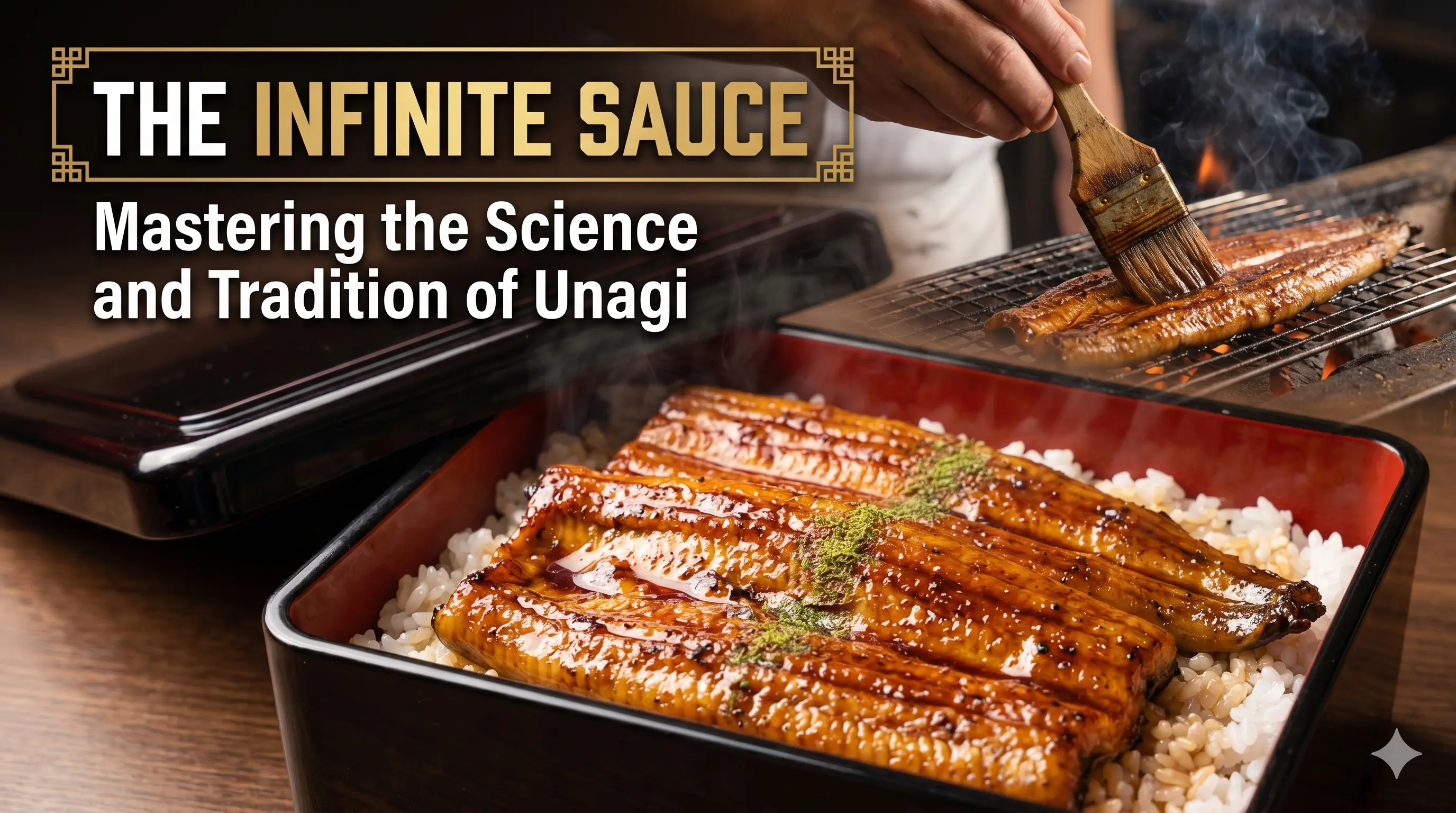
In the technical hierarchy of Japanese cuisine, Unagi (freshwater eel) occupies a unique position. It is one of the few ingredients that requires a specialized chef (unagi-ya) and a preparation process that takes decades to master. The core of this discipline is the Tare (basting sauce)—a “living” liquid that is technically infinite, often maintained by a single restaurant for over a hundred years.
To master Unagi, one must understand the biological complexity of the eel’s fat and the chemical evolution of a “perpetual” sauce.
Part 1: The Kabayaki Technique – Fat Management
Cooking Unagi is a study in thermal fat-rendering. Freshwater eel is exceptionally high in lipids and collagen, requiring a three-stage technical process to achieve the correct texture: Slice, Steam, and Sear.
1. The Slice (Kiri)
As discussed in the knife articles, Unagi requires a specialized knife (Unagi-saki). The eel is spatchcocked (butterflied) while alive to ensure the fat remains integrated with the muscle tissue.
2. The Steam (Mushi) – The Kanto Innovation
In the Tokyo (Kanto) style, the eel is steamed before grilling.
- The Technical Goal: Steaming dissolves the tough connective collagen and renders out the “heavy” surface fats, leaving a texture that is impossibly soft and “melt-in-the-mouth.”
3. The Sear (Yaki)
The eel is basted in Tare and grilled over Binchotan charcoal. The high infrared heat of the charcoal caramelizes the sugars in the sauce while the smoke from the dripping eel fat provides a deep, complex aromatic layer.
Part 2: The Infinite Tare – The Science of the Mother Sauce
The most fascinating technical aspect of an Unagi restaurant is the Tare. Many famous shops claim their sauce has been in continuous use for over a century.
How a Sauce Stays “Infinite”
This is not a myth; it is a matter of Perpetual Replenishment. The chef never finishes the jar of sauce. Instead, every day, they add fresh soy sauce, mirin, and sugar to the existing base.
- The Infusion of Essence: Every time a hot, grilled eel is dipped into the vat of Tare, a small amount of rendered eel fat and juices escapes into the sauce.
- The Emulsion: Over decades, the sauce becomes a hyper-concentrated emulsion of thousands of individual eels. This provides a depth of “animal umami” that cannot be replicated by a fresh recipe.
- The Biological Safety: The sauce is kept safe through high sugar and salt content (which prevents bacterial growth) and daily heating/dipping of searingly hot eel, which acts as a form of flash-pasteurization.
Part 3: The Sansho Balance – Chemical Palate Cleansing
Unagi is served with a small side of Sansho (Japanese pepper). This is not just for flavor; it is a technical requirement for the palate.
- The Paresthesia Effect: Sansho contains hydroxy-alpha-sanshool, which creates a tingling, numbing sensation.
- Fat Cutting: This chemical “vibration” on the tongue helps to cut through the heavy, rich fat of the eel, preventing sensory fatigue and allowing the diner to taste the nuances of the Tare until the final bite.
Conclusion: A Century in a Single Bite
Unagi is the ultimate example of Japanese culinary patience. It is a dish that relies on a century-old biological library (the Tare) and a high-precision thermal process. When you eat Unagi, you are not just consuming an eel; you are tasting a continuous chemical chain of flavor that has been engineered and protected by generations of master craftsmen.