
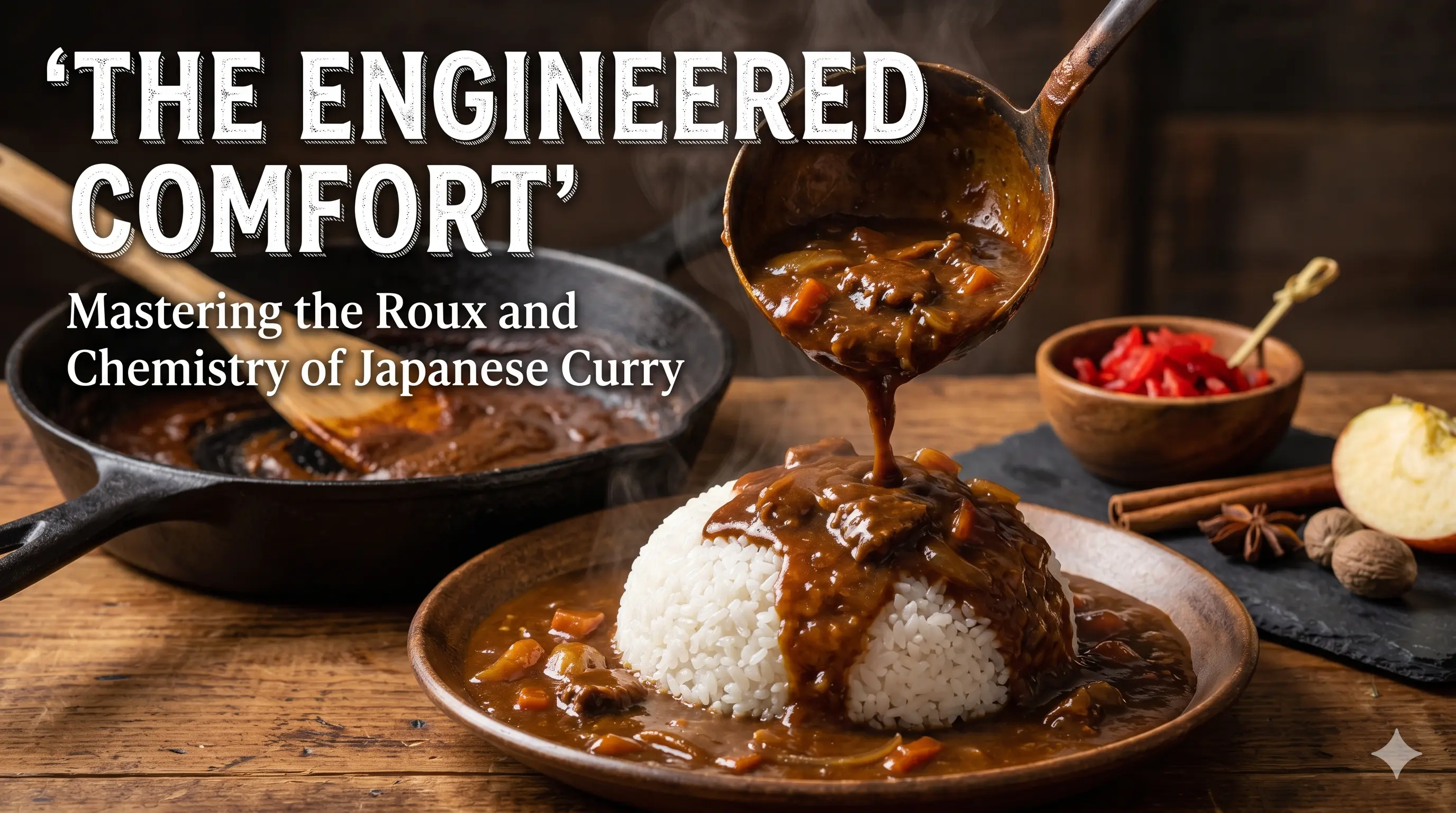
In the final technical pivot of this series, we examine a dish that isn’t native to Japan but has been systematically re-engineered into a distinct culinary category: Kare Rice (Japanese Curry). Unlike the spice-forward, high-heat complexity of Indian curry, Japanese curry is a masterpiece of European-style saucier technique combined with Japanese umami principles.
To master Japanese curry, one must understand the chemistry of the long-aged roux and the biological role of fruit-based enzymes in tenderizing proteins.
Part 1: The Dark Roux – The Architecture of Thickening
The defining characteristic of Japanese curry is its viscosity and deep, chocolatey color. This is not achieved through spices, but through a high-precision flour-fat emulsion.
The Slow Maillard Reaction
- The Base: A professional curry starts with a roux of butter and flour. However, while a French Béchamel uses a “white roux,” Japanese curry requires a “brown” or “dark” roux.
- The Thermal Window: The roux is cooked at a steady $140^{\circ}C$ for up to 45 minutes. This prolonged heat triggers the Maillard reaction in the wheat proteins, creating deep nutty and toasty aromatic compounds.
- The Emulsion Stability: Because the flour is so heavily cooked, it loses some of its thickening power but gains immense flavor. This allows for a sauce that is thick and velvety without feeling “starchy” or heavy on the palate.
Part 2: The “Secret” Acids – Enzyme-Driven Sweetness
A common technical confusion with Japanese curry is its inherent sweetness. This is not just added sugar; it is the result of enzymatic breakdown.
- The Grated Apple (Aomori Style): Most high-end curries include grated apple or honey. The malic acid and natural enzymes in the apple act as a chemical tenderizer for the beef, breaking down tough muscle fibers during the long simmer.
- The Onion Jam: Onions are caramelized for hours until they reach a jam-like consistency. This provides the “backbone” sweetness that balances the bitterness of the dark-roasted roux and the heat of the curry powder.
Part 3: The Aging Process (Ichiban-ne)
The final technical step in Japanese curry is the Resting Phase. Almost no professional curry shop serves a batch the same day it is made.
- Molecular Integration: During a 24-hour cooling period, the different flavor molecules—spices, beef fats, and fruit acids—undergo a process of “harmonization.”
- The “Day-Two” Effect: Cold temperatures allow the starch retrogradation to settle, resulting in a sauce that is more cohesive and has a “rounder” flavor profile. This is why “Day-Two Curry” is a technical benchmark in Japanese homes and restaurants alike.
Conclusion: The Saucier’s Triumph
Japanese Curry is a testament to the culture’s ability to adopt foreign concepts and refine them through the lens of precision chemistry. It is a dish where the “spice” is secondary to the technical construction of the sauce itself. By mastering the dark roux and the science of fruit-based tenderizing, the Japanese chef creates a comfort food that is as structurally sound as a French velouté but uniquely local in its soul.