
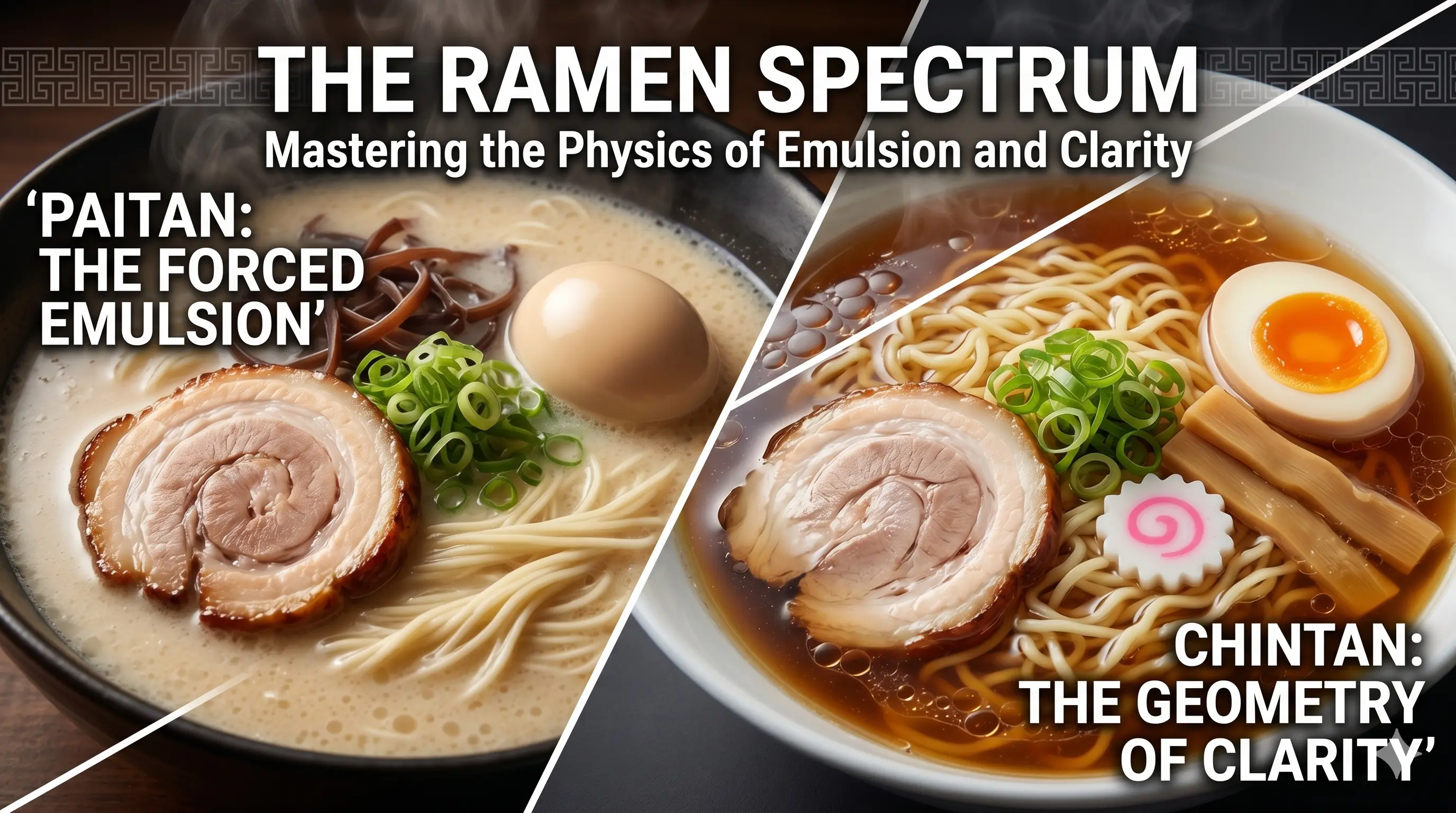
To conclude this technical masterclass, we arrive at the most globally recognized yet technically complex dish in the Japanese repertoire: Ramen. While often categorized as “soup,” a bowl of Ramen is actually a sophisticated architectural assembly of five distinct elements: Tare (seasoning), Koku (fat), Dashi (stock), Noodles, and Toppings.
The “Ramen Spectrum” is defined by two opposing physical states of the broth: Chintan (clear) and Paitan (cloudy/emulsified). Understanding the physics of bone-marrow extraction and the fluid dynamics of high-boil emulsion is the key to mastering the final frontier of Japanese culinary science.
Part 1: Tonkotsu (Paitan) – The Physics of the Forced Emulsion
The “cloudy” style, epitomized by Fukuoka’s Tonkotsu, is a triumph of high-energy fluid dynamics.
- The High-Heat Boil: Unlike French stocks, which are never allowed to boil to ensure clarity, Tonkotsu requires a violent, rolling boil for $12$ to $18$ hours.
- The Forced Emulsion: Bone marrow is high in collagen and fat. As the water boils vigorously, the kinetic energy physically breaks the fat into microscopic droplets.
- The Role of Gelatin: Simultaneously, the collagen in the pork bones breaks down into gelatin. The gelatin acts as a natural emulsifier, coating the fat droplets and preventing them from recombining. This creates a stable, creamy, opaque “white soup” that has a high-viscosity mouthfeel—a liquid that is physically thick with suspended lipids.
Part 2: Shoyu and Shio (Chintan) – The Geometry of Clarity
At the other end of the spectrum is the Chintan (clear) soup, typical of Tokyo-style Shoyu Ramen.
- The Sub-Simmer: To achieve a crystal-clear broth, the temperature must stay strictly between $80^{\circ}C$ and $90^{\circ}C$. There is no kinetic agitation.
- The Protein Scavenge: As the stock cooks, meat proteins denature and float to the surface. A master chef uses these proteins as a “filter” to trap impurities, resulting in a liquid that is rich in umami but optically transparent.
- The Separation of Fat: In a Chintan bowl, the fat (Aroma Oil) is added separately at the end. This ensures the fat floats on the surface as distinct, shimmering “jewels,” providing a rich aroma without clouding the purity of the stock.
Part 3: The Noodle – The Chemistry of Kansui
The one element that separates Ramen from all other noodle soups is Kansui (alkaline water).
- The $pH$ Shift: Kansui contains potassium carbonate and sodium carbonate. This raises the $pH$ level of the dough.
- The Resulting Texture: High $pH$ inhibits the enzymes that make wheat dough soft. Instead, it creates a specific “springy” or “chewy” texture (Koshi) and gives the noodles their characteristic yellowish hue. Without this alkaline chemistry, the noodles would simply be pasta; with it, they become structural elements capable of standing up to the intense heat and salt of the broth.
Conclusion: The Final Assembly
Ramen is the culmination of every technique we have studied: the starch control of the noodle, the molecular umami of the Tare, the thermal management of the broth, and the precision of the toppings. It is a dish that exists on a spectrum between the violent energy of an emulsion and the serene stillness of a clear stock. It is the perfect, complex finale to our journey through the technical heart of Japanese cuisine.