
While Western confectionery often relies on the structural properties of dairy fats and eggs, traditional Japanese sweets, or Wagashi, are built on the technical manipulation of plant-based starches and proteins. Specifically, Wagashi is a masterclass in the rheology of Anko (bean paste) and the gelling physics of Agar-agar (Kanten).These sweets are not merely "desserts"; they are engineered to provide a specific sensory counterpoint to the bitterness of Matcha, requiring precise control over moisture content and crystalline structure.Part 1: The Chemistry of Anko – Protein and Sugar SaturationThe foundation of most Wagashi is Anko, a paste made from Azuki beans. Unlike a simple puree, Anko is a complex suspension of starch granules encased in bean cell walls.The Breakdown of the AzukiThe "Go-zen" vs. "Tsubu" Distinction:Tsubu-an: Coarse paste where the bean skins are left intact. This provides a heterogeneous texture and rustic mouthfeel.Koshi-an: Fine, passed through a microscopic sieve to remove all skins. This results in a smooth, homogeneous protein-starch gel.Sugar as a Structural Element: Sugar in Anko isn't just for flavor; it’s a humectant. It binds to water molecules, preventing the starch from drying out and ensuring the paste remains pliable enough to be sculpted into the delicate, lifelike shapes seen in Nerikiri.Part 2: Kanten – The Thermostable GelWhile Western jelly relies on animal-based gelatin, Wagashi uses Kanten (Agar-agar), derived from red algae. The physical properties of Kanten are fundamentally different and more technically demanding.The Thermal ParadoxHigher Melting Point: Unlike gelatin, which melts at body temperature ($35^{\circ}C$), Kanten stays solid up to $85^{\circ}C$. This means Wagashi can maintain its sharp, engineered edges even in a humid tea room.Syneresis Control: If Kanten is not boiled correctly with the right sugar concentration, it will "weep" water—a process called syneresis. A master must balance the $pH$ and sugar levels to ensure the gel remains crystal clear and holds its internal moisture perfectly.Part 3: Nerikiri – The Sculptural EngineeringNerikiri is the pinnacle of Wagashi technique, often shaped into seasonal symbols like cherry blossoms or maple leaves.The Mochi-An Hybrid: It is a mixture of Shiro-an (white bean paste) and a small amount of Gyuhi (sweetened glutinous rice flour).The Pliability Factor: Adding the rice starch (Gyuhi) introduces elasticity to the crumbly bean paste. This creates a "culinary clay" that can be manipulated with specialized wooden tools without cracking.The Sensory Buffer: Because Matcha is high in tannins and acidity, Nerikiri is engineered with high sugar density. When eaten before the tea, the sugar coats the tongue, chemically "buffering" the palate so the tea’s umami and sweetness are highlighted rather than its bitterness.Conclusion: Engineering the Seasonal MomentWagashi is the intersection of botany, chemistry, and sculpture. It demonstrates that with just beans, rice, and seaweed, the Japanese craftsman can engineer a world of textures—from the firm, glass-like clarity of Yokan to the soft, velvet pliability of Nerikiri. It is the final, sweet proof that in Washoku, every ingredient is a tool to be mastered.

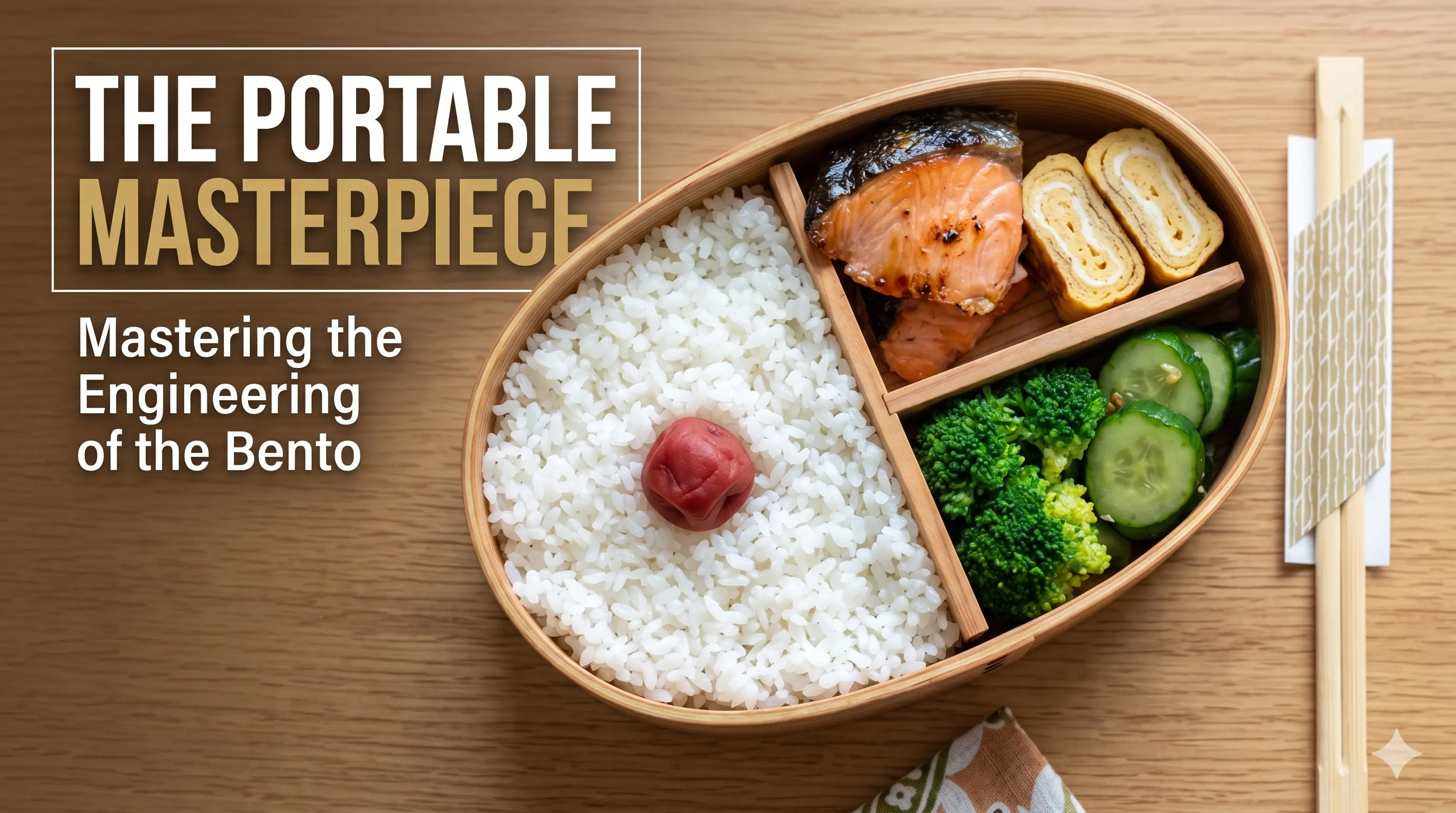
While many view the Bento as a simple lunchbox, it is technically an exercise in structural stability, moisture management, and food safety engineering. A professional Bento is designed to be eaten at room temperature, hours after assembly, without losing its textural integrity or becoming a biological hazard.

To master the Bento, one must understand the three ratios of volume, the physics of condensation, and the antibacterial role of natural preservatives.

Part 1: The Golden Ratios – Structural Engineering

A Bento is not packed at random; it follows a strict spatial logic designed to provide nutritional balance and physical support during transport.

The 3:2:1 Rule

  • 3 Parts Carbohydrate (Starch): Usually Gohan (rice). It acts as the “foundation,” providing the bulk of the calories and structural weight at the bottom of the box.
  • 2 Parts Protein: Fish, meat, or eggs. These are the “anchors” that provide satiety.
  • 1 Part Vegetable: The “buffer” that provides fiber and micronutrients.

The “No-Gap” Policy

  • Mechanical Stability: A Bento must be packed tightly. If there are air gaps, the food will shift and collide during transport, destroying the visual presentation and causing flavors to bleed into one another.
  • The Edible Divider: Professionals use “cup” dividers (like lettuce leaves or silicone molds) to isolate wet ingredients from dry ones, preventing the starch from becoming soggy through osmosis.

Part 2: Thermal Management – The Condensation Crisis

The greatest technical challenge of the Bento is moisture. If you close the lid while the food is hot, you create a “sauna effect.”

  • The Steam Trap: Hot food releases water vapor. If trapped, this vapor condenses on the lid and drips back onto the food, ruining the crispness of Tempura and making the rice gummy.
  • The Cooling Phase: All ingredients must be cooled to room temperature before the lid is sealed. This ensures the internal humidity remains low and the pressure inside the box stays neutral.

Part 3: Biological Safety – The Chemistry of Preservation

Because Bentos are often kept at room temperature (the “danger zone” for bacterial growth), Japanese chefs utilize Hozon-ryo (natural preservatives).

  • Umeboshi (The pH Guard): Placing a single pickled plum in the center of the rice isn’t just aesthetic (representing the Japanese flag). The high citric acid content of the Umeboshi creates an acidic “halo” that inhibits bacterial growth in the surrounding rice.
  • The Salt/Sugar Cure: Bento proteins are often cooked in Teriyaki or Shogayaki styles. The high concentrations of salt and sugar reduce Water Activity ($a_w$), making it harder for microbes to survive.
  • Antimicrobial Sheets: Modern bentos often include thin films infused with wasabi or mustard oils, which release volatile organic compounds that act as natural fungicides within the sealed environment.

Conclusion: The Portable Masterpiece

The Bento is the ultimate expression of Omotenashi (hospitality) in a box. It requires the chef to predict how food will behave hours into the future. By mastering the 3:2:1 ratio, cooling the ingredients to prevent condensation, and utilizing the chemistry of Umeboshi, the chef ensures that a meal eaten on a train or in an office is as safe and structurally sound as one served at a counter.


Writer - Daniel Carter

Daniel Carter

Daniel Carter is a Seattle-based food writer specializing in sushi, poke, and modern Japanese dining. With over seven years of experience reviewing local restaurants, he provides clear, unbiased insights to help diners understand menus, pricing, portion quality, and overall value. His straightforward writing style makes sushi easy to enjoy for both first-time visitors and regulars.

Leave a Comment