
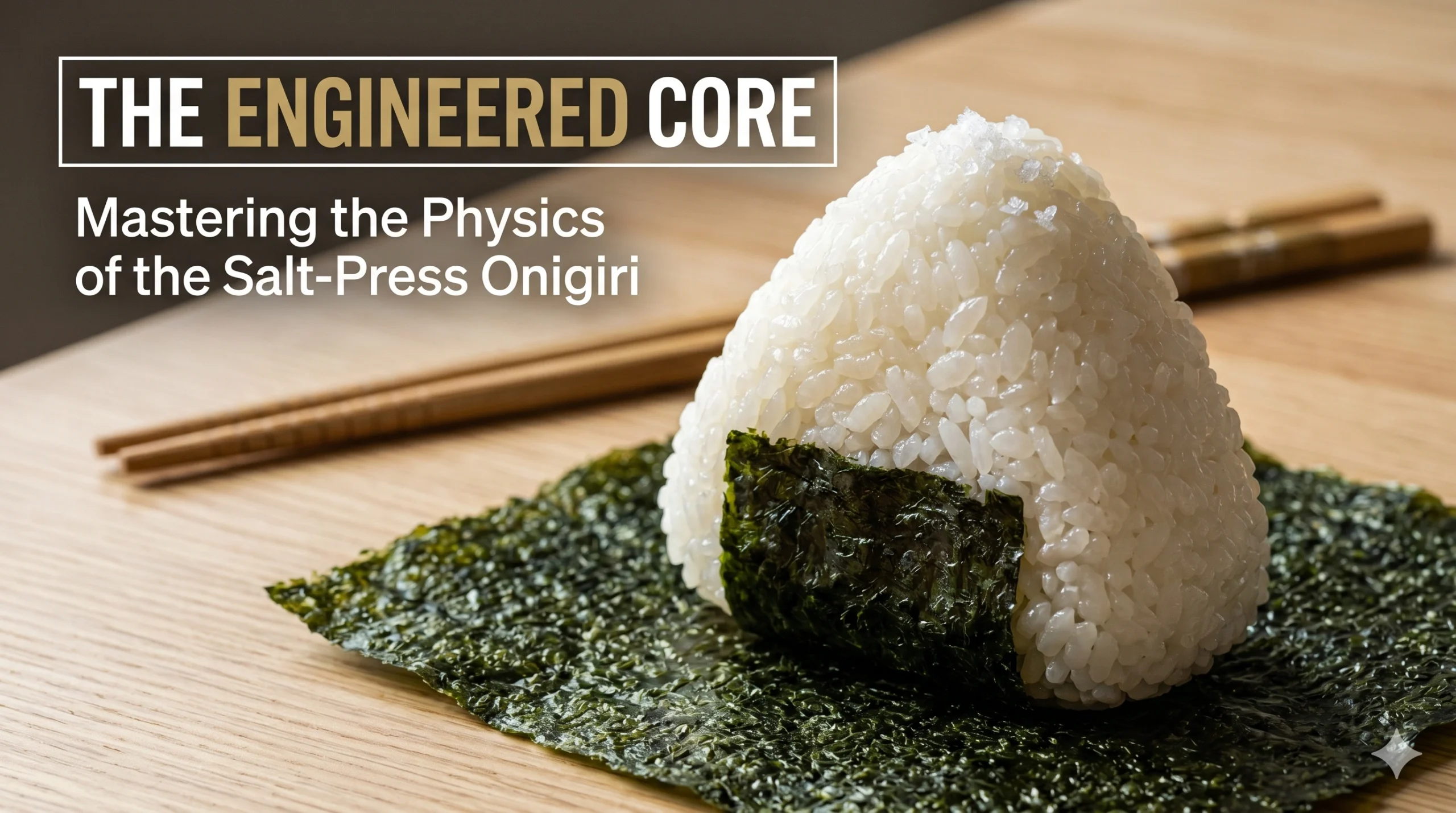
We conclude this technical exploration of the Japanese system with the Onigiri (rice ball). While often perceived as a simple snack, the Onigiri is a masterclass in surface tension, moisture migration, and manual compression physics. It is an engineered object designed to be stable enough for transport, yet porous enough to collapse instantly upon the first bite.
To master the Onigiri, one must move beyond “squeezing” and toward the management of the interstitial air gaps between grains.
Part 1: The Manual Compression – Avoiding the “Mash”
The most common technical failure in Onigiri production is over-compression. If you squeeze the rice too hard, you crush the individual grains, releasing starch and turning the ball into a dense, gummy mass.
- The “Hand-Form” (Nigiri) Geometry: The chef uses their palms to form a triangle, but the pressure is applied only to the exterior shell.
- The Interstitial Air Gaps: A technically perfect Onigiri is held together by surface tension, not physical force. By keeping air pockets between the grains, the chef ensures a light mouthfeel. This structure allows the rice ball to remain cohesive during transport but “scatter” easily once it hits the palate.
Part 2: The Salt-Press – Chemical and Biological Stability
Unlike sushi, which uses vinegar for preservation, Onigiri relies on the Salt-Press (Shio-musubi).
- The Hand-Salt Technique: Salt is applied directly to the wet palms before shaping. This serves two technical functions:
- Anti-Adhesion: The salt water creates a thin film that prevents the sticky starch of the rice from adhering to the chef’s skin.
- Surface Sterilization: Since Onigiri is often handled directly, the salt acts as a topical antimicrobial agent, reducing the biological load on the surface of the rice ball and extending its shelf life at room temperature.
Part 3: The Nori Interface – Managing Moisture Migration
The interaction between the dry Nori (seaweed) and the moist Gohan (rice) is a battle of water activity ($a_w$).
- The Crispness Paradox: Nori is extremely hygroscopic; it absorbs moisture from the air and the rice instantly. If wrapped too early, the Nori becomes leathery and tough.
- The “Separation” Engineering: Modern commercial Onigiri (like those in Japanese convenience stores) use a specialized plastic film to keep the Nori and rice separate until the exact moment of consumption. In traditional settings, the Nori is applied just before eating to ensure the cellular structure of the seaweed remains brittle, providing a sharp textural contrast to the soft, hydrated rice.
Conclusion: The Final Synthesis
The Onigiri is the ultimate proof that in Washoku, even the simplest form is a product of rigorous engineering. By managing manual pressure to preserve air gaps, utilizing salt as a structural and biological tool, and controlling moisture migration between rice and seaweed, the Japanese system creates a portable meal that is a perfect balance of stability and delicacy.