
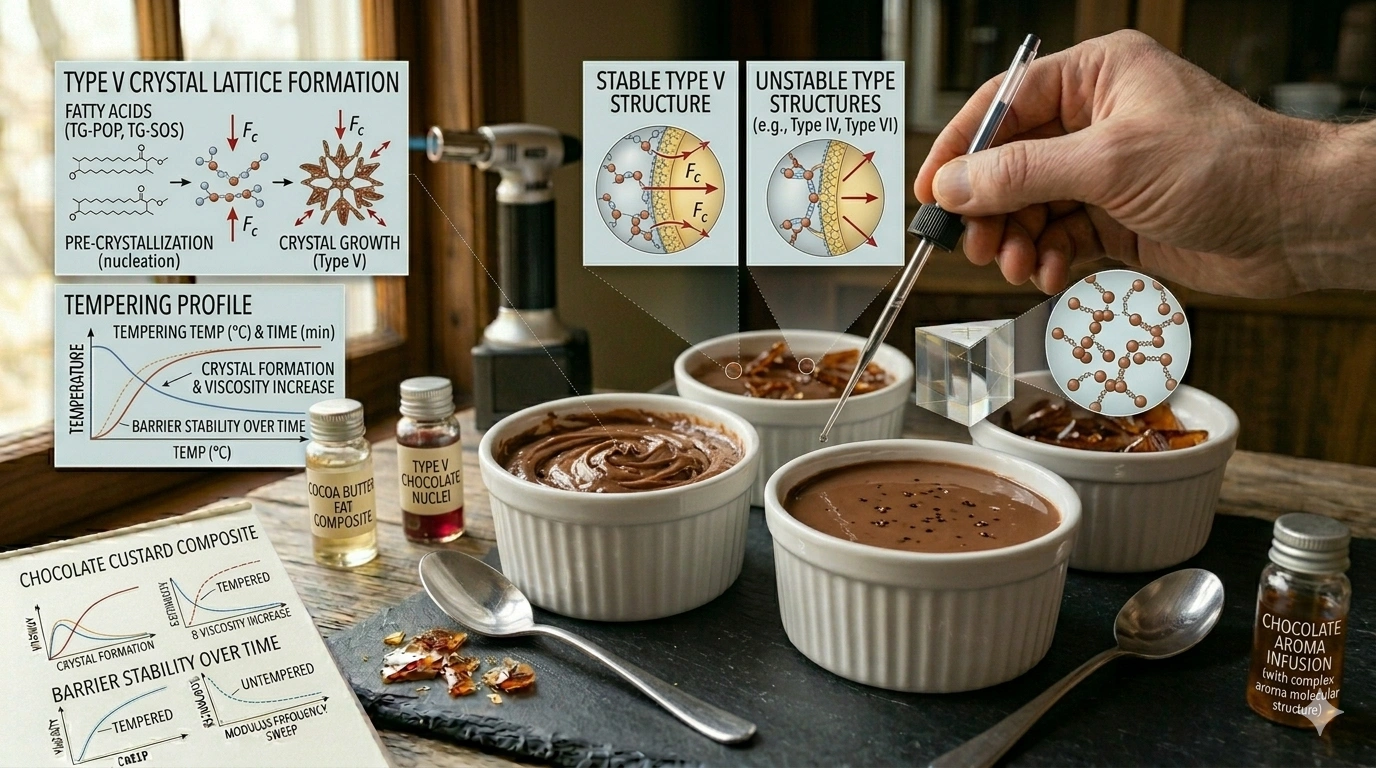
We move from the filtration of savory liquids to the solid-state physics of Chocolate Tempering. Chocolate is a polymorphic substance, meaning its primary fat—cocoa butter—can solidify into six different crystalline structures (Forms I through VI). Only one of these, Form V ($\beta$), provides the professional “snap,” glossy finish, and shelf stability required in high-end confectionery.
To master tempering, one must understand the relationship between thermal cycling and seed crystal nucleation.
Part 1: Polymorphism – The Search for the $\beta$ Crystal
Cocoa butter is a complex triacylglycerol that is highly sensitive to the rate of cooling. Without tempering, chocolate cools into a disorganized mix of low-melting-point crystals.
- The Unstable Forms (I–IV): These crystals melt at or below room temperature, resulting in chocolate that is soft, dull, and prone to “bloom” (where fat migrates to the surface, creating white streaks).
- The Gold Standard (Form V): This crystal lattice is tightly packed and stable. It melts at $32^{\circ}C$ to $34^{\circ}C$—precisely just below human body temperature. This is the “melt-in-your-mouth” engineering that defines quality chocolate.
- The Form VI Trap: While even more stable, Form VI crystals are too hard and take weeks to form. They are usually a sign of aged or poorly stored chocolate.
Part 2: The Thermal Cycle – Destructive and Constructive Heating
Tempering is a three-stage thermodynamic process designed to eliminate weak crystals and promote the growth of the $\beta$ lattice.
- Melting (The Tabula Rasa): Dark chocolate is heated to $45^{\circ}C$ to $50^{\circ}C$. This destroys all existing crystal structures, leaving a blank slate of liquid lipid.
- Cooling (The Seeding): The chocolate is cooled rapidly to $27^{\circ}C$. This triggers the formation of both “good” (Form V) and “bad” (Form IV) crystals. By agitating the chocolate (tabling or stirring), the chef encourages the formation of Form V “seed” crystals.
- Reheating (The Selective Kill): The chocolate is gently raised to $31^{\circ}C$ to $32^{\circ}C$. This temperature is high enough to melt the unstable Form IV crystals but low enough to keep the Form V seeds intact.
Part 3: Latent Heat and the “Snap”
When chocolate is tempered correctly, it undergoes a rapid phase transition as it sets.
- Shrinkage: Form V crystals are more dense than their liquid counterpart. As the chocolate sets in a mold, it actually shrinks slightly. This is what allows a tempered chocolate bar to release effortlessly from a mold.
- The Acoustic Snap: The tight, orderly lattice of the $\beta$ crystal creates a rigid structure. When broken, it releases energy in a clean, audible “snap,” which is the primary auditory indicator of a successful temper.
Conclusion: The Architecture of Lipid
Chocolate tempering proves that the arrangement of molecules is as important as the molecules themselves. By using precise thermal windows to curate a specific crystal lattice, the chocolatier transforms a soft, dull fat into a high-performance, glossy solid. It is the physics of controlled crystallization.