
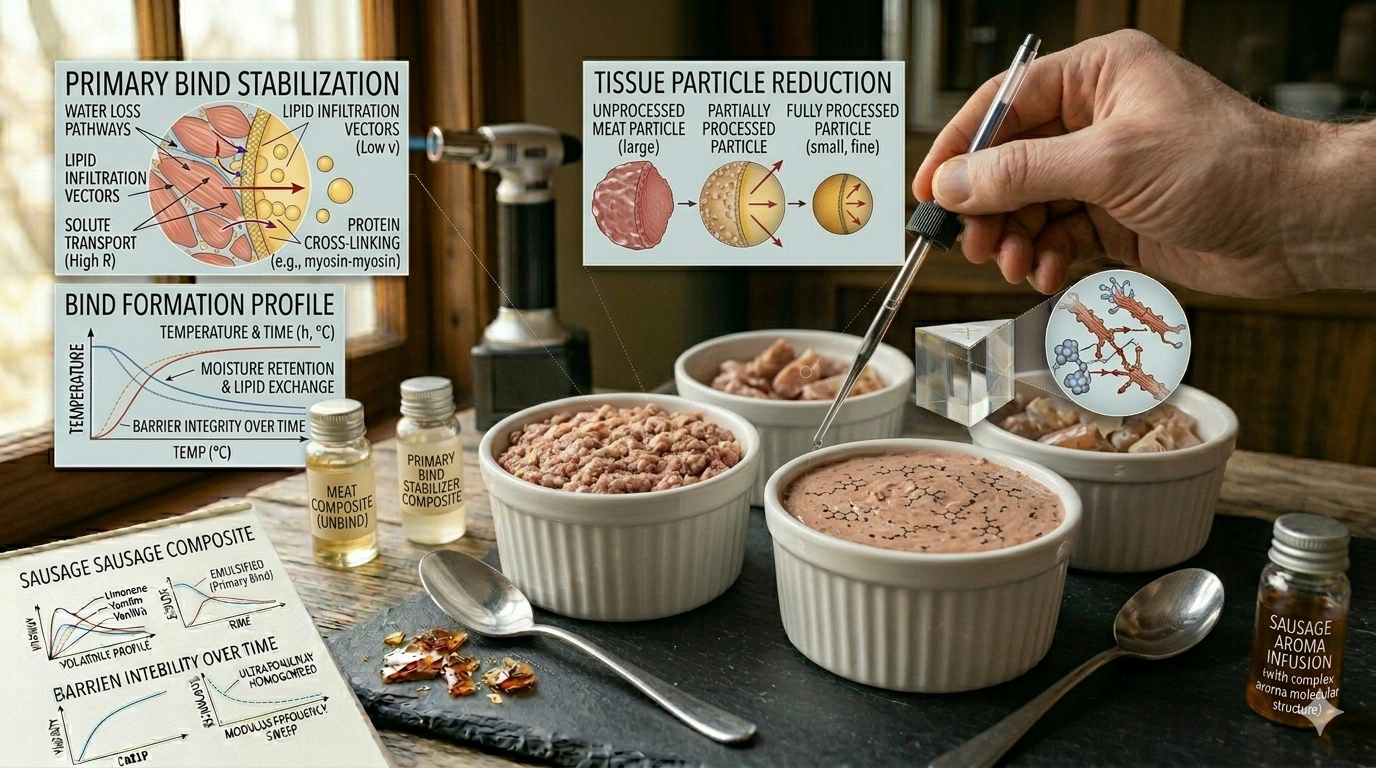
We shift from the crystalline structure of chocolate to the biopolymer engineering of the Emulsified Sausage (such as Mortadella, Frankfurters, or Bratwurst). Unlike a coarse-ground sausage, an emulsified sausage is a solid-state meat emulsion. It is a complex matrix where finely divided fat globules are suspended within a continuous phase of water and salt-soluble proteins.
To master the emulsified sausage, one must understand the relationship between myofibrillar protein extraction and thermal emulsion stability.
Part 1: The Primary Bind – Extracting Myosin
The “glue” that holds a sausage together is not the fat, but a specific protein called myosin. Myosin is a salt-soluble myofibrillar protein found within muscle tissue.
- The Role of Salt: Salt (Sodium Chloride) is added to the lean meat first. The salt ions cause the tightly packed muscle fibers to swell and the myosin strands to uncoil and dissolve into a sticky, actin-myosin paste.
- Mechanical Shear: High-speed blades (in a bowl cutter or food processor) physically break down the muscle cells, maximizing the surface area of the extracted myosin. This creates the “Primary Bind”—the protein net that will eventually trap the fat and water.
Part 2: The Fat-Protein Interface – Encapsulation
Once the protein net is established, fat is introduced. In a successful emulsion, the fat is not just “mixed in”; it is encapsulated.
- Micro-Droplet Formation: The cold fat is chopped into microscopic globules.
- The Interfacial Film: The dissolved myosin molecules migrate to the surface of these fat droplets, coating them in a thin protein film. This prevents the fat droplets from touching each other and coalescing into a greasy pool during the cooking process.
- The Water Phase: The same protein net also binds the added water (often added as ice), ensuring the final product is juicy rather than dry.
Part 3: The Thermal Set – Coagulation and the $13$°C Limit
The engineering of a meat emulsion is extremely sensitive to temperature. If the friction of the blades causes the meat to get too warm before it is cooked, the emulsion will “break.”
- The Critical Window: For pork, the emulsion should stay below $13^{\circ}C$ to $15^{\circ}C$ during the chopping phase. If the temperature exceeds this, the proteins begin to denature prematurely and lose their ability to coat the fat.
- The Final Gelation: Once the sausage is stuffed and heated (usually to an internal temperature of $68^{\circ}C$ to $71^{\circ}C$), the protein coating around the fat globules coagulates into a firm, elastic gel. This “locks” the fat and moisture in place permanently.
Conclusion: The Mastery of the Matrix
The Emulsified Sausage proves that meat can be engineered into a new physical state. By using salt to extract myosin and managing temperatures to ensure perfect encapsulation, the chef creates a material that is structurally uniform, elastic, and high in moisture. It is the physics of protein-lipid stabilization.