
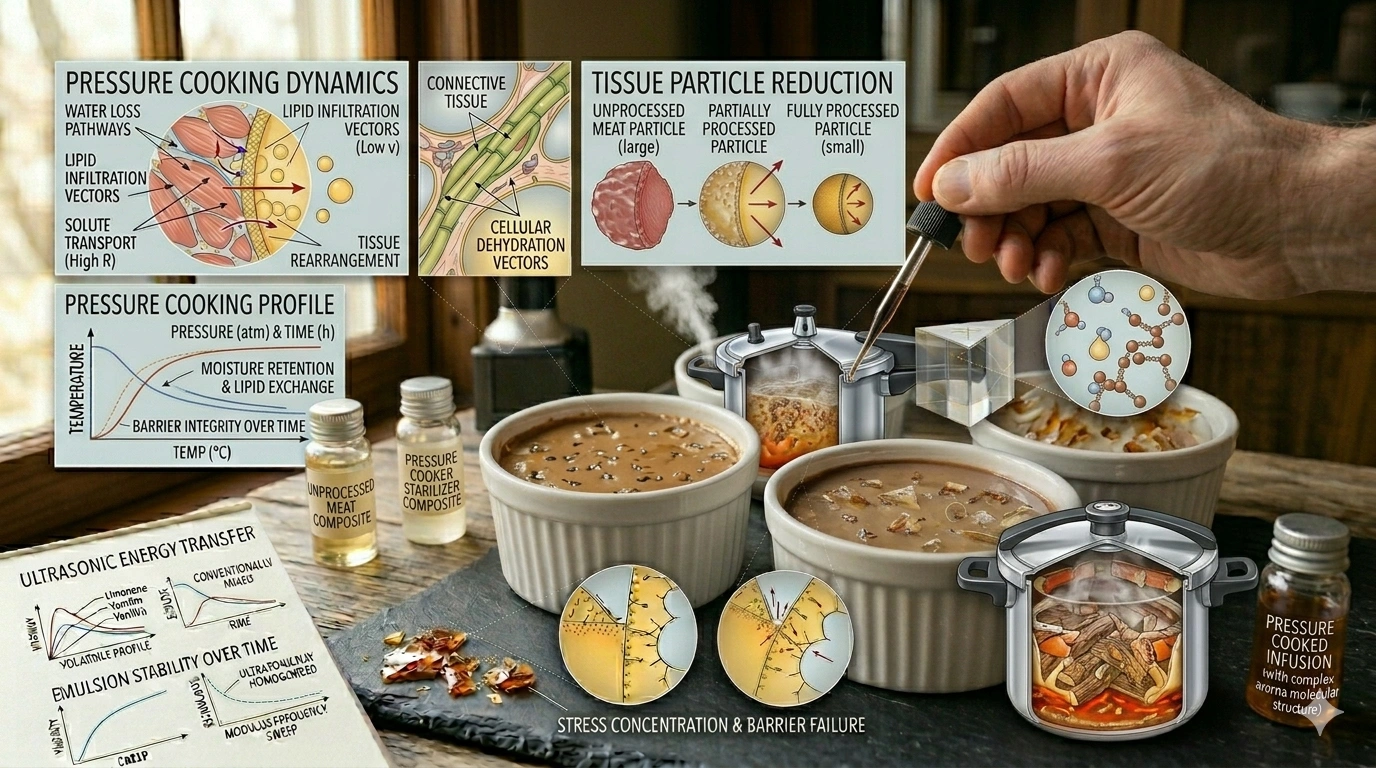
We move from the infusion of gas into solids to the high-pressure thermodynamics of the Pressure Cooker. This tool is the cornerstone of efficient kitchen engineering, allowing for the rapid transformation of tough proteins and starches by manipulating the physical properties of water. While a standard pot is limited by the local atmospheric pressure, a pressure cooker creates an artificial environment where the laws of boiling are rewritten.
To master the Pressure Cooker, one must understand the relationship between vapor pressure and boiling point elevation.
Part 1: The Pressure-Temperature Link – TheClausius-Clapeyron Relation
In an open pot at sea level, water boils at 100°C. No matter how much heat you add, the water will not get hotter because the energy is used to convert liquid into steam (latent heat of vaporization).
- The Sealed System: A pressure cooker uses a gasket to create a hermetic seal. As the water inside heats up, the steam produced is trapped, which rapidly increases the internal atmospheric pressure.
- Boiling Point Elevation: According to the principles of thermodynamics, as the pressure on a liquid increases, the energy required for the liquid molecules to escape into the gas phase also increases. At a standard pressure of 15 psi (approx. 1 bar) above atmospheric pressure, the boiling point of water rises to 121°C.
Part 2: Kinetic Acceleration – Cutting Cooking Time
The $21^{\circ}C$ difference between a standard boil and a pressurized boil is not incremental; it is transformative for chemical reaction rates.
- The Arrhenius Equation: In many chemical reactions, including the breakdown of connective tissue, the reaction rate roughly doubles with every $10^{\circ}C$ increase in temperature.
- Rapid Hydrolysis: Tough collagen in meat that might take 4 to 6 hours to turn into gelatin at a standard simmer can be converted in as little as 45 to 60 minutes under pressure.
- Enhanced Maillard Reaction: While the Maillard reaction (Article 68) usually requires a dry environment, the high temperatures achieved in a pressure cooker allow browning to occur even in a moist environment. This is why pressure-cooked stocks have a deeper, “roasted” flavor profile compared to traditional stocks.
Part 3: The Physics of Cooling – Natural vs. Manual Release
The most critical safety and technical phase of pressure cooking is the depressurization.
- Natural Release: As the heat is removed, the steam slowly condenses back into liquid, and the pressure drops. This is ideal for meats, as it prevents the muscle fibers from “squeezing” out moisture during a sudden pressure shift.
- Manual/Quick Release: If the valve is opened suddenly, the internal pressure drops instantly to match the outside atmosphere. Because the liquid inside is still at $121^{\circ}C$ (well above the “new” boiling point of $100^{\circ}C$), it undergoes flash boiling. This turbulence can shred delicate ingredients or cause starches to foam and spray through the valve.
Conclusion: Engineering Time and Temperature
The Pressure Cooker proves that the “limits” of cooking are often just the limits of the atmosphere. By utilizing a sealed vessel to elevate the boiling point of water, the chef can manipulate the kinetics of flavor extraction and protein breakdown with surgical speed. It is the physics of thermal acceleration.