
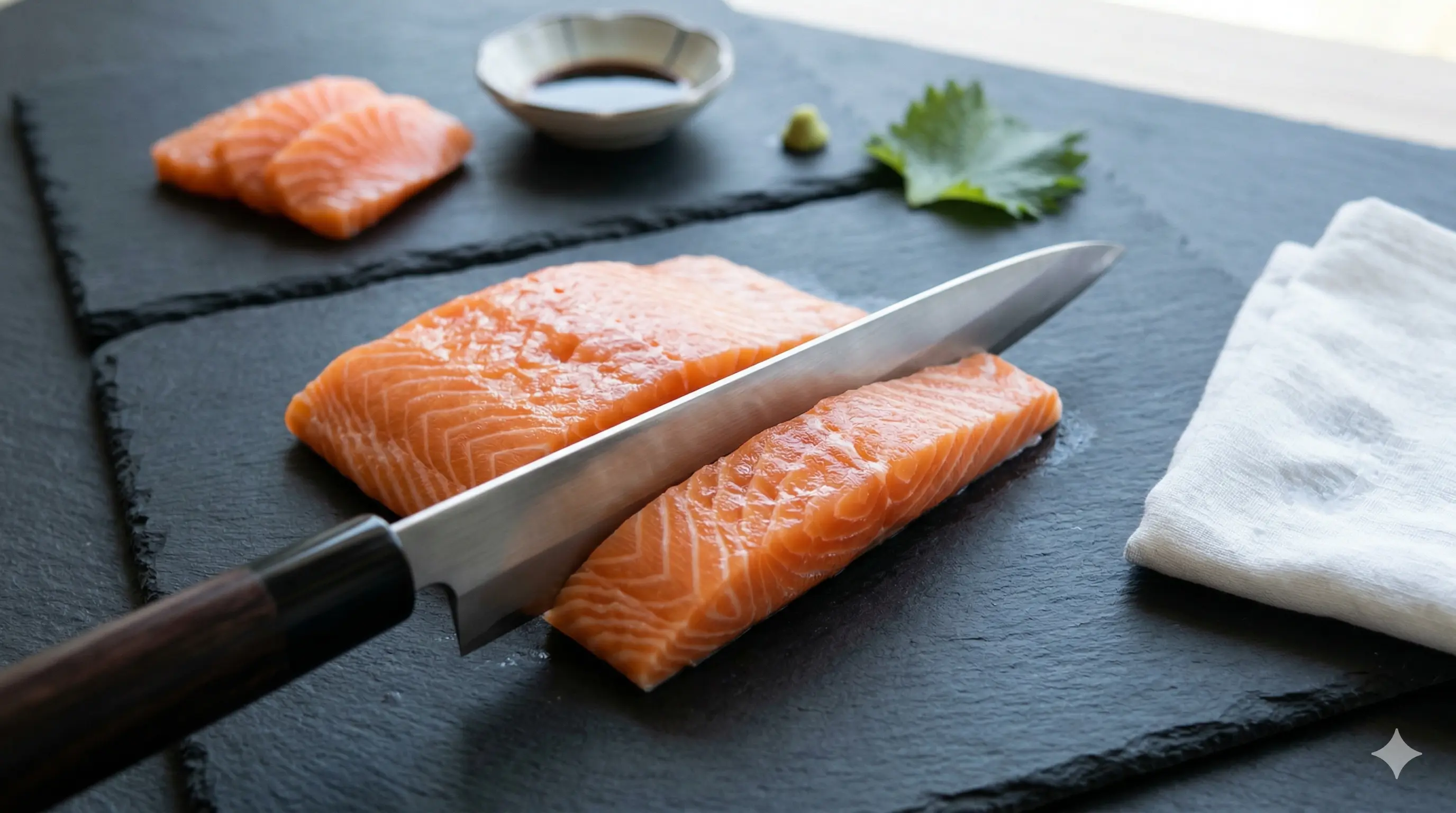
If you have already mastered perfect sushi rice (see our previous guide!), your next challenge is mastering the art of the knife. Slicing fish for Sashimi isn’t just about cutting a piece of seafood; it’s a technical skill that affects the texture, flavor, and presentation of the dish.
In Japan, specialized Itamae (sushi chefs) spend years perfecting their cuts. While you might not be running a professional kitchen, learning the proper technique can dramatically improve your at-home sushi experience.
1. Start with ‘Sashimi-Grade’ Fish
You cannot use regular grocery store fish for this. You must source Sashimi-Grade or Sushi-Grade fish. This means the fish was caught, cleaned, and frozen immediately to a temperature that kills parasites. When dealing with raw food, safety is always the first ingredient.
2. The Knife: Sharpness is Everything
You cannot make clean Sashimi cuts with a dull, serrated bread knife. A true sushi chef uses a Yanagiba—a long, thin, single-bevel knife that is kept razor-sharp. If you don’t have one, use your sharpest, thinnest chef’s knife.
A sharp knife slices through the muscle fibers rather than crushing them, which keeps the delicate textures intact.
3. The Essential ‘Hira-Zukuri’ Cut (Rectangular Slice)
This is the standard, vertical slice used for salmon and tuna.
- Position the Fish: Place the chilled fish loin on the cutting board.
- The Motion: Start with the heel of the knife against the fish, at about a 90-degree angle.
- The Pull: Draw the knife toward you in one single, smooth pulling motion. Do not “saw” back and forth. Sawing creates rough edges.
- The Thickness: For Sashimi, aim for slices about 1/4 to 1/2 inch thick (roughly 5mm to 1cm).
4. The Delicate ‘Usu-Zukuri’ Cut (Thin Slice)
This technique is used for firmer, white-fleshed fish like fluke, seabass, or snapper. It creates slices that are so thin they are nearly translucent.
- Angling the Knife: Instead of 90 degrees, angle the knife sharply—almost parallel to the cutting board.
- The Pull: Use the same smooth pulling motion. The goal is to maximize the surface area, highlighting the delicate texture of the fish.
5. Keeping it Cold
The warmth from your hands can dull the flavor and soften the texture of the fish. Work quickly, and keep the fish on ice or chilled in the refrigerator until the very moment you are ready to slice.