
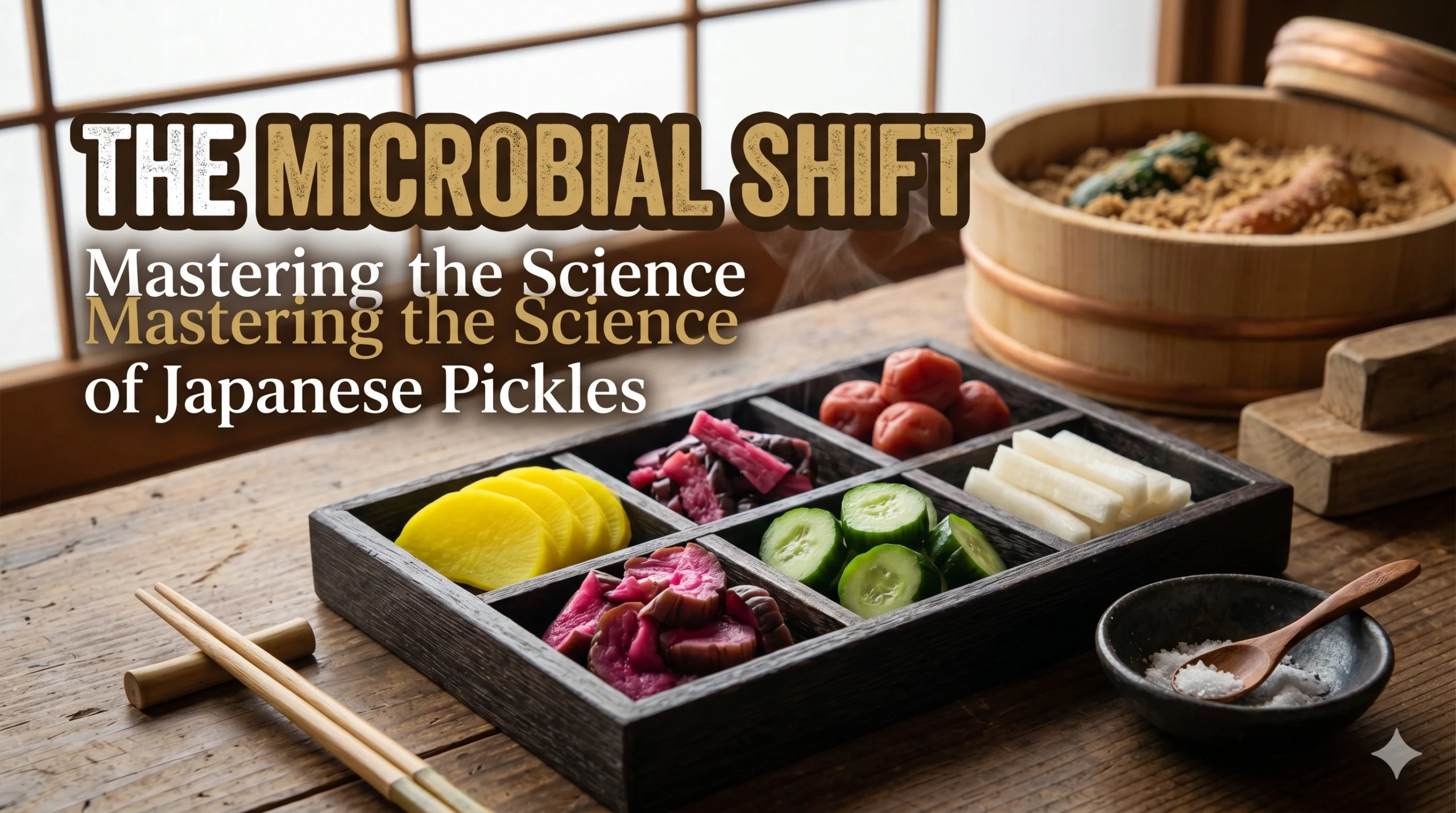
In the Japanese culinary system, Tsukemono (pickled things) are far more than a side dish; they are a high-precision method of biological preservation and flavor intensification. While Western pickling often relies on a high-acid vinegar soak to kill bacteria, Japanese pickling frequently utilizes fermentation, employing salt, rice bran, or miso to create a controlled microbial battlefield.
To master Tsukemono, one must understand the relationship between Osmotic Pressure and the selective cultivation of lactic acid bacteria.
Part 1: Osmotic Pressure – The Mechanical Foundation
The first stage of any Tsukemono is the application of salt and weight (Tsukemono-ishi). This is an exercise in pure physics.
- Cellular Dehydration: Salt is a desiccant. Through osmosis, it draws water out of the vegetable’s cellular vacuoles. This accomplishes two things:
- It creates a “crunchy” and dense texture by collapsing the cell walls.
- It reduces the Water Activity ($a_w$) of the vegetable, making it inhospitable for spoilage-causing bacteria.
- The Weight Factor: The heavy stone on top of the pickling vessel serves a technical purpose. It physically forces air out of the mixture, creating an anaerobic (oxygen-free) environment. This is the critical “switch” that allows beneficial fermentation to begin while preventing mold growth.
Part 2: Nukazuke – The Rice Bran Ecosystem
The most technically complex form of Tsukemono is Nukazuke, where vegetables are buried in a fermented bed of rice bran called a Nukadoko.
- The Living Bed: A Nukadoko is a complex microbial ecosystem containing billions of Lactobacillus and yeast cells. It must be “fed” and turned by hand daily to introduce just enough oxygen to keep the yeast healthy without allowing aerobic spoilage.
- Vitamin Enrichment: Unlike vinegar pickling, which can leach nutrients, Nukazuke is a bio-fortification process. The vegetables actually absorb Vitamin B1 and other minerals from the rice bran during their stay in the bed.
- The Flavor Profile: The result is a pickle with a unique “earthy” funk and a complex, sourdough-like acidity that cannot be replicated through any chemical means.
Part 3: The Regional Chemistry of Salt-Cures
Depending on the salt concentration and the “medium,” the chemical outcome of the pickle changes:
| Type | Medium | Technical Key |
| Shiozuke | Salt Only | Focus on crispness and the natural color of the vegetable. |
| Misozuke | Miso Paste | High protease activity; breaks down proteins into intense umami. |
| Kasuzuke | Sake Lees | Uses residual alcohol from Sake production to sterilize and sweeten. |
| Asazuke | Light Brine | “Morning pickles.” Short-term (minutes to hours) osmotic shift only. |
Conclusion: The Biological Safety Net
Tsukemono represents the final layer of the Washoku safety net. By mastering the osmotic pressure of salt and the microbial management of the Nukadoko, the Japanese chef ensures that no ingredient is wasted and every meal is accompanied by a probiotic, enzyme-rich aid to digestion. It is the quiet, biological engine that balances the salt and starch of the Japanese diet.