
To conclude our technical journey through the fundamental starch and protein systems of Japan, we must analyze Soba (buckwheat noodles). While ramen relies on alkaline chemistry (Kansui) to create a springy texture, and udon relies on intensive gluten development, Soba is technically a study in particle geometry and physical density. Soba, specifically Ni-Hachi (80% buckwheat, 20% wheat), represents the ultimate structural compromise between a non-gluten flour and a required matrix.To master Soba, one must move beyond "kneading" and toward the engineering of a non-cohesive particle stack.Part 1: Buckwheat Physics – The Gluten-Free CrisisThe core technical challenge of Soba is that buckwheat is not wheat. It lacks the necessary gluten proteins (glutenin and gliadin) required to form the elastic, cohesive structure of a noodle. Pure buckwheat flour (Jyu-wari Soba) is essentially a powder that dissolves in water.The Protein Difference: Wheat contains high amounts of glutenin (providing elasticity) and gliadin (providing extensibility). Buckwheat proteins, conversely, are primarily globulins and albumins, which provide no cohesive structure when mixed with water.The Binder System: This is why most professional Soba is Ni-Hachi Soba (20% wheat binder). The chef is technically creating a standard wheat dough matrix ($20\%$), which then must physical capture and support a non-cohesive buckwheat particulate load ($80\%$). It is a particle suspension, not a gluten chain.Part 2: Uchi – The Geometry of Particle StackingBecause Soba has very little elasticity, standard dough manipulation fails. If you stretch Soba, it breaks. Instead, the Soba-ya uses geometry to achieve thickness.The Standard Geometry:Maru-me (Circle): The dough is first worked into a perfect, dense sphere to equalize density.Kaku-出し (Square-Out): The dough is not rolled thin; it is physically flattened into a perfect, thin square by folding and applying downward pressure with a Menbo (rolling pin). The Soba chef maintains this square shape with perfect, 90-degree corners. Why?Physical Folding: To achieve thickness, the thin square sheet is folded into layers. These layers are not compressed; they are physically stacked. When the final cutting occurs, the thickness of the noodle is determined purely by the physical thickness of the stacked layer, not by any physical stretching.Part 3: Kiri – The Perfect Cross-SectionThe final technical act of Soba is the Kiri (cutting). This is the reason for the square geometry of the initial sheet.The Soba-Kiri Cleaver: The Soba knife is unique: a massive, heavy, dead-straight square-faced cleaver. The weight of the knife itself provides the cutting power.The Wooden Guide (Koma-ita): The chef uses a wooden board as a precision cutting guide. Each cut is perfectly straight.The Perfect Square Cross-Section: By cutting a perfectly flat, stacked sheet with a perfectly straight, heavy blade, the resulting noodle has a precise 1mm x 1mm square cross-section. This geometry ensures that every noodle has the exact same surface area, allowing for uniform cooking times (usually 60 seconds) and, crucially, a flawless Tsuyu (dipping sauce) adhesion. If the noodle cross-section were round or uneven, the Tsuyu would slip off; the square edge provides maximum surface tension.Conclusion: The Final Starch IntegritySoba is the triumph of geometry over material failure. By recognizing that buckwheat has no internal cohesive structure, the Japanese system utilizes the strict physical stack, the square sheet, and the precision cleaver to create an engineered noodle. It is the final proof that in Washoku, if the chemistry cannot provide the desired result, the geometry will.

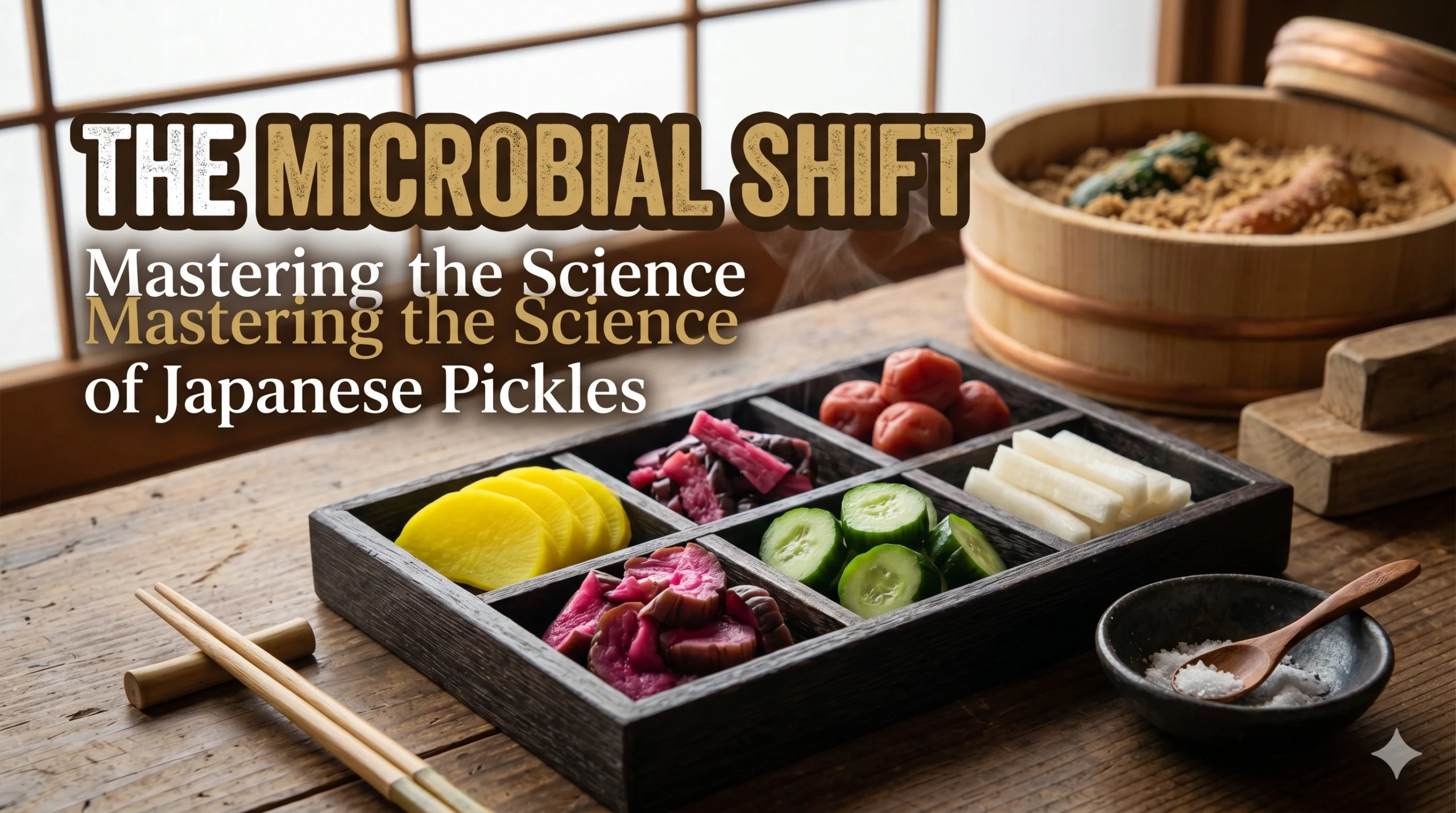
In the Japanese culinary system, Tsukemono (pickled things) are far more than a side dish; they are a high-precision method of biological preservation and flavor intensification. While Western pickling often relies on a high-acid vinegar soak to kill bacteria, Japanese pickling frequently utilizes fermentation, employing salt, rice bran, or miso to create a controlled microbial battlefield.

To master Tsukemono, one must understand the relationship between Osmotic Pressure and the selective cultivation of lactic acid bacteria.

Part 1: Osmotic Pressure – The Mechanical Foundation

The first stage of any Tsukemono is the application of salt and weight (Tsukemono-ishi). This is an exercise in pure physics.

  • Cellular Dehydration: Salt is a desiccant. Through osmosis, it draws water out of the vegetable’s cellular vacuoles. This accomplishes two things:
    1. It creates a “crunchy” and dense texture by collapsing the cell walls.
    2. It reduces the Water Activity ($a_w$) of the vegetable, making it inhospitable for spoilage-causing bacteria.
  • The Weight Factor: The heavy stone on top of the pickling vessel serves a technical purpose. It physically forces air out of the mixture, creating an anaerobic (oxygen-free) environment. This is the critical “switch” that allows beneficial fermentation to begin while preventing mold growth.

Part 2: Nukazuke – The Rice Bran Ecosystem

The most technically complex form of Tsukemono is Nukazuke, where vegetables are buried in a fermented bed of rice bran called a Nukadoko.

  • The Living Bed: A Nukadoko is a complex microbial ecosystem containing billions of Lactobacillus and yeast cells. It must be “fed” and turned by hand daily to introduce just enough oxygen to keep the yeast healthy without allowing aerobic spoilage.
  • Vitamin Enrichment: Unlike vinegar pickling, which can leach nutrients, Nukazuke is a bio-fortification process. The vegetables actually absorb Vitamin B1 and other minerals from the rice bran during their stay in the bed.
  • The Flavor Profile: The result is a pickle with a unique “earthy” funk and a complex, sourdough-like acidity that cannot be replicated through any chemical means.

Part 3: The Regional Chemistry of Salt-Cures

Depending on the salt concentration and the “medium,” the chemical outcome of the pickle changes:

TypeMediumTechnical Key
ShiozukeSalt OnlyFocus on crispness and the natural color of the vegetable.
MisozukeMiso PasteHigh protease activity; breaks down proteins into intense umami.
KasuzukeSake LeesUses residual alcohol from Sake production to sterilize and sweeten.
AsazukeLight Brine“Morning pickles.” Short-term (minutes to hours) osmotic shift only.

Conclusion: The Biological Safety Net

Tsukemono represents the final layer of the Washoku safety net. By mastering the osmotic pressure of salt and the microbial management of the Nukadoko, the Japanese chef ensures that no ingredient is wasted and every meal is accompanied by a probiotic, enzyme-rich aid to digestion. It is the quiet, biological engine that balances the salt and starch of the Japanese diet.


Writer - Daniel Carter

Daniel Carter

Daniel Carter is a Seattle-based food writer specializing in sushi, poke, and modern Japanese dining. With over seven years of experience reviewing local restaurants, he provides clear, unbiased insights to help diners understand menus, pricing, portion quality, and overall value. His straightforward writing style makes sushi easy to enjoy for both first-time visitors and regulars.

Leave a Comment