
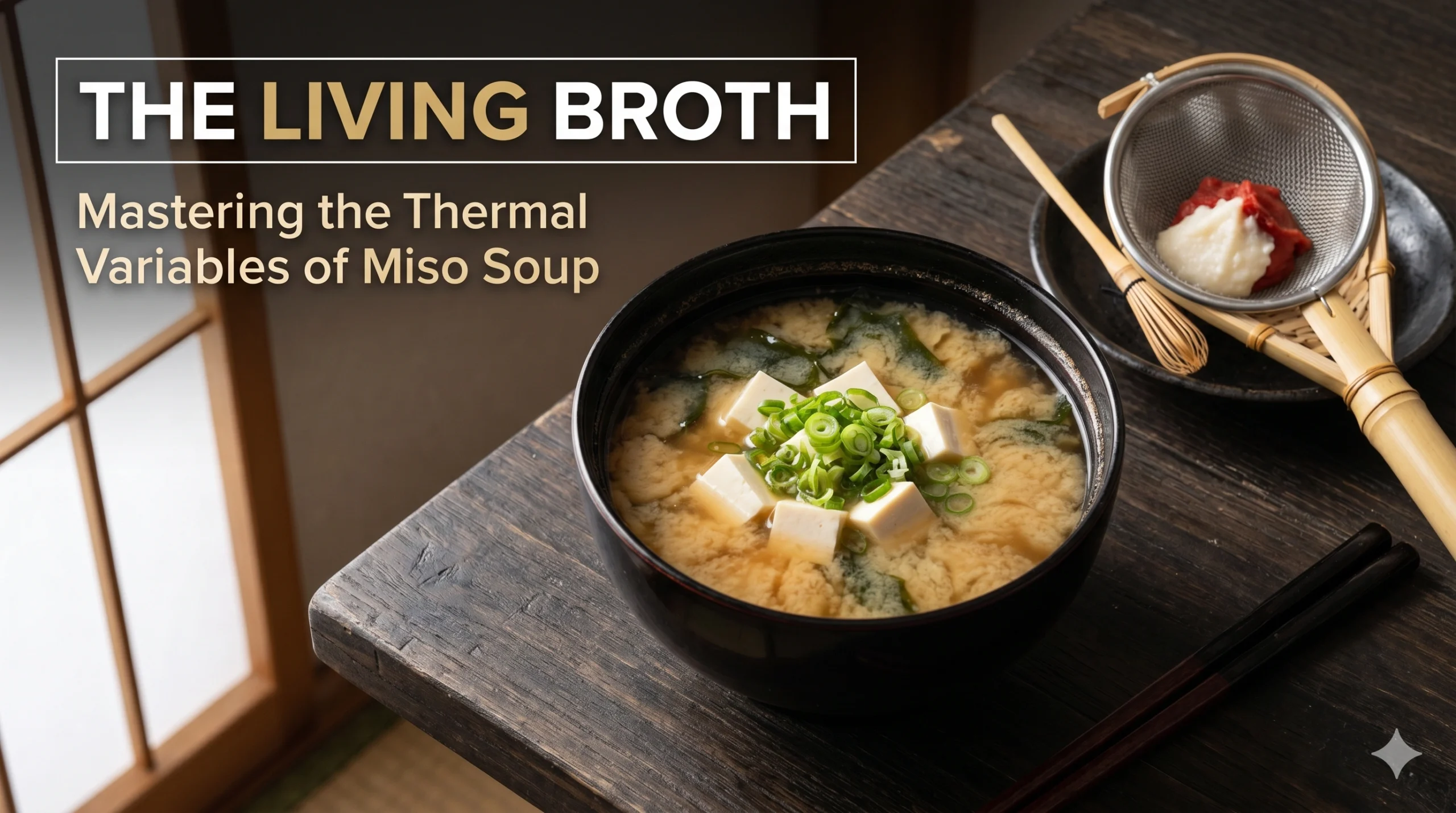
While often treated as a simple side dish, Miso Soup (Misoshiru) is technically a sophisticated bio-chemical suspension. A masterfully executed Miso soup is not a “stew” where ingredients are boiled together; it is a two-part assembly consisting of a high-purity extraction (Dashi) and a live-culture inoculation (Miso).
The technical success of the dish depends entirely on managing the enzymatic thermal window—the precise temperature range where flavor is maximized and biological activity is preserved.
Part 1: The Bio-Inoculation – Protecting the Protease
Miso is a living product, filled with enzymes created by the Koji mold (Aspergillus oryzae). The most important of these is protease, which continues to break down soy proteins into savory glutamates even after the miso is packaged.
The Thermal Kill Zone
- The Error: Adding miso to boiling water ($100^{\circ}C$).
- The Consequence: Boiling water instantly denatures the enzymes and vaporizes the delicate, volatile aromatic compounds that give miso its characteristic “earthy” and “floral” notes. The result is a soup that tastes flat, salty, and one-dimensional.
- The Technical Solution: The Nidome-no-Hi (second fire) rule. The soup base is heated, the heat is turned OFF, and only then is the miso whisked in. The goal is to keep the final serving temperature between $80^{\circ}C$ and $85^{\circ}C$. This preserves the “living” aromatics and keeps the enzymes intact for the diner.
Part 2: The Colloidal Suspension – Managing the “Bloom”
Miso soup is not a solution (where solids dissolve completely); it is a colloidal suspension. The tiny particles of fermented soybean and rice are physically suspended in the Dashi.
- The Miso-Koshi (The Sieve): A professional never simply drops a clump of miso into the pot. They use a deep, conical sieve. By whisking the miso through the mesh directly into the hot liquid, they break the paste down into microscopic particles.
- The “Kaminari” (Thunder) Effect: When properly suspended, the miso particles undergo Brownian motion, creating beautiful, cloud-like swirls in the bowl. This is the visual marker of a perfect suspension. If the particles are too large, they sink to the bottom, and the soup “breaks,” losing its velvety mouthfeel.
Part 3: Ingredient Density and Cooking Sequence
Because the Miso is added last, the “solid” ingredients (Gu) must be cooked according to their density and thermal requirements:
- Hard Vegetables (Daikon, Carrots): Added to cold Dashi and simmered until tender.
- Delicate Proteins (Tofu, Wakame): Added just before the heat is turned off to prevent textural collapse.
- Aromatics (Scallions, Mitsuba): Added to the individual serving bowl after the soup is poured to preserve their volatile oils.
Conclusion: The Final Warmth
Miso soup is the ultimate proof that temperature control is the highest form of seasoning. By respecting the thermal limits of the protease enzyme and engineering a microscopic colloidal suspension, the Japanese chef creates a dish that is biologically active, aromatically complex, and structurally beautiful.