
We conclude this technical exploration of the Japanese system with the Onigiri (rice ball). While often perceived as a simple snack, the Onigiri is a masterclass in surface tension, moisture migration, and manual compression physics. It is an engineered object designed to be stable enough for transport, yet porous enough to collapse instantly upon the first bite.To master the Onigiri, one must move beyond "squeezing" and toward the management of the interstitial air gaps between grains.Part 1: The Manual Compression – Avoiding the "Mash"The most common technical failure in Onigiri production is over-compression. If you squeeze the rice too hard, you crush the individual grains, releasing starch and turning the ball into a dense, gummy mass.The "Hand-Form" (Nigiri) Geometry: The chef uses their palms to form a triangle, but the pressure is applied only to the exterior shell.The Interstitial Air Gaps: A technically perfect Onigiri is held together by surface tension, not physical force. By keeping air pockets between the grains, the chef ensures a light mouthfeel. This structure allows the rice ball to remain cohesive during transport but "scatter" easily once it hits the palate.Part 2: The Salt-Press – Chemical and Biological StabilityUnlike sushi, which uses vinegar for preservation, Onigiri relies on the Salt-Press (Shio-musubi).The Hand-Salt Technique: Salt is applied directly to the wet palms before shaping. This serves two technical functions:Anti-Adhesion: The salt water creates a thin film that prevents the sticky starch of the rice from adhering to the chef’s skin.Surface Sterilization: Since Onigiri is often handled directly, the salt acts as a topical antimicrobial agent, reducing the biological load on the surface of the rice ball and extending its shelf life at room temperature.Part 3: The Nori Interface – Managing Moisture MigrationThe interaction between the dry Nori (seaweed) and the moist Gohan (rice) is a battle of water activity ($a_w$).The Crispness Paradox: Nori is extremely hygroscopic; it absorbs moisture from the air and the rice instantly. If wrapped too early, the Nori becomes leathery and tough.The "Separation" Engineering: Modern commercial Onigiri (like those in Japanese convenience stores) use a specialized plastic film to keep the Nori and rice separate until the exact moment of consumption. In traditional settings, the Nori is applied just before eating to ensure the cellular structure of the seaweed remains brittle, providing a sharp textural contrast to the soft, hydrated rice.Conclusion: The Final SynthesisThe Onigiri is the ultimate proof that in Washoku, even the simplest form is a product of rigorous engineering. By managing manual pressure to preserve air gaps, utilizing salt as a structural and biological tool, and controlling moisture migration between rice and seaweed, the Japanese system creates a portable meal that is a perfect balance of stability and delicacy.

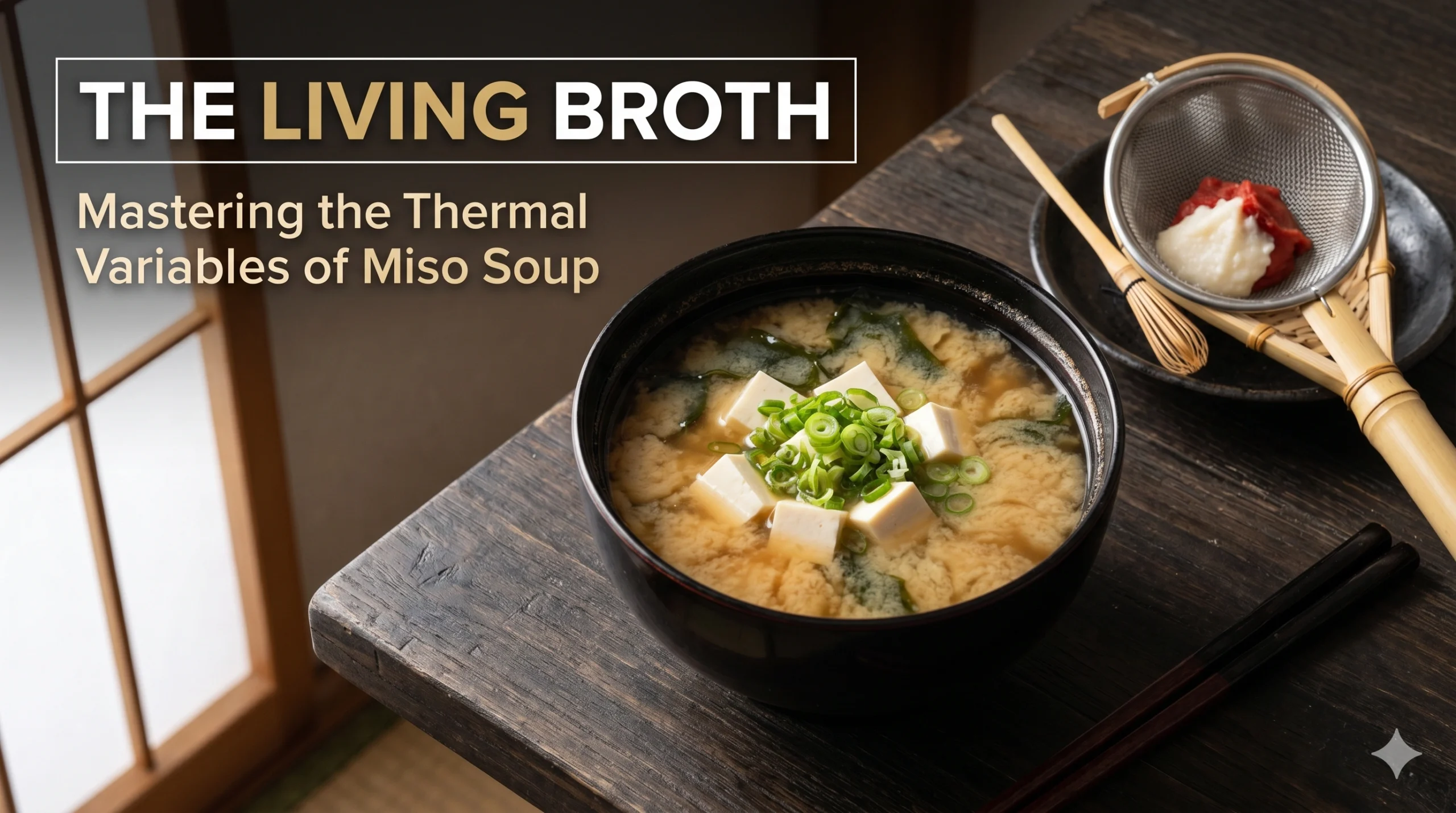
While often treated as a simple side dish, Miso Soup (Misoshiru) is technically a sophisticated bio-chemical suspension. A masterfully executed Miso soup is not a “stew” where ingredients are boiled together; it is a two-part assembly consisting of a high-purity extraction (Dashi) and a live-culture inoculation (Miso).

The technical success of the dish depends entirely on managing the enzymatic thermal window—the precise temperature range where flavor is maximized and biological activity is preserved.

Part 1: The Bio-Inoculation – Protecting the Protease

Miso is a living product, filled with enzymes created by the Koji mold (Aspergillus oryzae). The most important of these is protease, which continues to break down soy proteins into savory glutamates even after the miso is packaged.

The Thermal Kill Zone

  • The Error: Adding miso to boiling water ($100^{\circ}C$).
  • The Consequence: Boiling water instantly denatures the enzymes and vaporizes the delicate, volatile aromatic compounds that give miso its characteristic “earthy” and “floral” notes. The result is a soup that tastes flat, salty, and one-dimensional.
  • The Technical Solution: The Nidome-no-Hi (second fire) rule. The soup base is heated, the heat is turned OFF, and only then is the miso whisked in. The goal is to keep the final serving temperature between $80^{\circ}C$ and $85^{\circ}C$. This preserves the “living” aromatics and keeps the enzymes intact for the diner.

Part 2: The Colloidal Suspension – Managing the “Bloom”

Miso soup is not a solution (where solids dissolve completely); it is a colloidal suspension. The tiny particles of fermented soybean and rice are physically suspended in the Dashi.

  • The Miso-Koshi (The Sieve): A professional never simply drops a clump of miso into the pot. They use a deep, conical sieve. By whisking the miso through the mesh directly into the hot liquid, they break the paste down into microscopic particles.
  • The “Kaminari” (Thunder) Effect: When properly suspended, the miso particles undergo Brownian motion, creating beautiful, cloud-like swirls in the bowl. This is the visual marker of a perfect suspension. If the particles are too large, they sink to the bottom, and the soup “breaks,” losing its velvety mouthfeel.

Part 3: Ingredient Density and Cooking Sequence

Because the Miso is added last, the “solid” ingredients (Gu) must be cooked according to their density and thermal requirements:

  1. Hard Vegetables (Daikon, Carrots): Added to cold Dashi and simmered until tender.
  2. Delicate Proteins (Tofu, Wakame): Added just before the heat is turned off to prevent textural collapse.
  3. Aromatics (Scallions, Mitsuba): Added to the individual serving bowl after the soup is poured to preserve their volatile oils.

Conclusion: The Final Warmth

Miso soup is the ultimate proof that temperature control is the highest form of seasoning. By respecting the thermal limits of the protease enzyme and engineering a microscopic colloidal suspension, the Japanese chef creates a dish that is biologically active, aromatically complex, and structurally beautiful.


Writer - Daniel Carter

Daniel Carter

Daniel Carter is a Seattle-based food writer specializing in sushi, poke, and modern Japanese dining. With over seven years of experience reviewing local restaurants, he provides clear, unbiased insights to help diners understand menus, pricing, portion quality, and overall value. His straightforward writing style makes sushi easy to enjoy for both first-time visitors and regulars.

Leave a Comment