
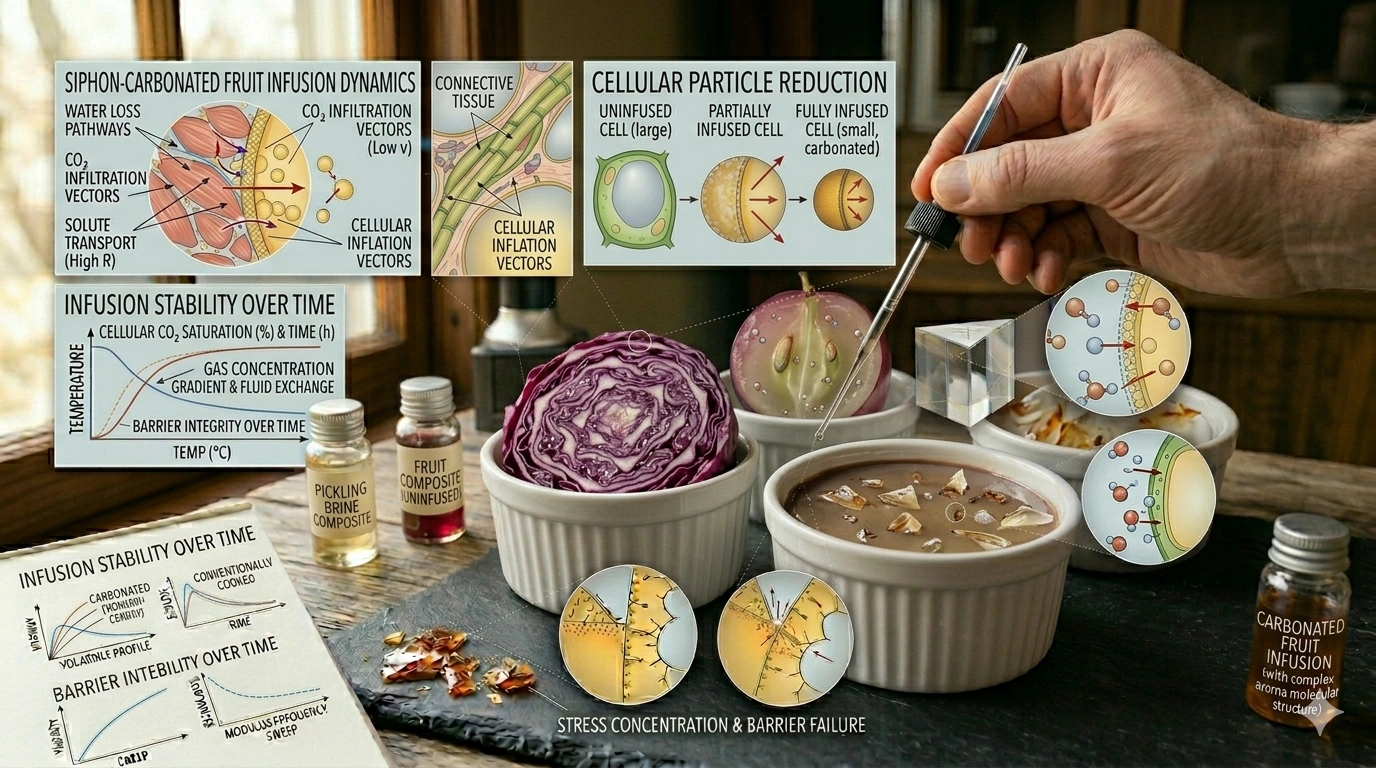
We move from the molecular browning of the Maillard reaction to the high-pressure thermodynamics of Siphon Carbonation. This technique allows a chef to turn solid fruit—like grapes, watermelon, or oranges—into “fizzy” snacks. Unlike carbonating a liquid, where gas is dissolved into a fluid, carbonating solid fruit involves forcing $CO_2$ into the liquid held within the fruit’s cellular structure through Henry’s Law.
To master carbonated fruit, one must understand the relationship between partial pressure and cellular diffusion.The fundamental principle at play is Henry’s Law, which states that the amount of dissolved gas in a liquid is proportional to its partial pressure above the liquid.
- Solubility under Pressure: At standard atmospheric pressure, very little $CO_2$ can enter the water inside a piece of fruit. However, inside a sealed whipping siphon, the pressure can reach $6$ to $8$ bars.
- The Diffusion Gradient: Under this high pressure, the $CO_2$ molecules are forced through the fruit’s skin and cell walls, dissolving into the intracellular juice until equilibrium is reached.
Part 2: Cellular Integrity – Choosing the Right Matrix
Not all fruits are suitable for carbonation. The success of the “fizz” depends on the structural engineering of the fruit’s anatomy.
- High Water Content: Fruits like grapes, citrus segments, and melons work best because they contain large vacuoles filled with liquid that can hold the dissolved gas.
- Surface-to-Volume Ratio: Small, thin-skinned fruits or porous fruits allow the gas to penetrate more quickly. A thick-skinned fruit (like an unpeeled apple) may act as a pressure barrier, requiring much longer infusion times.
- Pectin Density: Fruits with very dense, fibrous structures (like under-ripe pears) offer too much resistance for the gas to create a noticeable “pop” when eaten
Part 3: The Rapid Decompression – The “Fizzy” Sensation
The final step is the release of pressure, which must be handled with precision to avoid “venting” the flavor.
- Sudden Desorption: When the siphon is vented, the external pressure drops instantly. However, the $CO_2$ inside the fruit cannot exit the cells as quickly as it entered.
- The Bubble Effect: As you bite into the fruit, the remaining dissolved $CO_2$ rapidly expands and forms tiny bubbles on your tongue, creating the same tingling sensation as a carbonated beverage but within a solid structure.
- The Temperature Variable: $CO_2$ is more soluble in cold liquids. For maximum “fizz,” the fruit and the siphon must be chilled to near $4^{\circ}C$ before and during the carbonation process.
Conclusion: Engineering the Solid Liquid
Siphon-carbonated fruit proves that the boundaries between food states are fluid. By utilizing high-pressure siphons to manipulate gas solubility, the modern chef can turn a standard piece of produce into a multisensory experience. It is the physics of intracellular carbonation—a way to add a hidden dimension of texture to the most basic ingredients.