
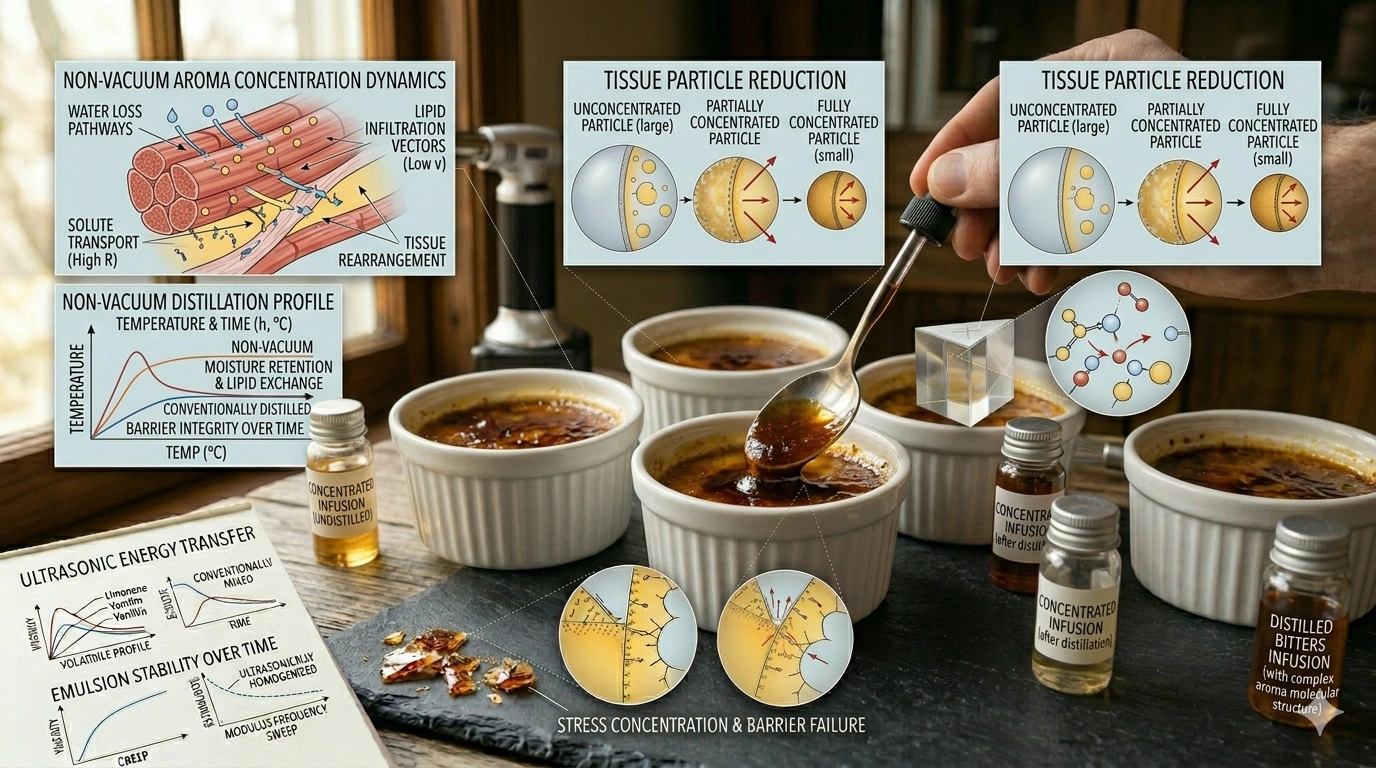
We move from the physical preservation of fats to the chemical concentration of volatile aromatics. While the Rotovap (Article 56) uses a vacuum to lower boiling points, traditional Distilled Bitters utilize atmospheric distillation and solvent-based extraction. This process leverages the differing vapor pressures of ethanol and water to strip flavor molecules from botanicals—roots, barks, and citrus—resulting in a high-potency liquid that acts as the “seasoning” of the liquid world.
To master Distilled Bitters, one must understand the relationship between azeotropic limits and essential oil solubility.
Part 1: The Maceration – Solvent-Driven Extraction
Before distillation begins, the chef must perform a maceration. This is a study in diffusion kinetics.
- The Ethanol Solvent: High-proof ethanol (usually 95% ABV) is used because it is a superior solvent to water. Many aromatic compounds—terpenes in citrus and resins in barks—are hydrophobic and will only dissolve in alcohol.
- Molecular Displacement: Over time (days or weeks), the ethanol penetrates the cellular structure of the botanicals, displacing the essential oils and bringing them into the liquid phase.
Part 2: The Pot Still – Selective Vaporization
The distillation phase is where the “concentration” occurs. Unlike vacuum distillation, this happens at standard atmospheric pressure.
- Fractional Volatility: Alcohol boils at approximately $78^{\circ}C$, while water boils at $100^{\circ}C$. By carefully controlling the heat, the chef vaporizes the ethanol first.
- The Vapor Load: As the ethanol turns into gas, it carries the dissolved aromatic molecules with it. This is known as steam distillation (even when using alcohol), where the vapor acts as a physical carrier for the heavy essential oils.
Part 3: The Cuts – Managing the Aromatic Profile
A distiller does not keep everything that comes out of the condenser. The engineering lies in the “Cuts.”
- The Heads: The first liquid to emerge contains high-volatility compounds like methanol and acetates. These are often harsh or “solvent-like” and are discarded.
- The Hearts: This is the technical target. It contains the most balanced and pleasant aromatic esters and oils.
- The Tails: The final phase contains heavy, bitter, and sometimes “earthy” or “musty” compounds. In bitters, a small portion of the tails is often kept to provide the necessary “rooty” base notes that define the genre.
Conclusion: The Essence of the Botanical
Distilled Bitters prove that flavor can be condensed into a functional tool. By leveraging the solvent power of ethanol and the selective vaporization of the pot still, the chef creates a library of “liquid spices.” It is the physics of molecular isolation—a way to distill the soul of an ingredient into a single, potent drop.