
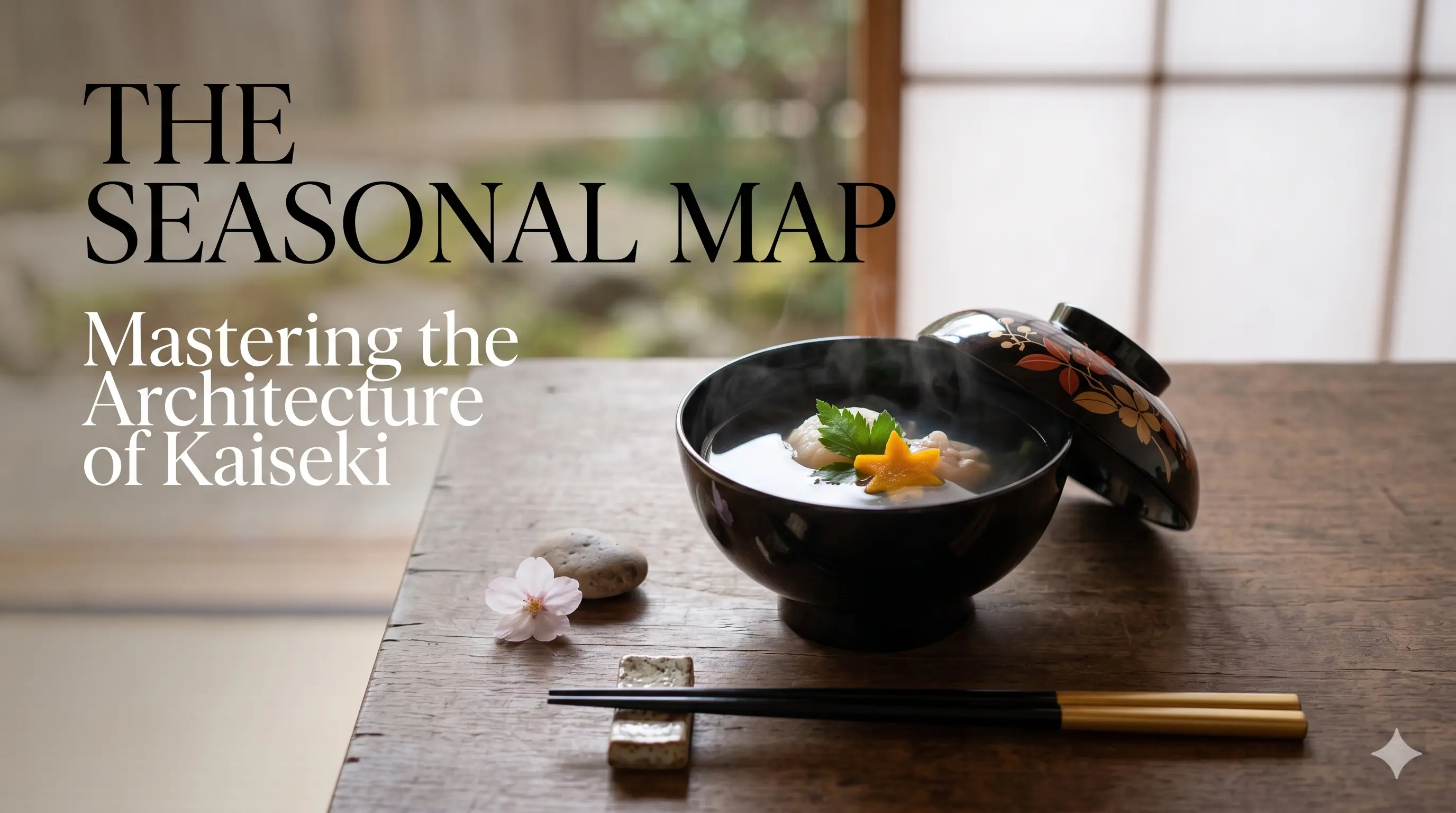
If Ramen is the high-energy engineering of the street, Kaiseki is the silent, high-precision architecture of the soul. It is the ultimate expression of Japanese fine dining—a multi-course meal that functions as a temporal map of a specific moment in the year. While a Western tasting menu often focuses on the chef’s ego or technical bravado, a Kaiseki menu is engineered to erase the chef, leaving only the ingredient and the season (Shun).
To master the concept of Kaiseki, one must understand that it is governed by a rigid structural sequence designed to move the diner through every fundamental Japanese cooking technique. This article deconstructs the technical progression of a Kaiseki meal and the philosophy of Shun.
Part 1: The Philosophy of Shun and “Pre-Shun”
In Kaiseki, an ingredient is never just “fresh.” It is categorized by its relationship to its peak:
- Hashiri (The Arrival): Ingredients that have just appeared. They are prized for their novelty and energy, often served with minimal intervention to highlight their “youthful” flavor.
- Shun (The Peak): The moment an ingredient reaches its maximum flavor, texture, and nutritional density.
- Nagori (The Farewell): The end of a season. These ingredients are often more fibrous or intense. A Kaiseki chef engineers dishes to “honor” this maturity, perhaps using deeper simmering or stronger seasonings to complement the ingredient’s fading profile.
Part 2: The Structural Sequence (The Technical Map)
A Kaiseki meal follows a mandatory technical progression. Each course represents a different “state” of water and heat.
1. Sakizuke (The Appetizer)
The “handshake” of the meal. Usually a small, chilled dish that introduces the primary seasonal theme. Technically, it focuses on acid balance to stimulate salivary glands.
2. Wanmono (The Clear Soup)
The most important course for the chef’s reputation. It consists of a pristine Ichiban Dashi (First Stock) and a “jewel” (a piece of fish or a tofu dumpling).
- The Engineering of Aroma: The bowl is served with a lid. When the diner lifts it, they should experience a “vacuum-sealed” burst of seasonal fragrance. The Dashi must be seasoned so delicately that it tastes like “shadows and light”—present but nearly invisible.
3. Mukozuke (The Sashimi)
A study in knife architecture. The fish is cut to specific thicknesses based on its fat content. Leaner fish are sliced paper-thin (Usu-zukuri) to increase surface area for soy sauce, while fatty fish are cut thicker to provide resistance to the teeth.
4. Yakimono (The Grilled Course)
Usually a piece of local fish grilled over Binchotan. As discussed in Article 3, the goal here is the Maillard reaction—creating a crispy, salted exterior while the interior remains at a perfect, steamed medium-rare.
5. Takiawase (The Simmered Course)
Vegetables simmered separately (Nimono) and then assembled in one bowl.
- The Complexity of Individual Simmering: To keep colors vibrant (e.g., the bright green of a pea pod next to the orange of a carrot), the chef must simmer them in separate pots with different Dashi concentrations. If simmered together, the colors would muddy, violating the visual architecture of the meal.
6. Shokuji (The Finale)
The meal always ends with Rice, Miso Soup, and Tsukemono. This returns the diner to the “foundation” of the Japanese palate after the complex journey of the previous courses.
Part 3: The Vessel Architecture (Utsuwa)
In Kaiseki, the plate is as much a part of the “engineering” as the food.
- Thermal Matching: Warm dishes are served on thick, heat-retaining ceramics (Bizen or Shigaraki). Cold dishes are served on glass or thin, lacquered wood.
- Spatial Geometry: A Kaiseki plate is never “full.” The empty space (Ma) is calculated to allow the diner’s eye to focus entirely on the architectural form of the food.
Conclusion: The Vanishing Chef
The highest technical achievement in Kaiseki is when the diner forgets they are eating “cooked” food and feels as though they are experiencing the forest or the sea directly. It is a masterpiece of logistics, timing, and sensory engineering that transforms a meal into a moving meditation on the passage of time.