
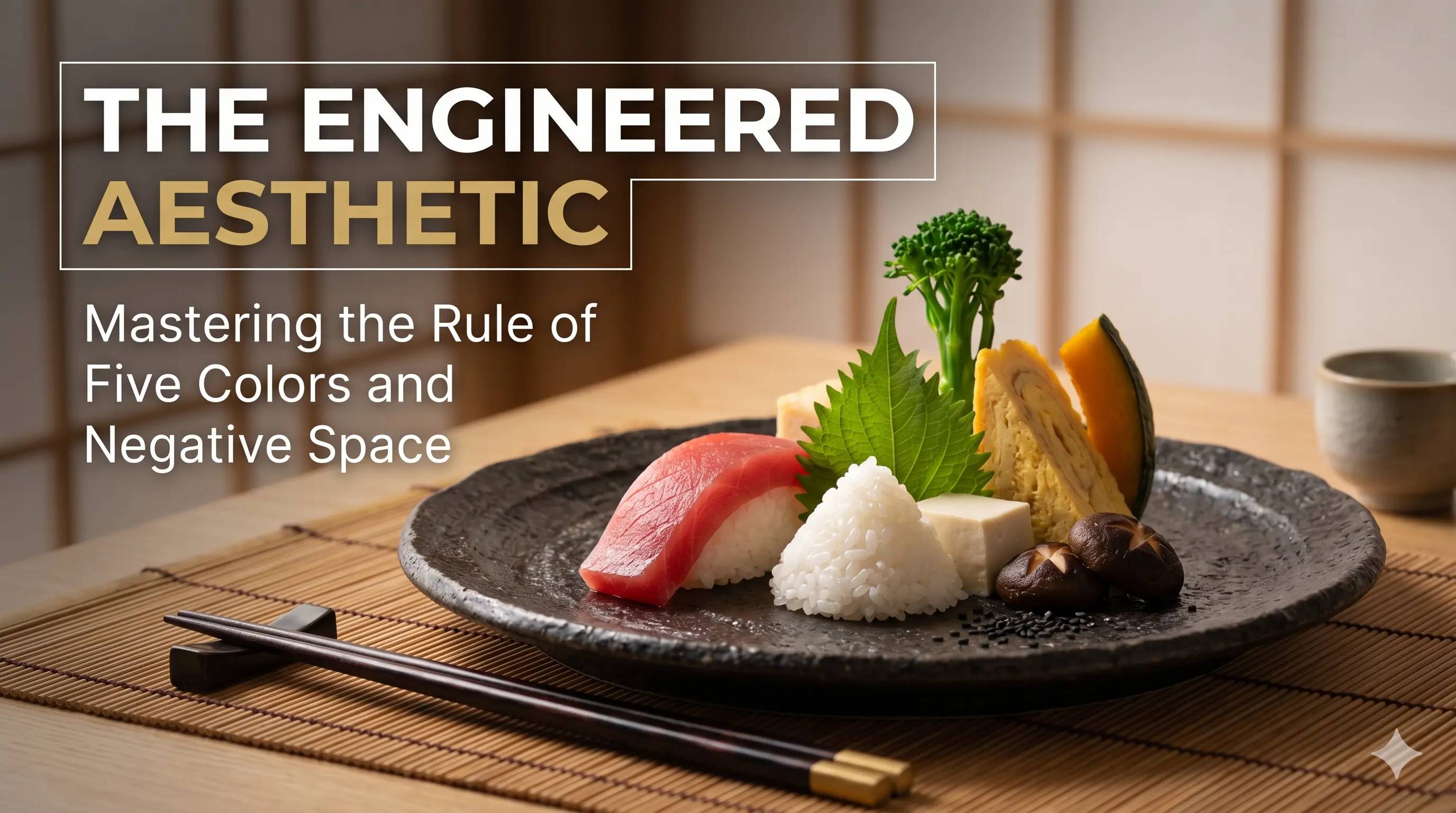
In the preceding 28 articles, we have analyzed the biochemistry of umami, the physics of a single-bevel knife, and the fluid dynamics of a rolling boil. However, in Japanese cuisine, the work is not complete when the food is cooked. The final, critical discipline is Moritsuke (the art of arrangement). While often dismissed as mere decoration, Moritsuke is technically a form of architectural engineering designed to structure the diner’s experience, balance flavor, and communicate seasonality.
To master Moritsuke, one must move beyond “making it look nice” and toward the management of negative space, the “Rule of Five Colors,” and the geometry of asymmetry.
Part 1: Sashi – The Management of Negative Space
The first rule of Moritsuke is that what you do not plate is as important as what you do plate. The Japanese concept of Ma (negative space) is vital. A crowded plate is seen as disorganized and technically failing.
- The Sashi Ratio: A standard technical rule is that only $60\%$ of the plate’s surface should be covered by food. The remaining $40\%$ is left empty as a sensory buffer. This negative space frames the food, concentrates the viewer’s focus on the chef’s precision, and suggests that the food itself is a precious commodity.
- The Directional Line: Food is plated along a subtle diagonal line (the “flow”), leading the eye from the foreground to the background.
Part 2: Go-Shiki – The Rule of Five Colors
Moritsuke utilizes the ancient Daoist principle of Go-Shiki (Five Colors). This isn’t just aesthetic; it is a bio-nutritional marker of success. If a meal contains these five colors, it is technically balanced.
The Five Colors (Five Essential Nutrients):
- Black (Kuro): Seaweed (Kombu), mushrooms (Shiitake), or black sesame. These provide deep minerals and vitamin D.
- White (Shiro): Rice, tofu, or daikon. These are the carbohydrate/protein backbone.
- Red (Aka): Salmon, red tuna, carrots, or peppers. These indicate carotenoids or proteins.
- Yellow (Kiiro): Egg (Tamagoyaki), pumpkin (Kabocha), or lemon. These indicate vitamin A and fats.
- Green (Midori): Scallions, Shiso leaf, broccoli, or Matcha. These are raw, fibrous, or vitamin C-rich.
[Image showing a chart of the five colors with food examples]
Part 3: The Geometry of Asymmetry (Hake-zukuri)
In Western plating, the goal is often perfect, symmetrical balance (the center-plated steak). Japanese aesthetics, however, find perfection in structured imperfection. Symmetrical plates are static; asymmetrical plates possess kinetic energy.
- The Triangle Rule: Almost all plated components are arranged in an asymmetrical triangle (Utsutsu-nabe). This can be a three-point base (a piece of fish, a mound of rice, and a garnish) or a single three-dimensional pyramid structure.
- Vertical Dimension (Yama-zukuri): Food is never plated flat. Like a miniature landscape, it must have vertical height (Yama – mountain). Fish is leaned against a base, rice is molded into a peak, and garnishes are built upward. This three-dimensional plating creates shadows and depth, enhancing the perceived texture and richness of the dish.
Conclusion: Engineering the Final Perception
Moritsuke is the final proof that Washoku is a synthesis of art and science. By mastering the $60/40$ negative space ratio, incorporating the five-color spectrum, and building asymmetrical vertical geometry, the Japanese chef forces the diner to engage with the meal’s technical precision before the first bite. It is an act of sensory engineering that transforms a simple meal into a structured, unforgettable moment.